Heated Rivalry and the Heated Debate of Queerness
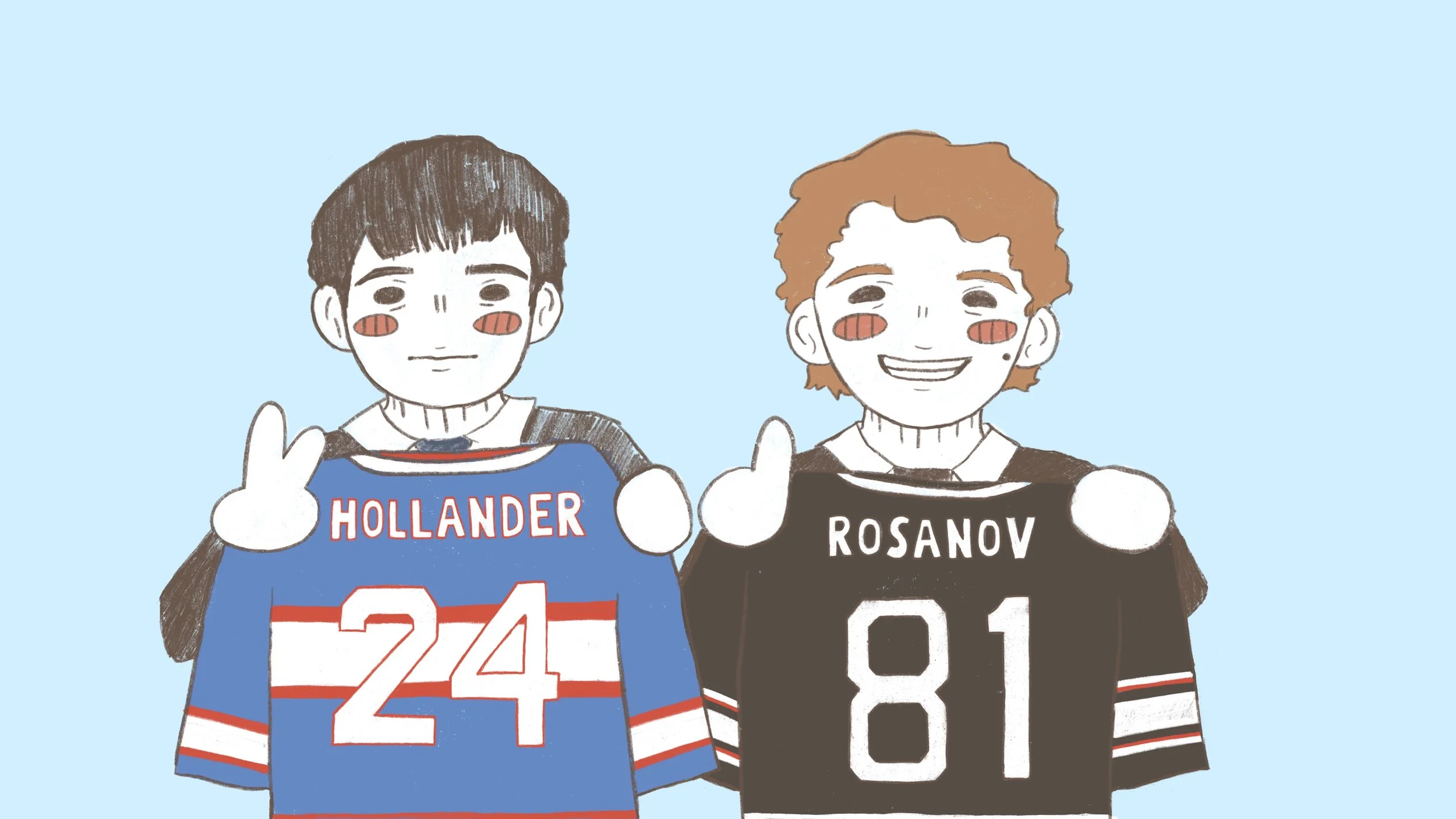
Illustration by Geliza Paunan
If you're anything like me, you’ve been stuck in “Heated Rivalry Psychosis” since the show first aired in November. After a collectively shitty 2025 for seemingly everyone, but especially queer and trans people, Heated Rivalry feels like an against all odds win. Adapted from author Rachel Reid's Game Changers series and funded on nothing but Canadian tax dollars, duct tape, and a dream, the show has been a runaway success.
For many, myself included, the show feels like it saved our 2025. The show is first and foremost a romance, documenting the nearly ten-year love affair between pro hockey stars Shane Hollander and Illya Rozanov. The two main characters struggle to keep their attraction to each other a secret from the world and from each other. For hockey fans like myself, the commentary about the current state of the NHL is glaringly obvious: as of 2026, there has never been an openly queer NHL player, active or retired. Though steps have been made to include the LGBTQ+ community, the NHL has also folded to the whims of homophobic players, recalling pride tape and pride jerseys from their games.
Still, Heated Rivalry for the most part remains fairly lighthearted and sweet. The majority of the conflict, in typical romance movie form, is derived from the characters' inability to communicate with each other. Yes, the homophobia of the hockey world and the early to mid two thousands is present, but never really the main focus. In many ways, this is what makes the show so wonderful. A sentiment I saw echoed by many was how great it was to watch a show about gay people where nothing horrific happens to the main characters.
On top of that, the show is genuinely well made. It’s clear that the amount of love and passion poured into the show by everyone involved. Actor Connor Storrie, who portrays Illya Rozanov, has been almost universally praised for his performance. Hudson Williams has also become a darling of the internet for his “unhinged” press interviews, as well as his nuanced and restrained portrayal of Shane as an autistic character.
I honestly can’t shower this show with enough praise; it absolutely has its flaws, both from the original source material and some of the choices that were made when adapting the novels. But despite its flaws, I’ve grown to really love this TV series. However, I can't say the same thing for the Heated Rivalry fandom.
While I have seen a wealth of beautiful and original artwork, edits, and commentary created by this fandom in the last few months, I have also seen some truly disturbing behavior, especially when it comes to the incessant prodding into the real lives of the actors. While all of the main cast members have been victims of this invasion of privacy, much of the discourse has been directed towards Hudson Williams regarding his sexuality.
Speculation about actors' and musicians' sexuality is nothing new; fans feeling entitled to private information around actors is predictable, and discourse around whether straight actors playing gay roles is ethical or not is frankly mind-numbing to me now. Still, the speed and severity with which all of this was launched at Williams was duly impressive and disturbing. This culminated when celebrity gossip site, Deuxmoi released a podcast episode revealing the identity of Williams’girlfriend while slamming his performance in the show.
This move by Deuxmoi was met with almost universal vitriol from supporters of the show to other cast and production members. In the aftermath, I saw many posts discussing the dangers that come with insisting that actors who portray gay characters must be gay themselves, how this excludes all queer people who are not in a situation where they feel it is safe to come out. I also saw many posts discussing the very real possibility that even if Williams isn’t gay, that doesn't automatically mean he’s straight, and many other people discussing how this is none of anybody's business. While I agree with basically all of these points, I still found myself somewhat annoyed by them. Annoyed that, as a culture, our understanding of queerness still feels so limited. I am not personally invested in what label Hudson Williams uses to define his sexuality. However, even if Williams would self-identify as straight, why can’t he also be queer?
While this whole situation has unfolded, I have often found myself discussing this topic with my other queer friend. When we were discussing the controversy surrounding William’s sexuality, my friend put it quite nicely: “I don't care if he’s gay, I just care if he’s safe, and from all we can tell, he’s pretty safe.” A point with which I completely agreed, and responded: “I don't care if he sleeps with men, I just care that he has game.” Both of which are sentiments I think can be extended to who we consider queer more broadly.
The number of labels we have to describe sexuality has blossomed in the past ten to fifteen years, allowing people to find niche descriptors for themselves and form communities with others. However, the baseline definition of queerness has remained, in my opinion, pretty narrow. Most people understand queerness as a person who identifies as something other than Cisgender or Heterosexual, or that this is an essential prerequisite. This assumption, in many ways, ties queerness to romantic or sexual attraction. While this tie is vital, it is also restrictive. Being queer, to me, is so much more than who I’m attracted to or who feels attracted to me. I have certainly had the experience of meeting gay people who are not queer, and frankly, straight men and women who I think are.
During a panel with The New School on queerness and the black female body, bell hooks said, “I often identify myself as queer, past gay…all of our lives we've experienced ourselves as queer, as not belonging, as the essence of queer. I think of Tim Dean's work on being queer, and queer not as being about who you're having sex with. That can be a dimension of it, but queer as being about the self that is at odds with everything around it and has to invent and create and find a place to speak and to thrive and to live.”
When conversations like one surrounding Williams come up, I can’t help but think of this quote. How much community building we could do with an expanded definition of queerness. I understand the resistance from people who identify as LGBTQ+, so many of us have been hurt by straight cis people. We point to the legal protections we have been historically denied. For some of us, especially those in queer areas, legislative discrimination can feel more real, more tangible, than other types of hate. Who cares if a straight man feels ostracized? Our trans brothers and sisters in Kansas are having their driver's licenses revoked. While I completely understand and sympathize with this feeling, it’s one I’ve certainly had myself. I also know how scary it is to have slurs screamed at you by people on the street who think you look a little off. I also know those people aren't going to double-check how you personally identify before pushing you into a pile of trash.
I don’t know how Hudson Williams identifies, and frankly, it doesn't matter; it’s none of my business. But I do have the information he’s provided in interviews, where he’s often discussed feeling othered, loving queer media, and relating to the experience of not being able to express your true self. I have his body of work before Heated Rivalry fame, including short films he directed. I don't know how much of himself Williams puts into his work, but there is one quote from his short film, Inside Augustine Mendoza's Quotidian Apartment-Director’s Cut, that has consistently stood out to me since I heard it: “This here's my ukulele, I don't actually know how to play it. I don't know how to play any instrument. But I keep it here as a reminder to the little boy that was too ungifted to know how to play any instrument, too unathletic to play ball with the other boys in the school yard, too gay to kiss the girls, to fucking much of a pussy, pussy to kiss the boys.” Hudson Williams may very well be straight, but he is also so deeply and identifiably queer to me.