How to Live A Fulfilling Life Under Tyranny
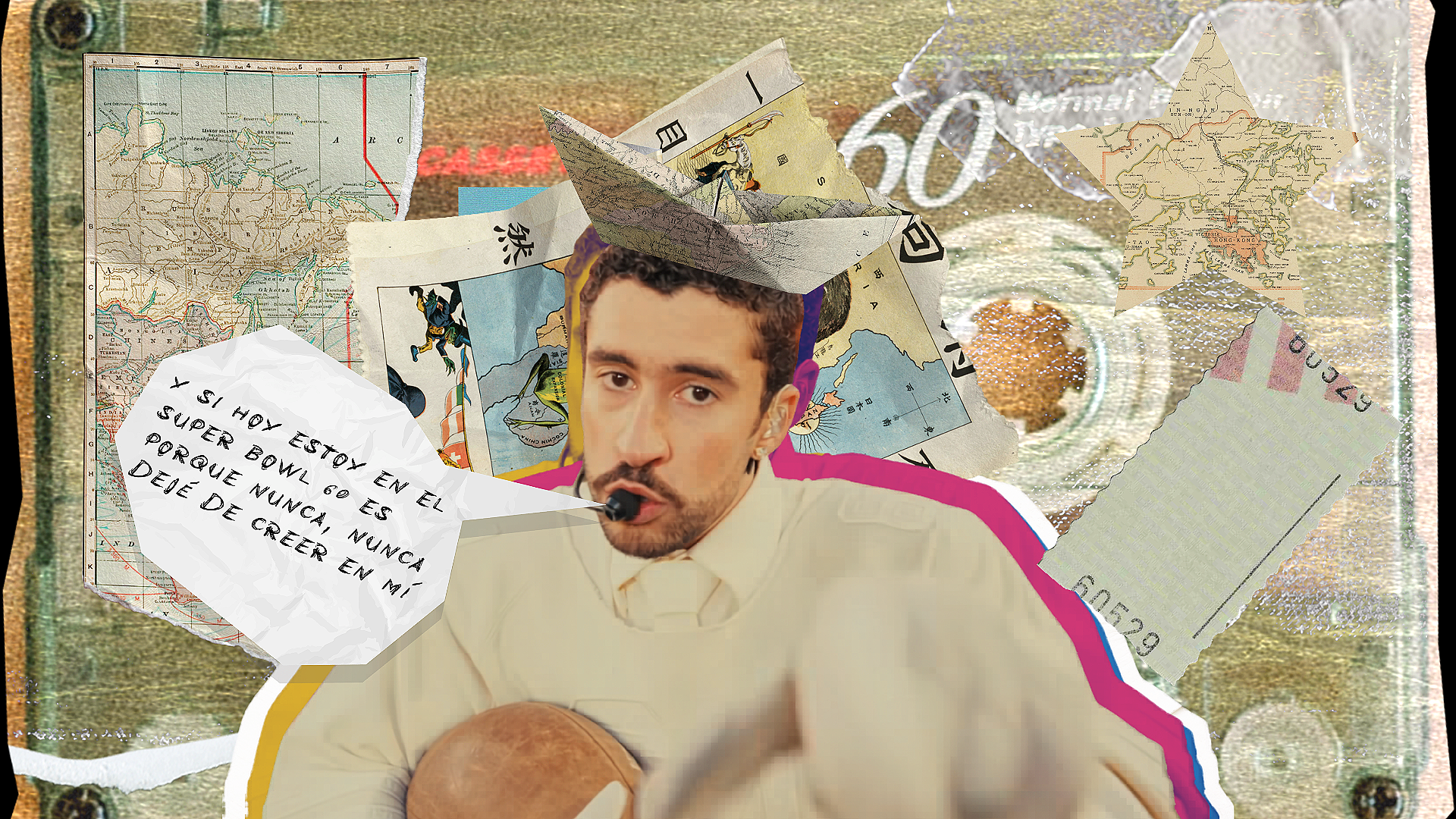
Digital Collage by Eden Pela
Inside a community center at Allentown, Pennsylvania, the Working Families Party (WFP) organized a watch party for the Super Bowl half time show for groups of migrant families—only one of many around the country. The air was heavy with anxieties of a possible ICE raid as people huddled around one screen to watch a great American artist perform. This is not an excerpt from Orwell’s 1984, or a 21st century fiction retelling of World War II. This was two weeks ago in the U.S.
If you could warn voters in November of 2024 that this would be our nation’s reality a mere year and three months ahead, I doubt the majority of Americans would have believed. As Susan B. Glasser from The New Yorker states, we are truly living in the “golden age of awful.”
At the beginning of WWII, C. S. Lewis held a sermon at Church of St. Mary in Oxford with a group of Oxford students. In the transcript, “Learning in Wartime” (1939) he says, “— indeed how can we— continue to take an interest in these placid occupations (fiddling and making art) when the lives of our friends and the liberties…are in the balance? Is it not like fiddling while Rome burns?” Lewis was trying to encourage the young men who continued pursuing their study of art and philosophy while their “friends” and other classmates were shipped off to Germany and Poland to fight against Hitler’s reign of terror in Europe. The students could not contend with the necessity of artistic pursuits in the middle of such global chaos.
It’s safe to say that given recent events, we find ourselves in (what feels like) the same predicament. How can we even take pleasure in life when proud dog-killers like Kristy Noem—who Trump even spoke about in a conversation with Don Dr. saying, “That’s not good at all…Even you wouldn’t kill a dog, and you kill everything”—reign over the country? How can we carry on with life when a mere Super Bowl halftime show watch party—a staple of the American dream—threatens people’s survival? How can we live a fulfilling life under tyranny?
In a slew of controversy, two weeks ago at the NFL’s Apple Music Super Bowl LX Halftime Show, Benito Antonio Martinez Ocasio (Bad Bunny) gave us an answer, “We dance!” Not avoid the war, as C.S. Lewis reiterates, but exert our humanity through the noble pursuit of art.
Benito’s cultural declaration became one of the most streamed performances in NFL history—128.2 million views right under Kendrick Lamar, Michael Jackson, and Usher. He redefined the meaning of “America.”
As a half-Nigerian who has lived in the U.S. for some time now, I have forgotten the way I used to speak. My accent has turned into an odd blend of less rounded “a”s and softened “t”s. I don’t fit in back home, and I’m too cultural for the West. To be in the United States, you must assimilate. You must learn their way of speaking, know their history, often forsaking yours, smoothen your identity, and translate yourself. I am dutifully reminded of the price I paid for my acceptance in the West—perfecting the American accent so people can understand me better.
Benito’s refusal to translate his performance put me and other assimilators to shame by delivering the first ever halftime show performed fully in Spanish for the now over 135 million viewers making it the most watched halftime show of all time. He chose not to dilute his identity for the comfort of the West at a time where the South American accent has been weaponized against citizens. While Latin music has graced the Super Bowl stage before with Shakira and Jennifer Lopez’s co-headline in 2020, they did so with a genre blend to make it more digestible.
The outrage on social media leading to the event signaled that many people including FOX News hostess, Tomi Lahren who stated on her podcast, “He’s not an American artist,” forgot that Puerto Rico is a United States territory (it was ceded in 1898 following the United States’ invasion during the Spanish-American war). Still, Puerto Rico has managed to maintain most of its culture which is slowly erasing as many more English-speaking Americans buy properties and gentrify the island. Benito explores his anxieties about culture erasure in his song, “Lo Que Le Paso a Hawaii,” performed by Ricky Martin during the halftime show. Its lyrics say,
They want to take my river and also the beach/Quieren quitarme el río y también la playa
They want my neighborhood and for grandma to leave/Quieren el barrio mío y que abuelita se vaya
No, don’t let go of the flag or forget the lelolai/No, no suelte' la bandera ni olvide' el lelolai
'Cause I don't want them to do to you what happened to Hawaii/Que no quiero que hagan contigo lo que le pasó a Hawái
Be careful, Luis, be careful/Ten cuida'o, Luis, ten cuida'o
Here, no one wanted to leave, and those who did dream of coming back/Aquí, nadie quiso irse, y quien se fue, sueña con volver
…
They want to take my river and also the beach/Quieren quitarme el río y también la playa
They want my neighborhood and for your kids to leave/Quieren el barrio mío y que tus hijos se vayan
Let’s discuss a few more culturally significant moments shall we?
1. The Artistic Direction
In my research for this article, I investigated other sets that have been done at the Superbowl and none of them (in my opinion) come close to the significance, beauty, color, and artistic direction of Benito’s performance. Every single aspect and choice in the set direction was carefully chosen with little to no mistakes.
At the beginning of the performance, we are introduced to a wide shot of a luscious green sugar cane field with Puerto Rican farmers wearing traditional pava hats (straw) and chopping cane with machetes—the economic engine behind sugar production built on unseen Puerto Rican labor—forcing the audience to acknowledge the history.
During the song, Titi Me Pregunto, we move through the fields to the vecindad (neighborhood) paying homage to old men playing dominoes and young latina nail technicians. Additionally, real vendors were featured such as the traditional Puerto Rican Piragua stand, Canoe Stand (Shaved Ice), Villa’s Tacos (L.A.), Lalo’s Barber Shop (Brooklyn), and the famous Maria Antonia “Tonita” Cay, the 85-year-old owner of Toñita, a Caribbean social club in Brooklyn, NYC whose business has been booming ever since.
2. Political symbols
During his song, El Apagón (The Blackout), Benito and his dancers climbed electric poles that exploded and sparked, signifying the U.S. government’s neglect and poor maintenance of Puerto-Rico’s power grid which left the territory in darkness for 11 months after hurricane Irma and Maria in late 2017. And, we cannot discuss strong cultural symbols without identifying the turquoise puerto rican flag. During this segment of his performance, he sported the Puerto rican flag with the azul clarito rather than the official navy blue, referencing the Gag Law of 1948 which criminalized the display of that very flag in Puerto Rico. Lady Gaga’s sweet performance of a latin version of her famous song, Die with a Smile, featured her wearing the same color in a Raul Lopez, adorned with a bright red flor de maga, Puerto Rico’s national flower.
Shortly after this song, Benito’s mascot, “Sapo Concho,” an animated version of the sapo concho—a Puerto Rican crested toad—filled the screen for approximately two seconds, representing the threat of an “invasive species” and the gentrification of Puerto Rico.
3. The “Grammy Kid”
I know we all probably teared up when Bad Bunny handed his grammy award to a staged younger version of himself played by Lincoln Fox with two parents and an old TV displaying his grammy acceptance speech. Although some did speculate it to be Liam Conejo Ramos, the 5 year old detained by ICE in Minnesota.
4. The Real Wedding!
Midway through the performance, the stage transformed into a real wedding ceremony and reception as the couple, Thomas Walter and Eleisa Aparicio signed their marriage license on stage. The couple had originally invited Bad Bunny to their wedding, but due to his schedule, he couldn’t make it and offered that they get married on stage at the Super Bowl, serving as the witness.
Even popular conservative commentator Candace Owens said during a recent live podcast, “I actually thought the set design was really cool…and it wasn’t just authentic to him and how he grew up but also in America…If you guys don’t know…that (the neighborhood) looks familiar to me and the way that I grew up…the corner Bodega…all around the United States these communities exist.” Ironically, released footage showed that the president who criticized the NFL's choice of Bad Bunny as a headliner was caught watching his performance instead of TPUSA’s simultaneous “All American Halftime Show” featuring Lee Brice singing, “I just want to (catch) kiss my fish, drive my truck, drink my beer” while performing an acoustic rendition of his wildly unpopular song, Country Nowadays.
C.S. Lewis says “we cannot suspend our (artistic) pursuits during war.” The expected response from the Latin American community to the recent activities in the U.S. was fear and hiding. But Bad Bunny said no.
To conclude this article, I will quote previous NFL superstar and 2017 Pulitzer Prize Winner, Kendrick Lamar, “they tried to rig the game, but you can’t fake influence.” While this administration continues to pump out militarized advertisements and videos of ICE agents raiding innocent men and women with a background of Sabrina Carpenter’s music, we will dance and not forsake our culture.