“Polymerizing is Not Resurrection,” A close reading of Pynchon's “Gravity's Rainbow."
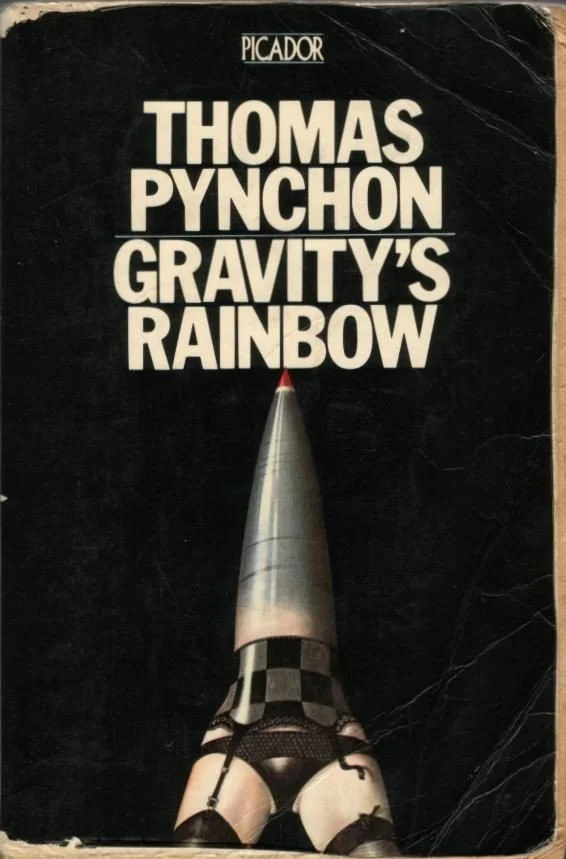
2nd UK Paperback Edition
Publisher: Picador (1975)
Cover Painting: John Holmes
A séance is due to begin in Berlin. Elites from the “corporate Nazi crowd” gather around a table. Ivory and silk are abundant; light from candles catches on “silver lapel-swastika[s].”
This description, down to the “corporate Nazis” in attendance, may read like the set-up for a Palantir soiree, but fear not, I’m merely recalling a scene from Thomas Pynchon’s 1973 post-modern epic, Gravity’s Rainbow.
By the time Pynchon guides his readers into this gilded hall of Völkisch occultism, we’re over 150 pages deep in the ceaseless stream of surreal shenanigans that is Gravity’s Rainbow. The book has already included showtunes on the culinary versatility of the banana, featured a rather horrific sequence involving a harmonica falling into a toilet bowl, and hinted at a relationship between V2 rockets and erections. A Nazi séance doesn’t earn so much as a raised eyebrow.
Gravity’s Rainbow is about a lot of things. It explores paranoia and conspiracy, culpability and morality. And all of this is set against the backdrop of Europe before, during, and directly after World War II. It’s dense and disturbing and devastating and somehow hilarious. It’s also all about plastic and how evil it is.
Think I’m wrong? Let us return to our Weimar-era séance.
The year is 1930. The “corporate Nazis” in question are mostly executives of IG Farben, and “the objective tonight is to get in touch with the late foreign minister Walter Rathenau.”
In the manner of most Pynchon works, the lines between fiction and history here are permeable. The dye company turned chemical and pharmaceutical conglomerate known as IG Farben was very real, as were its many contracts with the Nazi Party, its use of slave labor from concentration camps, and its production of Zyklon B, the chemical used to murder millions in gas chambers. Walter Rathenau, “prophet and architect of the cartelized state,” who was assassinated in 1922 by ultra-right nationalists, was also very real.
And what has inspired this esoteric interaction? Business, of course. It would seem that these titans of Aryan industry are seeking affirmation from Rathenau regarding their own political and industrial aspirations. No attendee dares suggest that Rathenau, a Jew, might regard the men now seeking his insight with some animosity, they being adherents to the same antisemitic far right fanaticism that fueled his murderers.
“Whatever comes through the medium tonight they will warp, they will edit, into a blessing,” writes Pynchon. “It is contempt of a rare order.”
What comes through the medium, as one can predict, ends up being distinctly unwarpable.
It turns out that Rathenau is happy to speak from beyond the pale, though he sidesteps the demands of his inquisitors, writing off their fascist business model as “another illusion... a very clever robot.” No, for his brief contact with the living, Rathenau is going to be talking about one thing and one thing only: coal tar. “Imagine coal, down in the earth, dead black, no light, the very substance of death,” the departed foreign minister waxes. “Death ancient, prehistoric, species we will never see again.”
Reading Gravity’s Rainbow is a bit like attending a Rathenau séance—there’s a lot of foolish Nazis involved, esoteric wisdom oozes, and a surprising amount of time is spent on the topic of coal tar. This may not strike one as obvious fodder for great literature (even great literature that includes songs about bananas), but count on Thomas Pynchon to educate generations of book nerds on coal tar’s quiet but monumental role in industrial history.
Primarily composed of hydrocarbons, coal tar was the original substance from which the chemist Leo Baekeland developed the first synthetic plastic in 1907. This discovery paved the way for a brave new world of polymerization. The early 1930s clanged with exotic words—polystyrene, polyester, polythene—as resilient and pliant in the mouth as the materials that they described. This was all great news for petrochemical companies, as coal and petroleum provided the hydrocarbons needed for polymerization.
With the foresight of the dead (or at least the foresight of an author living in the early 1970s), Rathenau is perfectly aware of the impending plastic revolution and how it will shape World War II:
“But this is all the impersonation of life. The real movement is not from death to any rebirth. It is from death to death-transfigured. The best you can do is to polymerize a few dead molecules. But polymerization is not resurrection. . . Look at the smokestacks, how they proliferate, fanning the wastes of original waste over greater and greater masses of city. Structurally, they are strongest in compression. A smokestack can survive any explosion—even the shock wave from one of the new cosmic bombs . . . The persistence, then, of structures favoring death. Death converted into more death. Perfecting its reign, just as the buried coal grows denser, and overlaid with more strata—epoch on top of epoch, city on top of ruined city. This is the sign of Death the impersonator.”
(Gravity’s Rainbow, 169)
Over the course of 750-plus pages, plastic becomes the novel’s primary metaphor. It is the sinister driver of conflict, a source of obsession, the grossly insufficient bandage placed on the chests of men who have clawed away their own souls, trying to assert their superiority. Plastic embodies the Nazis’ own obsession with primacy at the expense of goodness. Of course, as Rathenau warns, the innovations that they believe will carry them beyond the confines of Earthly existence are nothing but “impersonation[s] of life,” and to pursue them is to refuse the beauty inherent in existence. It all calls to mind our own industrial titans who extol the wonders of life on Mars, failing to recognize that all they’re selling is a cheaper version of life on Earth.
Pynchon’s subversive brilliance lies in convincingly establishing a thematic connection between fascism and plastic. It is the material the Nazis, failing to understand that “polymerization is not resurrection,” use to forge their false heaven, the brittle basis for their society that collapsed so spectacularly.
Funny. Here I am in America, 80 years since we supposedly won our great war on fascism, surrounded by plastic. At least the Nazis are gone, right?
It wasn’t just IG Farben that was buoyed by plastic-production through WWII. Petrochemical companies of all political alignments grew precipitously during the war (the persistence of structures favoring death, indeed, Herr Rathenau), and in turn, had to make a quick shift to maintain profits in peace. This led to the mass marketing of single-use plastic products.
In her essay, ‘I Heard Beauty Dying’: The Cultural Critique of Plastic in Gravity’s Rainbow, Katherine Sharpe observes that “the distinctly fascist twist that Pynchon places on [plastic’s early days in the United States] calls the gung-ho patriotic optimism of the position sharply into question.”
In the early 1970s, when Pynchon was writing plastic into a literary metaphor for the death-obsessed Nazi society in Gravity’s Rainbow, the material was hastily establishing itself as a social metaphor for the profit-obsessed capitalist American society. Ignoring the West’s—for lack of better term—incredibly-fucking-restrained attitude toward fascism since WWII (Operations Paperclip and Gladio come to mind), how different are the values that drive our capitalist consumer culture that demands economic growth through endless resource-extraction, from those that drove the elites of IG Farben in 1930?
By 1973, Thomas Pynchon had his answer, which he delivered in a joyfully messy book about rockets and erections. Gravity’s Rainbow tells us that plastic is the garb of the death cult, capitalism is a quasi-fascist system bent on suicide, and we’re squandering our finite planet for a dream that’s not making anyone particularly happy.
We’re producing nine times as much plastic annually today as we were in 1973. Whales keep washing up on beaches with stomachs full of plastic, and microplastics are embedded in the crops we grow, and the oil rigs keep pumping, and maybe this time we’ll start heeding Rathenau—sorry—Pynchon, maybe this time we’ll finally heed Pynchon’s warning.