The Joke isn’t Funny Anymore
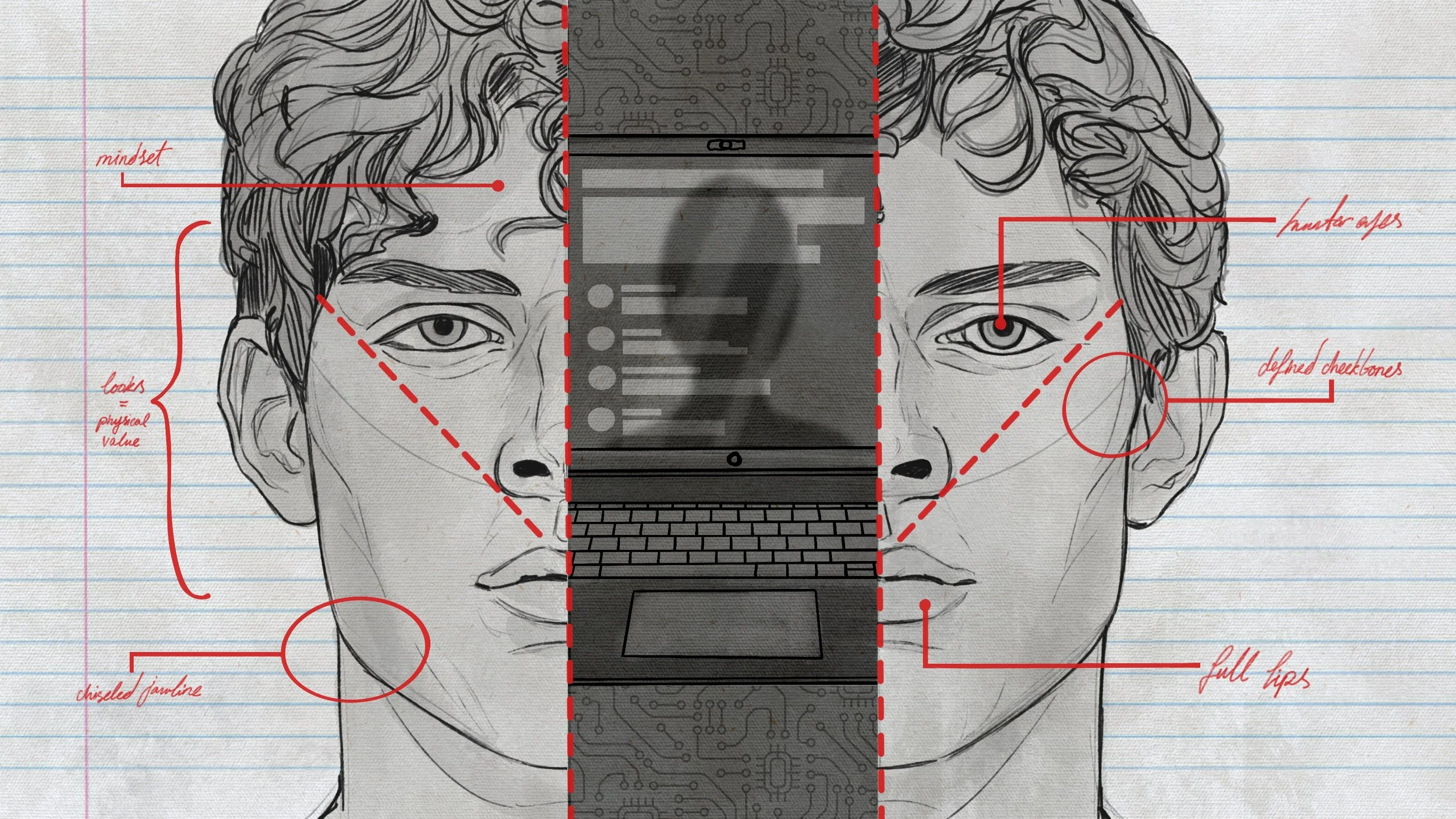
Illustration by Vlada Popyk
You’d be surprised at what loneliness can do to someone – where it can drive you.
In the 21st century, loneliness is no longer defined by physical isolation, but by a constant proximity to others that never quite becomes connection. Young adults are increasingly raised in environments where social life is mediated through screens, where ‘connection’ is abundant but rarely reciprocal. The result is not just isolation, but a distortion of what it means to be valued. Emerging online figures like Clavicular are less anomalies than early indicators of what prolonged digital isolation can produce.
Clavicular is not a socially adept individual; he has expressed his many failed attempts to find belonging in reality, but to no avail. Like most young people, he turned to the internet – a place where you have access to absolutely everyone, the illusion of connection all whilst in the privacy and safety of your own bedroom.
Whilst finding solace with like-minded individuals, Clavicular developed a jaded sense of the world coming to the nihilistic conclusion that nothing really matters. So what does he turn to to give his life meaning? His only directly accessible asset: his body. Not unlike women who starve themselves to gain a higher form of social currency, looksmaxxers like Clavicular do ‘whatever it takes’ to reach utmost perfection.
Whilst his perspective is extreme, it is better understood as a response to perceived conditions rather than a justified account of existence – less a remedy for loneliness than a clinical attempt to make it legible.
Increasingly, the act of living doesn’t have a lot to offer young people these days: a political rift drives men and women further away from each other, social media doesn't foster real connection, the boomer-filled fantasy of owning a house and making a stable living seldom exists and an increased visibility of unequal wealth creates a sense of helplessness.
In the last month or so, I’ve been made aware of Clavicular's existence. He first popped up on my social media radar through a youtube commentary video which led me to his home turf: online streaming spaces where people watch others for hours on end, often with little substance occurring. “Looksmaxxing”thrives here, with an ability to disseminate on forums that lack appropriate oversight, the community propagates an ideology that is loosely defined by a set of often pseudoscientific, appearance-focused practices that promise men they can ‘ascend’ socially through physical optimisation.
Many of these spaces treat attractiveness like a fixed biological hierarchy. There’s measurement, ranking, ‘diagnosis’ – almost like people are pathologizing their own faces. Personality, chance and social context are stripped away, replaced by a rigid determinism.
Clavicular’s online presence is defined by this same detached, analytical language. His methods present themselves as cures to a bleak existence, turning human connection into something of a rigged market rather than a mutual exchange
Recently, however, Clavicular has broken out of his niche corner of the internet into the mainstream. Interviews attempt to undermine his ideology, YouTube video essays deconstruct his philosophy and countless clips, removed from their original context are pasted all over Tiktok.
At what point does the internet go from laughing at someone, to laughing with them? When does mockery stop functioning as critique and start becoming an endorsement? When do extreme figures become objects of satire in a way that normalises the very ideas they express?
Upon my immersion into the “looksmaxxing” world I was struck with the various forms of physical assault that Clavicular promotes in pursuit of an ‘optimal’ self. His digital footprint stretches back to early adolescence, suggesting that his worldview is not a result of a sudden grift, but a perspective developed over time.
The racism, misogyny and disregard for human life embedded in his content are difficult to ignore. My initial reaction was disbelief – that such a worldview could exist so openly. Like many others encountering him through a more conventional algorithm, I interpreted him as a misguided figure, the ideology spewing out of his mouth so bizarre that I concluded it must all be some sort of sick satirical joke. But it wasn’t.
It was only when concepts like ‘tiptoemaxxing' entered the frame, that the tone shifted to absurdity. Yet as these clips circulated, reframed as entertainment, I found the humour wearing thin. Phrases like ‘Chad does what Chad wants’, commented under my favourite edits of Tom Welling as red-Kryptonite Clark unveiled the unsettling reality not limited to irony: a patriarchal fantasy of what men believed they were owed – a reflection of how subjugation is still admired, excused and reproduced in contemporary social culture.
The internet was now doing what it often does: algorithms push unconventional content beyond its original spaces, and people outside those contexts encounter it without the necessary background. It becomes unintelligible, and so it becomes funny. Somewhere, in that process, the original conditions that made the content disturbing are lost. We forget why it was obscene in the first place.
All that remains are the most exaggerated elements; context dissipates through a smokescreen of online ‘satire’ and someone like Clavicular is easier to consume, to share, to laugh at. Gradually, it becomes socially acceptable to describe him as simply ‘funny’, detached from the structures that produced the content.
And so that prompts a complex dilemma: at what point does laughing at deviant behaviour stop being critique and start becoming complicity?
A broader issue simmers underneath. The internet is structured around attention as currency: engagement produces visibility, and that visibility produces profit. In that system extreme or unconventional behaviour is not just tolerated but rewarded; the ludicrous nature of the content enables it to circulate more easily. The audience becomes complicit in this cycle. What begins as critique of entertainment feeds back into the algorithm, encouraging further escalation until the boundary between ‘character’ and person becomes increasingly unstable.
This raises a more uncomfortable question about figures like Clavicular: at what point does an online persona stop being a performance and start becoming identity? If one’s livelihood depends on sustaining a digital self, then the distinction between behavior and branding collapses. The internet does not just reflect personality – it shapes it.
I can’t help but feel a complicated emotional unease when engaging with figures such as Clavicular. Beyond the analysis, there is a sense of disquiet in watching someone appear so visibly shaped by the ideology they represent. The ideology that he embodies to generate visibility, also rewards escalation, often at the expense of wellbeing, turning personal deterioration into content.
Creators, audiences and platforms all participate in sustaining this cycle – attention behaves like inertia, requiring constant output and therefore overriding the conditions needed to sustain it. The result is a figure who appears less like an autonomous individual and more like something maintained by engagement itself.
It is difficult, at times, not to feel a sense of discomfort at this dynamic – not because it is exceptional, but because it feels structurally familiar: a system in which visibility and value are tied together so tightly that suffering can become indistinguishable from performance.
Within this environment, looksmaxxing can be understood less as an isolated subculture and more as an intensified expression of existing cultural logic: the body treated as capital, attractiveness treated as hierarchy and self-worth rendered as measurable.
What appears at first as absurdity, then, is not separate from culture but continuous with it. The difference is not that it is new, but that it is now impossible to ignore. This is where its recent visibility becomes significant – what appears to be a new or exaggerated male subculture is often interpreted as absurd or anomalous, but this reaction itself reveals a blind spot. Many of the logics underpinning looksmaxxing – body surveillance, modification, optimisation in pursuit of social value, are not new. They have long been normalised in other contexts, particularly for women, where bodily discipline has historically been framed as routine rather than extreme.
Seen in this light, the visibility of Clavicular does not introduce a new system so much as expose an existing one. The difference is not that these behaviours have emerged, but that their extension into male spaces makes the underlying logic harder to dismiss as individual excess.
Overall, Clavicular is merely a symptom of modern culture still learning what digital socialisation has produced. Social media fosters an increasing detachment from reality – not only in a literal sense, but also through the erosion of a stable sense of self. Contemporary generations have acclimatised to the suggestion that individual life is only valuable if it's generating profit.
These afflictions emerging from social media increasingly reveal what happens when visibility is prioritised over actually being seen. ‘Looksmaxxing’ functions as a clinical framework through which loneliness is interpreted rather than resolved; young people are made aware of the fact that they are effectively priced out of a system larger than themselves, their perceived value shaped by limited individual currency simply defined by having had less time on earth.
In this environment, access to near-limitless information paradoxically enables broader ideological conclusions: that the elements which once made life feel meaningful can appear increasingly inconceivable in a world where profit is elevated above human value.
Given this precedent, it's no mystery as to why the unorthodox thrives online. It is simply reflecting, in distorted form, a wider tendency to treat transgressions and degeneracy as a form of attention currency within digital economies.