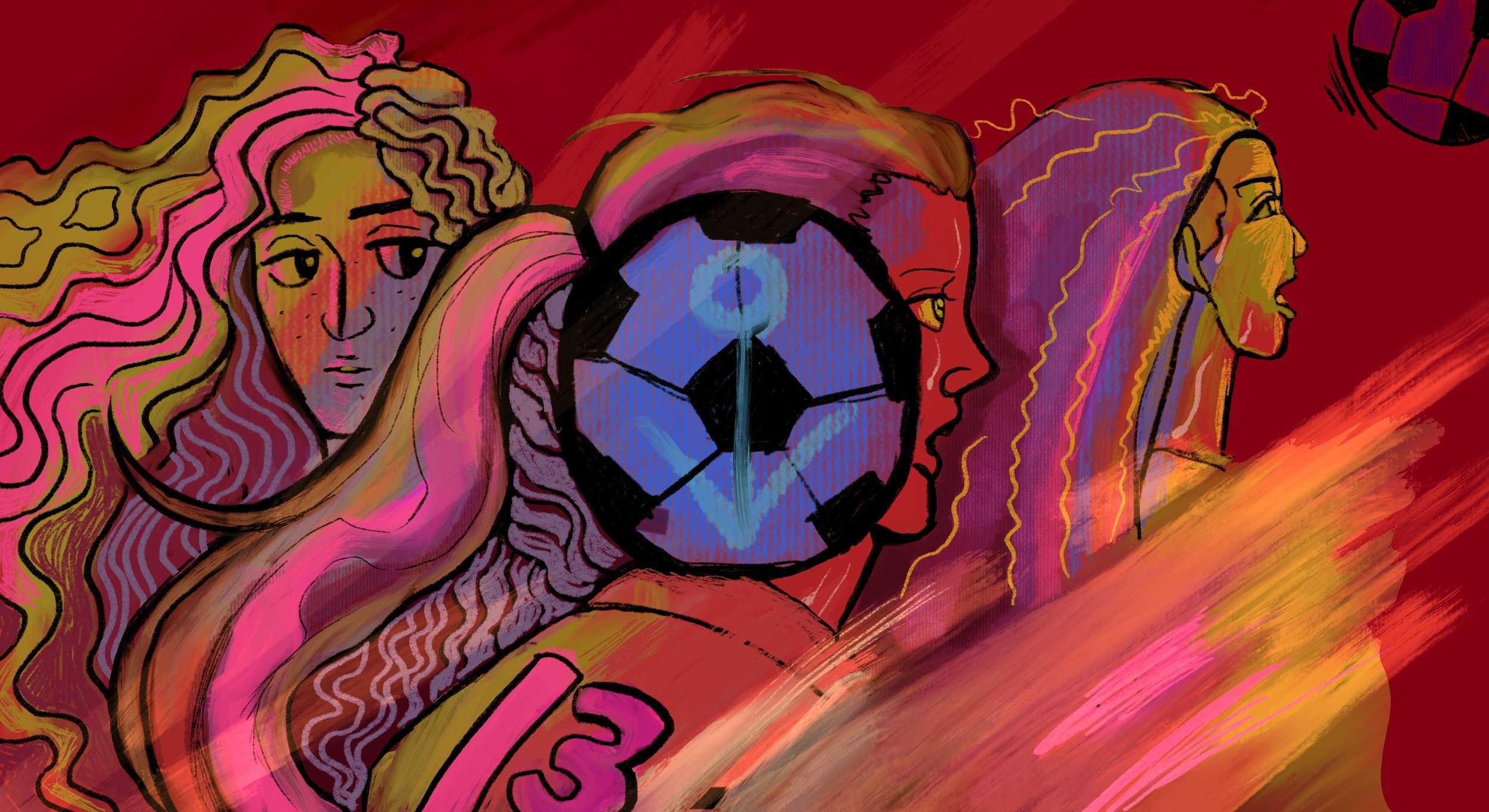
Illustrated by Heather Han
Here’s what you do when you are the only girl who shows up to pick-up soccer:
You first have to figure out where to sit to put your shoes on. Too close and you put yourself in an awkward situation where the guys wonder why the hell you’ve chosen to sit next to them. Too far away and they won’t even notice that you’re there to play with them. You’ll spend the time it takes tying your laces hoping another girl materializes.
You next have to get the timing right to step out onto the field, too. Bodies will start to mill about, putting on pinnies, or dividing teams into white and dark shirts, or, worst, separating into shirts and skins. There are some split-second decisions you have to make—what group of guys do you join to pass the ball around, what team do you join, how do you avoid ending up on skins?
Playing with men becomes an anthropological study of how boys interact. They have their own rituals that they perform with a habitual casualty, and you have to figure out where you slot into them. I have found, playing college men’s club soccer (as my college didn’t have a women’s club team), co-ed amateur leagues that are 90% men and 10% women, and male-dominated pick-up matches, that men will rarely introduce themselves. You have to osmosis their names as the game goes on, or take all the initiative of introducing yourself to everyone. Most of the time, I wind up joining a quiet passing circle, listening to the occasional conversation about the current Premier League or sports betting, letting it all wash over me as these nameless men talk.
Then the game starts.
Being a woman at pick-up soccer means that for the first half of the game you will do a lot of running and very little soccer. It takes a long time for the men to pass to you. If you look carefully enough, you can even pinpoint the exact moment they decide that you are not worthy of receiving the ball.
You’ll be out on the wing, even if you are a center midfielder, because you haven’t built up the courage to strong-arm your way into your actual position, and one of the guys will receive the ball. He’ll look up, make eye contact with you, wide open and calling for the pass, and then turn away from you and hit a crazy ball that half the time ends up out of bounds. The calculations he just made are obvious – he wants to play a good pass; playing a good pass means playing to a good player; the girl is not a good player.
That’s all you are at the start of pick-up soccer. Just a girl.
Playing pick-up soccer with random people invites a level of assumption and judgment as everyone gathers at the field. Everyone looks at each other and thinks, that guy looks athletic, or he looks like a baller, or he has two left feet and is just here to have fun. But when a girl joins the group, she doesn’t get that same assessment. The judgment of a man starts neutrally—he shows up to the field as an athlete, and then his perceived level of play goes up and down as the game progresses. A woman starts her judgment at the bottom—she showed up to pick-up soccer as a woman and now has to continuously prove she is better than what they assume women are. You end up fighting not just for a spot on the field as the only girl, but to be viewed as an athlete outside of your own gender. You have to find a way to transcend being a woman.
The first pass you do finally receive in the game will be the most important ball you receive in your life. You only get one chance when you’re a girl and not an athlete. If you play it well, you’ll get a few more. Play it wrong, and it will be ages before you get another pass. An athlete gets second chances because other men assume he is capable; a girl gets one because they assume she is incapable.
When you play well, there’s something horribly addicting about it. You played well in spite of what they thought, in spite of the judgment, in spite of the odds. You play long enough, and it becomes thrilling to see their judgments of you change mid-game, but it’s a double-edged sword. Some of the misogynistic things I’ve heard at pick-up soccer have come with the utter earnestness of men trying to compliment my playing—“You play so well for a girl” or “all the other women I’ve played with have been so bad, but you’re amazing.”
As a single woman in my mid-twenties, my mom is always asking if I’ll ever meet someone I can date at pick-up soccer. I don’t know how to explain to her that the whole time I’m playing, I am desperately trying to get these boys to forget I am a woman. If a guy thinks of you as someone to date, or, worse, thinks that you think he’s attractive, you will never be anything more than a girl on the soccer field. It becomes inescapable.
It’s hard to explain to my mom that the best thing I’ve ever heard was after a 9-on-9 game I subbed for. After scoring a brace and holding a big guy over six feet to no goals, the boys begged me to come play with them again. Clapping my hand one of them said with such honesty, “You were a beast out there.” It was devoid of all flirtation. Devoid of gender. Devoid of assumption. I was a beast out there that night—that was the closest thing I got to not being a girl.
Breaching the boys’ club of sports is a daunting task. You put up with the sexism and the patronizing comments and the occasional man that targets you and the alien rituals that all boys seem to intrinsically know—to this day, I still have a spike of fear watching a guy go down the line dapping his bros up and knowing I am going to be next. And yet I continued to do it because there are almost no equivalents for an all-women’s pick-up group. Either there aren’t enough women to play, or a women’s pick-up group is forced to become a catch-all social experience for all skill levels, degrading the actual soccer that gets played.
Try as we might, the gender disparity in sports is yawning wide open. While professional women’s sports are seeing a surge in viewership and attention, there are still gaps that persist. Roughly 50 to 70% of young girls drop out of athletics before the age of 14 due to a combination of financial barriers and social pressures. From ages 8 to 10, roughly 80% of both girls and boys feel that sports are “for someone like me.” By 18, that figure drops to 73% for boys and only 66% for girls.
That dream gap pushes young girls out of sports at the youth level, and it culminates in an adulthood dominated by men playing pick-up soccer and pick-up basketball and tag football, while women lose out on those types of social spaces.
The prominence of professional women’s sports is growing, but it’s not growing fast enough. And in the places it is growing, it is still dogged by violent misogyny, especially online. Girls watching clips of their favorite NWSL team might open the comments and find them filled with vile mentions about how much women suck at sports and how professional women’s soccer can never compete with men’s soccer. It’s draining for these young girls.
These gender gaps are insidious, and they crop up in all aspects of life. When I was growing up, I watched one sports movie—Bend It Like Beckham. It was the only sports movie that featured women playing. I loved that movie. I was just starting to play on elite club teams when I first watched it, and I saw myself in Keira Knightley and Parminder Nagra’s characters as they navigated playing on an elite team in London.
But even still, that movie, that was a foundational piece of my soccer life, was inundated by these gender disparities. Jessminda is not allowed to play soccer because her parents think it’s not something a woman should do. The girls’ coach is a man, and their blow-up fight is about fighting for his attention. In the park where Jessminda, played by Nagra, plays pick-up soccer, she plays with all men—23 years later and I am still experiencing a similar gender divide.
Boys get all kinds of sports movies that aren’t focused on gender discrimination. For girls, that’s the only thing their movies can focus on. Bend It Like Beckham, A League of Their Own, the most famous sports movies featuring women are about what it means to be a woman who plays a sport. For young boys, they get films about universal themes like redemption, persistence, determination. They get Miracle, and Rocky, and Remember the Titans. Their movies are about what it means to be an athlete, and the general, basic image of an athlete is persistently a man. It’s no wonder that so many little girls feel that they have no place in sports.
More recently, we saw this phenomenon once again in the newest season of Ted Lasso, which featured the women’s team.
Ted Lasso is a television show that is always trying too hard to be a feel-good experience. During the seasons that featured the men’s team, we watched as the team grappled with abusive fathers, the terror of getting old in professional sports and having to retire, homesickness, choosing forgiveness in the face of hurt—all universal themes. In the fourth season, the focus on the women’s team inevitably became about whether women could play professionally.
Now, on one hand, it’s a valid thing to focus on considering the struggles in women’s professional soccer and the lack of respect these amazing athletes are given. On the other hand, Ted Lasso’s fourth season doesn’t give the women’s team the same focus on the soccer field as it gave the men’s team. There are fewer practice sessions, fewer games. The one player who is meant to grow on the field, Shannon, we see do one solo practice session for ten seconds, and then suddenly she’s scoring the game-winning goal. There is no attention given to the individual players. The women’s team becomes a singular blob of a character fighting for respect, as opposed to the men’s team that had distinct characters with personal and specific struggles.
In Ted Lasso, women’s soccer is relegated to the grand idea of women playing a sport, rather than how women can individually be amazing athletes with their own struggles and talents. It brings me back to how it feels to walk out onto a pickup field.
When I am the only girl there, I am this stand-in for all girls who play soccer. Every woman the other men have played with is represented by me, and in return, I set the standard for all other women the men will play with. It’s a heavy burden to bear. Play badly, and it reinforces the unconscious assumption that pick-up soccer is for men anyway, not the women who want to join.
It’s an isolating experience, and one that’s nearly impossible to describe to the men I play with. The boys on the pick-up teams I have stayed with are some of the nicest people I’ve had the pleasure to play with, and even still, I have heard the same lines about being good for a girl, and experienced those moments where I have to prove my playing ability to them.
Even amongst the best of the best, men I consider my close friends, I cannot escape all that comes with being a girl on a pick-up team.
There are two other women that I play with on the pick-up team compared to the 40 men that are in the group chat. We do our best to hold the line, searching for more women to come play to even out the odds.
But it’s an uphill battle. How do you ask another woman to face everything that comes with being one of the few women in a field like this? How can you condemn her to this place? When will women get to walk up to the field and be seen as the athletes they are?
I hope it’s some day soon. For now, all I can do is keep showing up, believing that one day women will be able to exist in these spaces as the athletes they are.