2016: The Fever Dream of Optimism
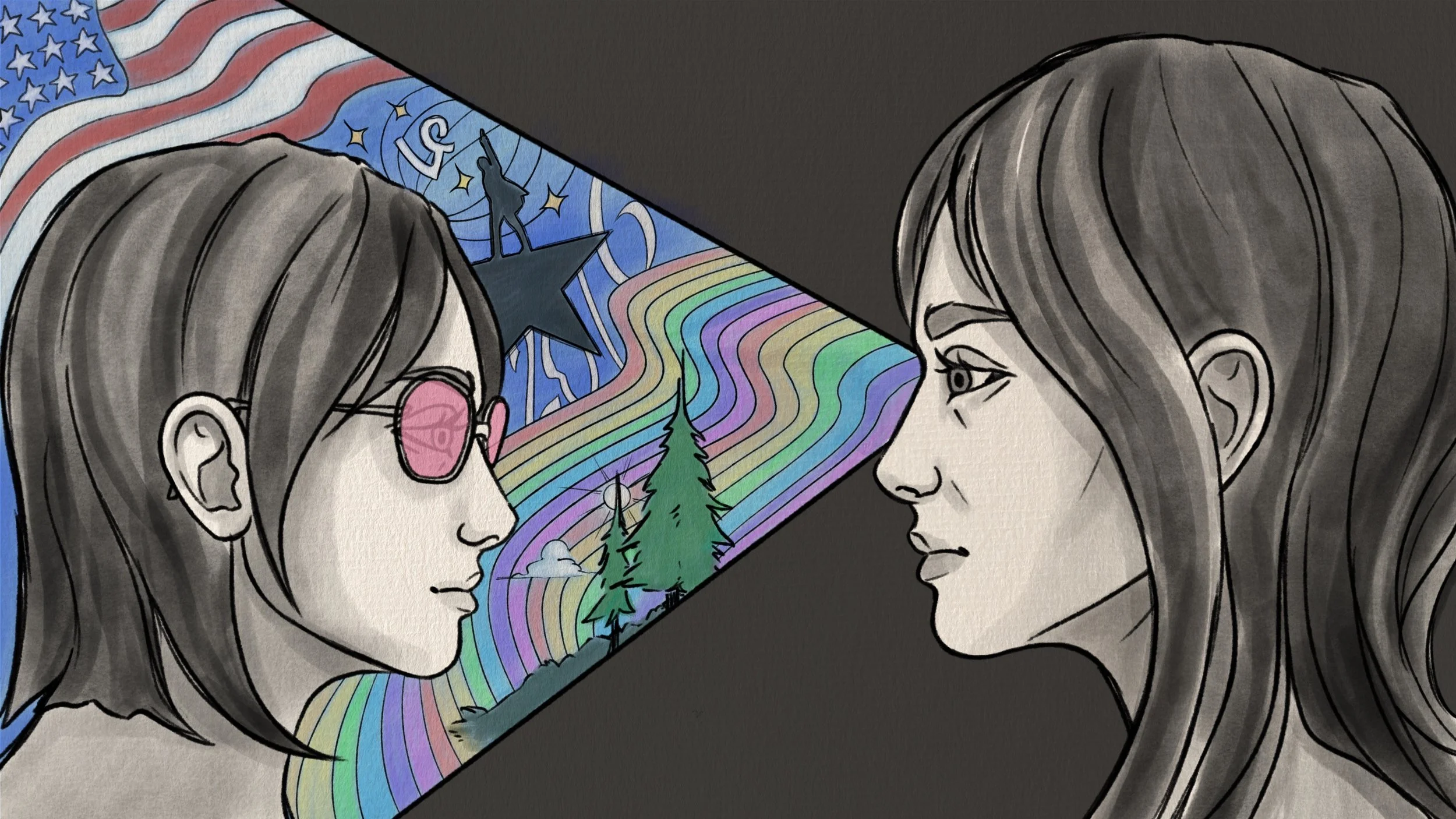
Illustrated by Vlada Popyk
There’s a satisfaction in calendrical isolation, in leafing through time’s vast catalogue and pausing at a specific page while professing “Here! This is where it all changed.”
It’s a cheap exercise, rife with fallacies and destructive simplifications, but still, I can’t help but jam my finger at 2016—the year where it all started going wrong. I’m American, so of course my mind drifts accusatorily toward the evening of November 8th when Donald Trump won the 2016 presidential election, but there’s a constellation of moments and omens that allude to the year’s transformative status. Internationally, there was the spike in European right wing populism punctuated by the Brexit vote, the election of Rodrigo Duterte in the Philippines, the vicissitudes of the Syrian Civil War and the refugee crisis it fueled. At home, there was the occupation of the Malheur National Wildlife Refuge by armed right-wing militiamen (culminating in a lethal shootout with federal law enforcement); a few months later, 49 people were killed at the Pulse Night Club shooting.
“On this Independence Day 2016, we may reasonably feel like hostages to our own newfound freedom, blindfolded and bound in the trunk of a careening car called change,” observes David Von Drehle in an Independence Day-themed op-ed for Time Magazine. “And every bruise and contusion we suffer jostling down the rutted road to the future brings us a little closer, so we fear, to an unseen doom.”
Ten years later, I find myself nodding along as I read. It’s the Fourth of July and I can feel the smoldering fingers of yet another record-breaking heat wave. A pop-up occupies the lower right quadrant of my computer screen, imploring me to “Explore the full archive of TIME, a century of journalism, insight, and perspective, with AI.” The accompanying search bar inviting readers to “Ask me anything” cuts off a sponsored thumbnail announcing how “Cognitive Decline Has Been Tied to This Common Breakfast Item;” the image depicts a hand, brilliantly wrinkled, which clutches a stack of cashews or maggots or popcorn shrimp that glisten beneath a stream of honey or perhaps piss. A notification on my phone alerts me that President Trump has no intention of cancelling the America 250 fireworks show (it will include “more than 80 times the typical amount of pyrotechnics”) despite environmental concerns and the unprecedented heat dome. Unseen doom, indeed.
Twenty-sixteen was not an easy year. But like much of the content pushed forth from that era, the majority of Von Drehle’s essay, titled “The Bright Side in America Today” reads to the 2026-resident like a cloying denial of reality.
After a clear-eyed appraisal of the woes faced by his countrymen, Von Drehle makes the same error as so many failed American pragmatists of the past decade by appealing to blind optimism. For Von Drehle, this optimism blooms in “our ability . . . to unleash the strength and creativity of individuals.” It’s a pleasant sentiment, sweet as a Hamilton lyric on the tongue of Lin Manuel Miranda at the 2016 Tony Awards — it’s also the exact type of sentiment that brought us to the dumpster fire of today.
It was mostly nostalgia that prompted me to pitch an essay reflecting on 2016. From a personal perspective, the year was defined by a whirlwind of novelty. It was the year I graduated from high school and started college. I canvassed for local progressive candidates and traveled outside North America for the first time. I experienced my first heart break, got way too high, voted in my first election, got way too drunk. It was the year of solitary solipsistic late night walks and navel-gazing journal entries, paying for tattoos with scholarship money and never tipping at cafes . . . the year of being a little shit. In my defense, I was 18. I was also high on a uniquely 2010s brand of optimism — a fusion of American exceptionalism, technocratic capitalism, and the affirmation that greatness is achieved by moving fast and breaking things.
“America is bicycle mechanics who figure out how to fly, newsboys who grow up to invent the lightbulb and scientists in muddy boots who defuse the population bomb by feeding more people on fewer resources,” Von Drehle waxes. “America is unplanned, nimble, fake-it-’til-you-make-it.”
Had I stumbled upon the essay upon its publication in 2016, I’d have likely found Von Drehle’s appeal to American individualism invigorating. His aviating bicycle mechanics and industrious newsboys are heroes not in spite of, but because of their arrogance — little Sam Bankman-Frieds brewing greatness and having fun while doing it.
The problem with this 2016 brand of optimism is that it is an obfuscation. It directs our attention to shimmering ideals of liberty and away from the very real issues of rising wealth inequality, entrenched racism, environmental devastation, and the obstinate refusal of our leaders to do anything to fix these problems. Instead of interrogating the idiosyncratic American goal of forging a classless society on an economic system reliant on the existence of a labor class, or acknowledging the malignant grip of whiteness on our meritocratic mythologizing, 2016 gave us Hamilton, which laundered the images of the founding fathers, and hipsterism, which presented a more inclusive and quaint brand of whiteness. We got a Superbowl halftime show with rainbow placards spelling out “Believe in Love” and back-up dancers dressed as sexed-up Black Panthers. The optimism of 2016 twisted the words of Audre Lorde, suggesting that maybe the master’s tools are adequate; maybe the house doesn’t even need dismantling; maybe a fresh coat of millennial pink paint will do the trick.
Von Drehle’s appraisal of America is optimistic, but with a decade of hindsight, it seems, well, wrong. Maybe this is the country whose “contributions to philosophy are Pragmatism and Self-Reliance,” as Von Drehle writes, but arguably, those are the very values that allowed Donald Trump to twice ascend to the White House. They are the values that keep the scales tipped toward those at the very top, that keep us isolated and more trusting of our devices than our own neighbors.
Ten years since 2016, I’d like to think I’ve matured. Age and hard but necessary lessons have curbed my hedonistic and narcissistic proclivities. That sweet optimism of 2016 hasn’t necessarily faded, but it’s shifted. It’s shifted from easy pride and inherent assuredness in my rugged American individualism to something more universal and amorphous. I’m optimistic that in spite of the distractions that threaten to shatter our focus and erode our social skills, these last ten shitty years have sharpened our collective awareness that something is deeply wrong with the way our society functions. With the veil of pseudo optimism lifted from our eyes, we can finally do the work of forging something better.