An Age-Old Attraction
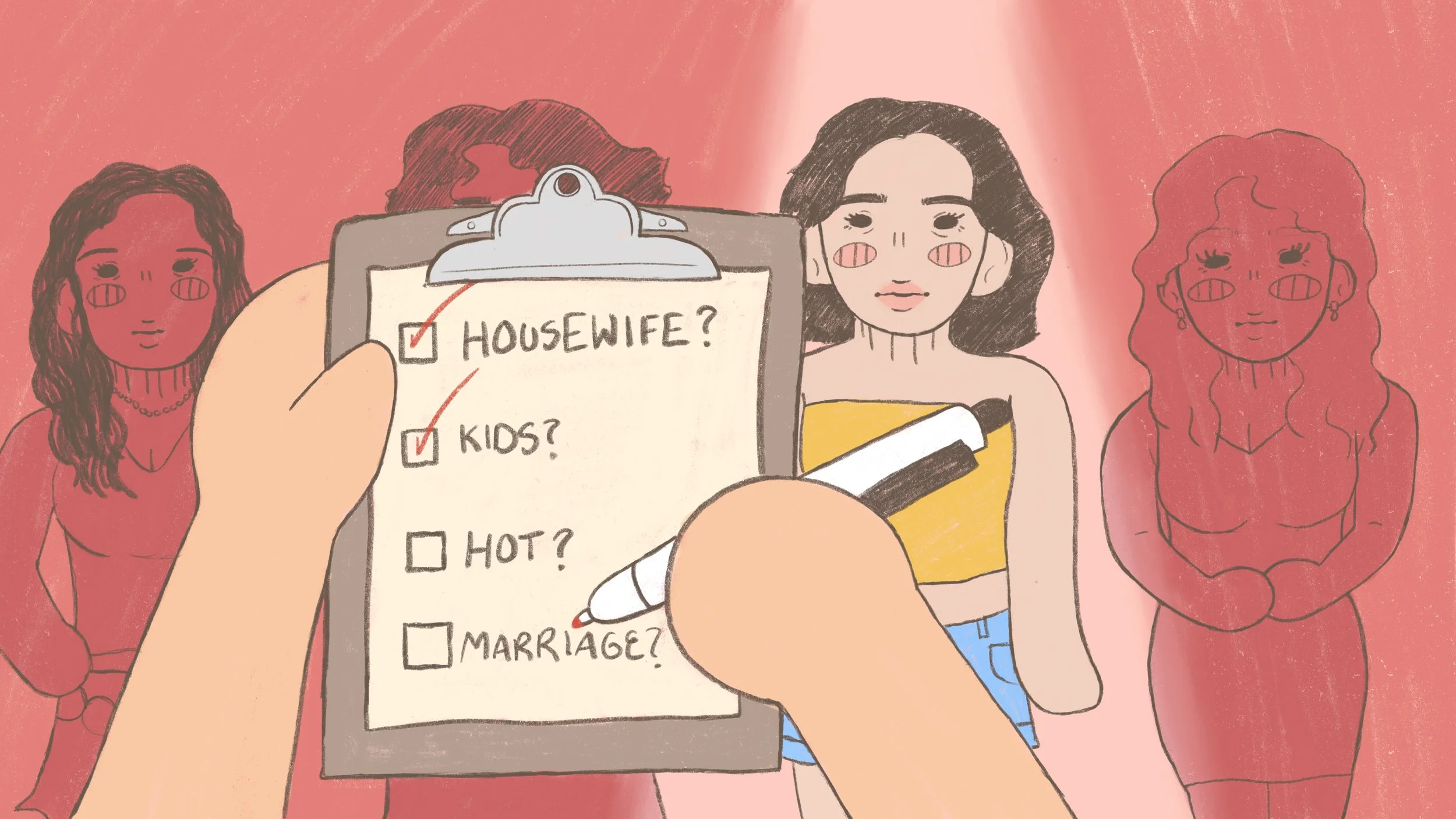
Illustration by Geliza Paunan
Pop the wine, dim the lights, grab the blankets, and get ready for the latest and greatest reality TV show, Age of Attraction. A bastard love child of the infamous MILF Manor and Love is Blind, the show asks a bold question: can you tell how old these people are under all of their plastic surgery?
Age of Attraction relies on a simple premise – the producers send a crowd of people to live at Whistler for a couple of weeks, hoping they will pair off into dramatic, made-for-TV couples. The only real rule of the show is this: you cannot ask anyone how old they are. Once people are officially paired up, they go to the Promise Room, avowing that they will continue their relationship in the “real world,” and then dramatically reveal their ages.
Once coupled up, the show follows six of the pairs as they spend some time living together, meeting each other’s families, and deciding if the relationship is strong enough that they want to continue dating after the show ends. As you might imagine, Age of Attraction opts to follow the couples with the most controversial age gaps:
Chris (26) and Leah (41) with a 15 year age gap.
Libby (22) and Andrew (38) with a 16 year age gap.
Pfeifer (23) and Derrick (43) with a 20 year age gap.
Logan (29) and Vanessa (49) with a 20 year age gap.
John (27) and Theresa (54) with a 27 year age gap.
Vanelle (27) and Jorge (60) with a 33 year age gap.
After its debut season, Netflix quickly announced it would be renewing the show, prompting the question, what is it about this show that deserves another season? Age of Attraction wants to claim that it’s a progressive experiment, testing to see if age is just a number while simultaneously empowering people to date outside of the rigid boxes of what society says is appropriate.
And while I was, admittedly, hooked on the show the way you rubberneck on the highway to see a car crash on the other side of the median, Age of Attraction achieves neither of these lofty goals. Instead, it became just another dating show in a long line of dating shows that upholds conservative, traditional, and often misogynistic dating norms.
The thing about Age of Attraction, and other shows like it, is that they hide behind a guise of being “progressive” while in reality, they push heternormative, conservative lifestyles. The opening of these shows is always about choice. Contestants intermingle and date many people at once. They’re given option after option for dating partners with the promise that anything could happen. But ultimately, all of the couples turn out to follow traditional, heterosexual roles.
Age of Attraction follows that exact same path, inviting 40 couples to a retreat up in Canada and setting no rules except the fact that people couldn’t ask anyone their age. And yet, everyone pairs off into hetersexual couples that are pursuing the ultimate goal of marriage. It is a false promise of possibility. Instead of exploring all the options of the dating world, the show confines itself to contestants that are pursuing traditionally conservative lives.
We see this conservative bend even more clearly in the contestants’ talking head interviews.
The younger women all talk about how they’ve signed up for this dating show because the men in their dating range are too “immature,” and they are here on this show to find someone to provide for them. The older women worry that they will be seen as past their prime as they are beyond childbearing years. The men want to find a woman who will be a good mother and wife. Everyone asks about the timeline to having children, and even the few contestants the show follows that don’t want children, end up in relationships with people who already have kids.
In a show that is supposedly interrogating the bounds of what is socially acceptable in the dating world, all the relationships careen headlong towards 2.5 kids and a white picket fence.
There’s no moment that more encapsulates the conservative bend of this show than when one contestant butts up against the rigid structure. Pfeiffer, a 23 year old who is now dating a 43 year old man with two kids, is trying to come to terms with the fact that they live states apart and one of them will have to move to make the relationship work. Since Derrick has kids, both of them agree that it’s Pfeiffer who should move. But Pfeiffer is worried about what that means for her. In one of the more emotional conversations in the show, Pfeiffer tears up when she fully realizes that she’s going to be leaving behind her job, friends, and entire life back in Seattle. As she tries to choke back tears, she admits that she had always promised herself that she would never change her life for a man, wanting to remain a strong, independent woman.
Now, she’s in a situation where she has no choice but to change her life for a man. It’s heartbreaking to watch as she transforms from a 23 year old girl with her own life to a wife and step mother to a man 20 years her senior. All Derrick can offer her is a half hearted nicety that everything always works out in the end – something that’s rich coming from a man who has to give up nothing for this relationship to work.
Pfeiffer eventually relents to the conservative pull of the show and agrees to move for Derrick so they can continue the relationship once the show ends. It’s the pinnacle of the show’s contestants bending to traditional relationship norms. Of course the woman has to give up her life for the man.
So, if the show didn’t actually push dating boundaries, did it succeed in proving that age is just a number? Unequivocally, no.
Contestants were obsessed with each other’s ages. And as a viewer, I was also obsessed with their ages. Before they paired off and revealed how old they were, my friends and I spent entire episodes just trying to guess how old everyone was. In a show overrun with botox and filler and contestants trying to make themselves seem younger than they are, it was one of the most interesting things about each person.
The women in particular were handcuffed by the obsession with age.
Leah spent her time at Whistler reiterating how surprised people were going to be when she revealed how old she was, and took immense pleasure when people thought she was younger than 41. Vanessa struggled to know if Logan was attracted to her, even asking if she should get more botox to look younger for him. Theresa eventually ends her relationship with John, unable to date a man younger than her oldest child. Age is such a problem to Theresa that she categorically refuses to tell her children how old John even is.
The men also thought about age, although it was more about their partner’s age than their own age. Andrew, a 38 year old bartender, admitted that he always dates girls in their early 20s, and eventually pairs up with Libby who seemed so young I wouldn’t have been surprised if she was 16. Logan, continually expressed in his talking heads how he couldn’t wrap his mind around dating a woman as old as Vanessa. Chris, and his mom, worried about the timeline of having children since Leah was 41.
It’s a show packed with pseudo mommy and daddy issues, and power dynamics that became uncomfortable to watch sometimes, especially when you learned the older person often pursues people much younger than them.
Perhaps the line that really summed up how much of an issue age is in this show would be from a contestant, Tristan, who didn’t end up in a couple. After being turned down and turning down women he says in a talking head, “If you’re not as hot as my mom, then I’m not going to marry you.”
The troubling thing about these reality dating shows, besides being worried for the contestants well-being for choosing to go on these shows, is that they are, as the name suggests, a reflection of reality. Sure, it’s an over-produced reality that happens in front of the camera and edited by a team of people looking to drum up the most drama, but it is a reflection of what people want. These shows normalize behaviors and relationships.
And what this show normalizes is an obsession with youth and beauty, young women uprooting their whole lives for a man they’ve just met, and the conservative ideal that our main duty in life is to get married and have children.
Age of Attraction isn’t the only reality dating normalizing these behaviors. Love is Blind features many couples obsessed with looks, beauty, marriage, and the Trump administration. As the seasons have progressed, the contestants on Love is Blind have seemingly become more conservative, with many women proudly declaring that they want to find a man that keeps them pregnant and at home like a tradwife.
The reality of these shows is that this is the reality of the younger generations watching them.
Studies have found that young Gen Zers and the generation of kids coming after them are becoming more conservative, bucking the usual trend of young people in society being more liberal. The young kids are having less sex, drinking less, and have even become known as the “puriteens,” for their new prudish view of the world.
And they are becoming more and more preoccupied with beauty standards. The younger generations are obsessed with botox and filler, forever on a quest to look younger before they’re even old. It’s the era of emaciation with people trying to grow smaller as they grow up. And it’s the time of lookmaxxing, a term originating in the dark pits of online incel communities that has now blossomed into an everyday word to describe the radical steps people take to make themselves hotter.
As society becomes more conservative and more obsessed with their looks, reality TV becomes more conservative and more obsessed with looks, and then viewers become more conservative and more obsessed with their looks because that behavior is further normalized. It’s a never ending cycle.
Even as reality TV shows, like Age of Attraction, try to pretend they are pushing boundaries and making progress, they are folding themselves up into tighter, more rigid boxes of what’s deemed socially acceptable. And as they shrink, they are trapping their contestants and the viewers in boxes that are just getting smaller and smaller.