A (Very Polluted) River Runs Through It

AERIAL VIEW, LOOKING NORTH, OF PORT AUTHORITY GRAIN TERMINAL AND COLUMBIA STREET PIER, June 25, 1950. (Original negative GT-895)
In The Divine Comedy, Dante, already several circles deep into Hell, finds himself at the swampy banks of the River Styx. Sinners plod through stinking water in an unending slug-fest: these are the wrathful, condemned to an acrimonious eternity. Below the turbid surface, Dante’s guide explains, lie more souls,
“Stuck down there they mutter: ‘In the happy sunshine above we were sullen and sour while our hearts were filled with sloth. Now we lie here “singing” in this black muck!’ They don’t actually sing this ‘song,’ they just gurgle it in the slime there.”
It’s a provoking image—a river polluted not just by filth, but by the bodies of warring humans. Its fetid surface froths from diatribes of the sullenly submerged.
The ancient texts Dante drew upon for his epic are fecund with references to festering waterways—an understandable source of anxiety among communities that lacked filtration technology. The Styx of myth, specifically, has been culturally linked to the mortal realm in a tributary of the Karathis River known as the Mavroneri. Scholars from antiquity, including Plato and Pliny, made reference to the deadly properties of the Styx, and some suggested that it was Stygian water that poisoned Alexander the Great. Science tucks a truth behind the Styx’s toxic reputation: a deadly lichen is known to grow on the limestone rocks that flank parts of the Mavroneri.
The toxic waters of mythology flow freely into the discourse of modernity. Myths and legends may have changed from the giant-birthing waters of the Élivágar and the bloody Vaitarani described in the Garuda Purana, but accounts depicting the Cuyahoga on fire (real) and a three-eyed catfish being pulled from the Gowanus canal (fake?) stoke similar terror.
While the list of dangerously polluted waterways in the U.S. is extensive, few have captured the American imagination quite like Brooklyn’s Gowanus Canal. Sometimes frothy, sometimes covered in a nacreous scrim that one imagines peeling off like skin over scalded milk, the 1.8 mile canal’s infamous water is a wellspring of dark humor and incredulous facts.
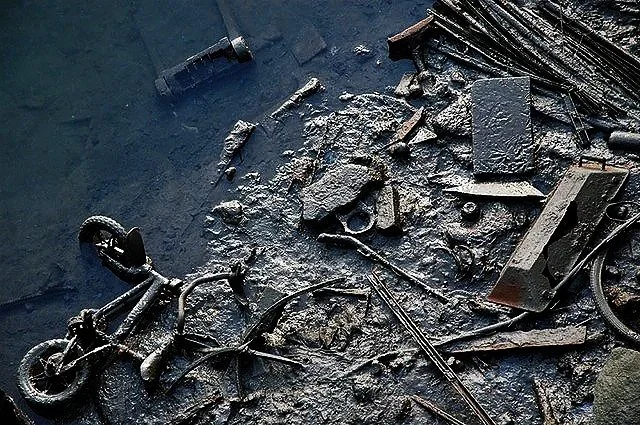
Image source: “gowanus toxic mud” by Jeffrey from Brooklyn, USA
Taken on 13 February 2005, 16:21
References have been made to floating dog carcasses and sentient slime and a stink that Thomas Wolfe described in 1952 as “symphonic . . . cunningly compacted of unnumbered separate putrefactions.” Multiple marine mammals have entered, then died in the canal, including “Sludgie,” a young minke whale who delighted New Yorkers for 24 hours before dying at the mouth of the canal in 2007 (an autopsy revealed that Sludgie’s death was likely a result of malnutrition and not her polluted surroundings, but her sad tale still ignited demands for action).
Not unlike the Styx, the canal’s stinking waters have inspired references to the underworld. In his—to put charitably—schizophrenically xenophobic short story, “The Horror at Red Hook,” H.P. Lovecraft references the “oily waves” of the Gowanus Bay, lending credibility to his conclusion that Red Hook harbors an entry into Hell. In 2014, a site-specific theatrical retelling of Hades’ kidnapping of Persephone was set on the canal, which stood in for the Acheron, another of the six rivers of the Greek Underworld.
The source of the Gowanus’s poisoning has more in common with Dante’s Styx than that of the Mavroneri. Once a tidal wetland, the canal was dredged in the 1800s and lined with tanneries, oil refineries, and chemical plants that dumped their waste directly into the waterway. It wasn’t active wrath, but negligence bordering on disdain for the environment, that polluted the Gowanus.
In 2010, the canal was declared a Superfund site by the Environmental Protection Agency, and efforts have since been made to dredge the sediment that has collected along the canal—a noxious blend of coal tar, heavy metals, sewage, and petrol waste, averaging 10 feet deep that has been unappetizingly dubbed “black mayonnaise."
“Singing in this black muck,” indeed.
The Gowanus continues to reek, but hope is not dead. Conservation efforts have seen marked improvements in river health. The Yangtze River, infamous for its ecological devastation from overfishing and industrial pollution, is showing signs of recovery after the Chinese government enacted a ten-year ban on fishing. Five years into the ban, the river has doubled its fish biomass and has witnessed a return of its beloved finless porpoises.
The pestilence of a wrath-ravaged river may stoke the imagination, evoking Dantean chimeras of Hell. But in a healthy Gowanus Canal, we just might manage to find heaven on Earth.