Chicken or the Egg: Kerouac, Writers and Alcohol
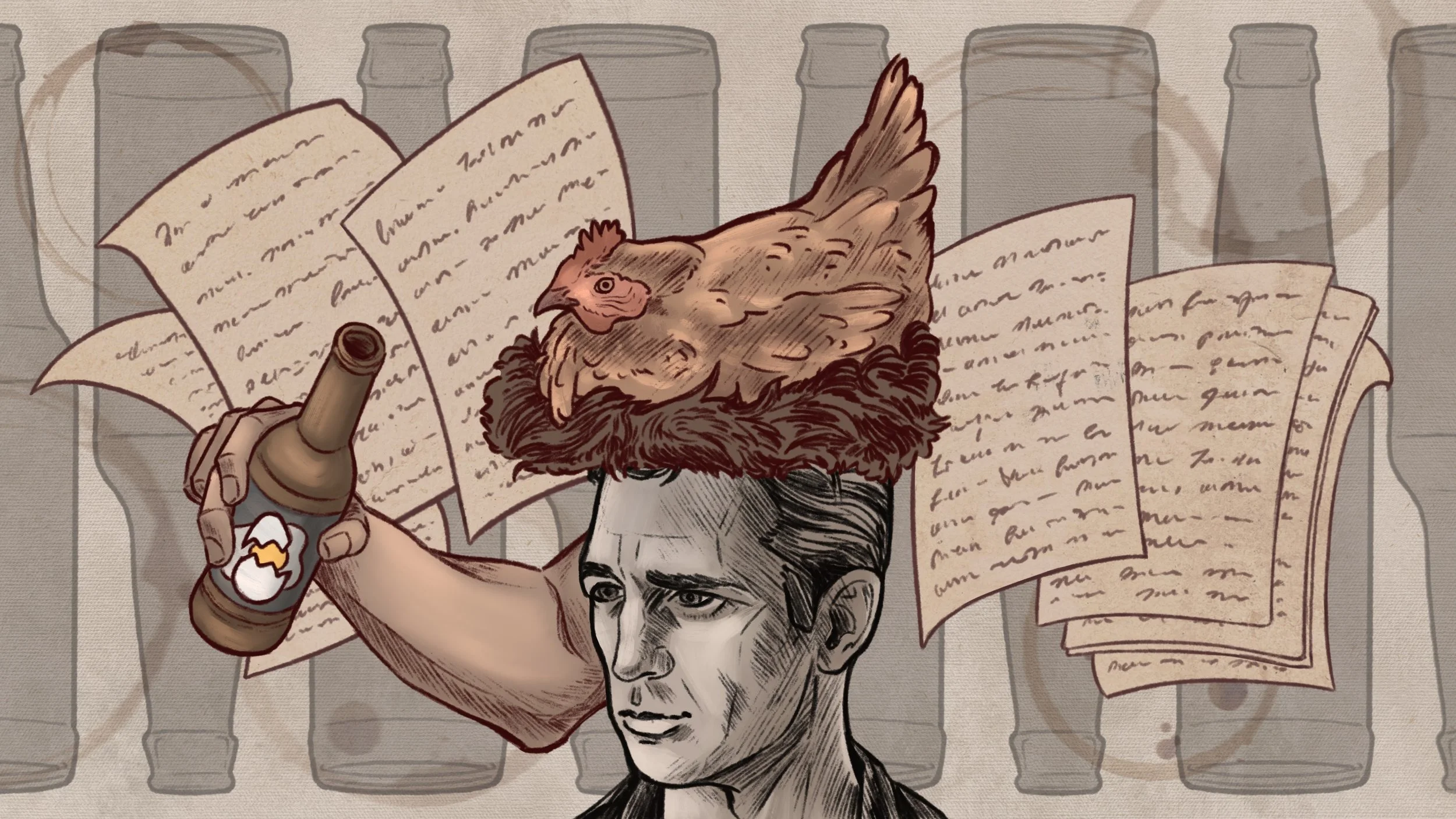
Illustrated by Vlada Popyk
Down the street from my house is the grave of Jack Kerouac. I don’t use that phrase figuratively, I mean his grave is literally a few minute’s walk from my house, just on the other side of the road. Growing up in Massachusetts, I’ve had a host of inspiring local writers who I could look up to, but something about the closeness of Kerouac’s resting place put him above the rest. His observations in On The Roadand his challenge of literary convention have inspired my own writing; the way I look at the world and at this country. His involvement in the Beatnik movement provides hope that young people just may be able to influence the flow of society. In many ways, as a young writer from Middlesex County trying to put his own mark on the world, it was easy to draw parallels between my life and his. Then, I started digging deeper.
Kerouac was born in Lowell, Massachusetts on March 12, 1922 to a union printer father and a factory worker mother. Both drank heavily, and Jack found himself skirting around their drunk fights throughout his childhood. He was both an athlete–he had a full ride football scholarship to Colombia–but found equal wonder in great literary works, especially those of Tom Wolfe. His father was quoted as saying that his son, “has always been seclusive, stubborn, headstrong, resentful of authority, being unreliable, unstable, and undependable.” As a young man, he frequented the bars and clubs of Lowell and was known for his short-lived sexual relationships with both men and women. While his father’s comments likely stemmed from their indefinitely strained relationship, Jack’s track record seems to support his unreliability. He left Colombia after a disagreement with the football coach and revocation of his scholarship. He joined the Merchant Marines during the second world war, but left three months in to return to Colombia and focus on his writing. He left Colombia again after only one month.
His early years were turbulent–whether of his own volition or a result of his stormy upbringing is up for debate. After he left Colombia for the second time he joined the Navy, but here too he struggled to fit in. His commanding officers cited his dismissal of authority, and his solitary preferences. According to his Naval personal records, he was prone to auditory hallucinations and often spoke about the meaninglessness he felt.
What concerns me most about my parallels to Kerouac is his eventual downfall into alcohol. In his later life he was a staple ornament in local bars and would frequently be involved in fights, one of which nearly ended his life. But when you stack Kerouac next to many of the literary titans, this trait doesn’t feel out of place. Many, many of the greatest writers have suffered with substance addiction, with alcohol as a frontrunning favorite. That got me wondering, what is the relationship between writing and alcohol? Does one come before the other?
On his first date at the age of sixteen, Raymond Carver got so drunk that he vomited over his partner’s dress. Whilst the highly-acclaimed short story writer worked on his collections, he was simultaneously fighting a battle with alcoholism that would alienate his family and landed him in the hospital on frequent occasions.
“Because Earnest Hemingway wasn’t sloppy about his drinking, he wasn’t called a drunk or any of the other pejorative terms used for alcoholics at the time.” An avid martini drinker, when doctors advised him of liver damage in 1937, he ignored their suggestions and continued to drink up until his death in 1961. Like other writers, Hemingway’s relationship with alcohol leaked into his public image. Unlike Kerouac, however, Hemingway–and this may have more to do with his literary esteem–was seen as a dignified drinker, despite many recorded drunk altercations. But Hemingway’s reliance on alcohol, especially in his later life, seemed to come from a variety of physical and mental health disorders, some which stemmed from his time as a young soldier during WWI, and posthumously diagnosed bipolar disorder which ran in his family.
Poet, fiction, and screenwriter, Dorothy Parker, too had a tenuous relationship with alcohol. One of her short stories, Big Blonde, was a semi-autobiographical fiction that gave the reader a glimpse into her addiction and the mental turmoil it took on her life. Parker’s childhood was unstable; she lost her mother at five and her father at twenty, her uncle was on the Titanic’s maiden voyage. Her life’s volatility continued with an unhappy, decade-long marriage to a New York stock broker and alcoholic, and then with her marriage to actor Alan Campbell, which ended in 1963 when he committed suicide. Parker would continue writing until her death at the age of 73–a heart attack, brought upon by alcohol-related complications.
The love affair between writers and alcohol is not a clear-cut one, it’s mired in the context of despair, broken upbringings, and tragedy witnessed on an unimaginable scale. The writers I’ve mentioned were at the forefront of social commentary. They found a way to pull back the curtain of the 20th century and transpose the pain they found onto the page. It’s what made them great to begin with.
Raymond Carver, on June 2, 1977, gave up alcohol for good. With the help of Alcoholic’s Anonymous, he lived the last decade of his life completely sober. He wrote a poem, Gravy, which I think these other writers would have concocted in their own words, had they had the chance.
No other word will do. For that’s what it was. Gravy.
Gravy, these past ten years.
Alive, sober, working, loving and
being loved by a good woman. Eleven years
ago he was told he had six months to live
at the rate he was going. And he was going
nowhere but down. So he changed his ways
somehow. He quit drinking! And the rest?
After that it was all gravy, every minute
of it, up to and including when he was told about,
well, some things that were breaking down and
building up inside his head. “Don’t weep for me,”
he said to his friends. “I’m a lucky man.
I’ve had ten years longer than I or anyone
expected. Pure gravy. And don’t forget it.”
In no way did drinking make Jack Kerouac a better writer. It was, instead, outward proof of the emotional turmoil he had experienced in his life. Durimmer stint as a fire lookout he wrote, “I’d rather have drugs and liquor and divine visions than this empty barren fatalism on a mountaintop.” He was a deeply flawed man, whose pain was both the catalyst for his addiction and his striking prose.ng his sober su
When I draw comparisons between myself and Kerouac now, it’s with a distant respect. A slight nod to the great writer that he was and the bad hand he was dealt. Good writing doesn’t come from substance but from the pits of life. Kerouac found himself here without agency, and alcohol became a confidant, a tool for momentary reprieve. We can’t ever know if his addiction affected his writing, for better or for worse, but we do know that it affected the man behind the page.
“Nothing behind me, everything ahead of me, as is ever so on the road. ”
-Jack Kerouac