DTF: St Louis: Where Middle Aged Malaise Meets Sexual Market Value
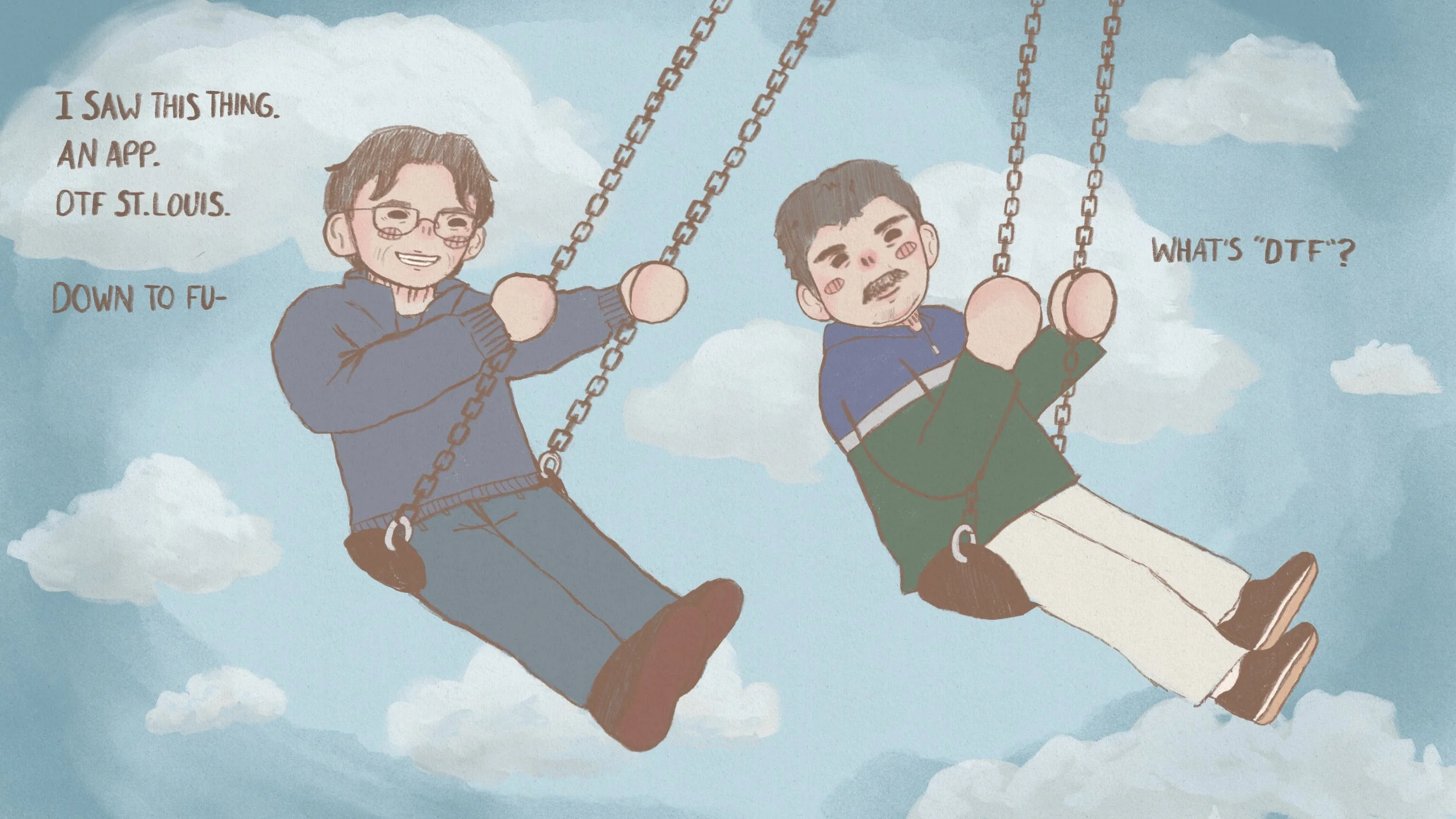
Illustration by Geliza Paunan
There’s something wrong with the men.
We keep making up new terms for it – male loneliness epidemic, the manosphere, incel communities – but it all boils down to the same thing: Scores of men are taking to the internet and to public forums to say that they have no friends, no romantic connections, and feel utterly alone.
Anecdotally, it feels true. As a single woman in my mid twenties, I have never felt more fulfilled by my friendships. I lean on them in hard times, and celebrate with them in good times. It doesn’t feel like men my age are doing the same thing.
Statistically, it’s only subjectively true. Research shows that both men AND women have become lonelier in the past few years, especially in the years after the global pandemic. A Pew Research Center survey found that about 1/6 Americans, or 16%, say they feel lonely all or most of the time. The difference this study found is that while men have as many friends as women, they are less likely to turn to them for emotional support.
It’s this self-made isolation that we are seeing impact young men in our society. And it’s pulling young men and women apart. In the last few years, I’ve become increasingly aware of the chasm of difference between the satisfaction of my life and the careening descent into hell it seems like many single men my age are on. My friends and I end up talking about it often. What’s happening with the boys? Why can’t they figure their shit out?
We talk about it so much it’s infected my social media algorithm. I recently ran across a Tik Tok I sent to my friend (my long running vice that I infect her occasionally with) that talks about the difference between men and women who aren’t in relationships. The video is a clip of an interview overlaying an edgy edit of every quintessentially fucked up man in movies. In the interview that’s overlaying the video, a man talks about how women who aren’t in romantic relationships pour their time and energy into friendships, clubs, and hobbies, and are by and large far more successful than men who aren’t in relationships. Widows, he says, are much happier than widowers.
My friend texts back: this edit is hilarious. And also: this is true for every single person in my life.
It’s this tumultuous cultural wave that men are caught in that DTF: ST Louis is set.
DTF: ST Louis is the type of show you want to tell everyone to watch, and then subsequently have to explain that DTF stands for “down to fuck,” and no, it’s not a trashy reality TV show. Instead, it’s a meandering pseudo-murder mystery following two men, Floyd Smernitch played by David Harbour and Clark Forrest played by Jason Bateman, as they wind their way through a melancholic middle-aged malaise that somehow ends up with Floyd Smernitch dead.
The show is gilded in the hallmarks of a murder mystery; it begins with a dead body in an abandoned pool house and then flashes back in time as the police in the present try to piece together alibis and motives. Under that Agatha Christie like coating, though, is a tender, earnest exploration into male friendships that ends in utter heartbreak. It’s not actually a murder mystery. It’s a love story.
If you read the full plot of the show, you might think I’m crazy for saying that. Clark and Floyd meet on the job as Clark is the lead weatherman in St. Louis and Floyd is the station’s ASL interpreter. As their friendship grows, Clark convinces Floyd to download the app DTF, which you eventually find out is a way for Clark to appease his guilt for sleeping with Floyd’s wife, Carol. The two of them meet often in a motel to have intense, kinky, roleplay fueled sex all while Clark becomes Floyd’s best friend.
Floyd and Carol have their own troubled relationship – Floyd’s insecurities turn their relationship cold, while he simultaneously finds himself unable to be attracted to Carol after she takes up a job working as an umpire to make ends meet because the umpire uniform is so ugly. Floyd also relentlessly tries to build a relationship with Carol’s son, Richard, who’s struggling with his own outbursts and ostracization in school.
Through it all, though, the one thing that endures is Clark and Floyd’s friendship. Even after Floyd finds out about Clark sleeping with his wife. Even after Floyd struggles with his self esteem after not getting any hits on DTF except for a guy who Floyd kisses just to “be polite” in a diner parking lot. Even after a failed attempt by Floyd to try sleeping with Carol again as Clark watched them. Even after Floyd’s financial struggles crescendo enough that he has to ask Clark for help. Their friendship endures.
The earnestness in which they handle each other is so soft it’s almost hard to watch. They admit their most vulnerable struggles to one another as they zoom through town on recumbent bikes, trying to work their way through failing marriages and the general malcontent of a dream life not realized.
You want to hope that this could be enough. You want to believe that they could find solace in one another and unearth a new joy in life built on this perfect, platonic love.
But it’s not enough.
It’s horribly reminiscent of the very real life of some men today. The lack of romantic love in Floyd’s life is his ultimate undoing. His insecurities and his sadness cannot be fixed by the love and support of his best friend who looks at him and sees the single greatest person he’s ever met. The people in Floyd’s life think he is unabashedly kind, perfect, loving, amazing. They think he’s a superhero. But because they don’t want to fuck him, he can’t have his happy ending.
In the last episode of the show, the gold plated scales fall from our eyes. Suddenly, we aren’t watching a murder mystery or a tender buddy comedy anymore, we are watching a tragedy.
As the show builds to its ending, there are a lot of different theories on who could have killed Floyd. Carol, painted as the bitter, conniving wife, Clark the friend sleeping with the wife, and even Richard, the kid with anger issues, all seem like possible suspects. The last episode undoes all of that suspicion.
We get to see Carol with the mask of the killer removed and discover the soft side of her. The side of her that’s a mom desperately trying to build a good life for her son by picking up a side umpire job so she can buy him a big kid bed. We see Richard as the troubled child who wants to take Clark’s dorky recumbent bike to his new school, and rides home triumphant to his mom after finally making new friends. And we see Clark as the faithful, best friend, who offers to watch Floyd and try to get hard in order to prove someone could be sexually attracted to him.
In the end, it’s none of the suspects who killed Floyd – it’s Floyd who killed himself.
The entire ending is a train wreck in slow motion. It begins in the poolhouse where Clark and Floyd agree to meet where Clark will try to will himself to get hard in front of Floyd to prove someone could be attracted to him – a plan that came to fruition after Clark failed to set Floyd up with an actual gay man. Clark, of course, is unable to get hard, and neither is Floyd, since neither of the men are actually attracted to other men. Then, Richard, who saw the DTF messages on Floyd’s laptop, rides to the pool to confront him and calls Floyd a “fat asshole” who no one could love in his rage. Floyd signs “I love you” to Richard as he storms away and then Floyd overdoses on a blood thinner that he brought to act as viagra.
It’s a quiet, pathetic ending for Floyd.
Romantic and sexual attraction has become the end all, be all. There’s a growing movement online that tells boys that if they are not desired in that way, they are categorically worthless. Incel communities will even go so far as to tell vulnerable, insecure boys that they should just kill themselves since nothing is worth living for if no one will sleep with you. That’s how we get this rise of “lookmaxxers” who will do anything to contort their bodies into what they consider to be physically attractive. It’s how we get a swelling of online podcasters and influencers whose only content is to instruct boys on how to pick up girls.
For generations, it was a woman's worth that was tied to her attractiveness to men. Women in the United States weren’t even legally allowed to open their own, independent bank accounts until 1974, so there were basic legal protections and advantages to being desired by and married to men. We had words for the women who didn’t achieve this standing – spinster, sad cat lady. Today, women are more independent from men than ever before. They don’t need them anymore for basic things like bank accounts. And it’s creating a cultural change – more people are single now than ever before.
In response, some men are reacting to this trend of rising singlehood by reinstating a worthiness of attraction. Instead of legal and financial protection that women gained by being attractive to men, men have created social capital by being attractive to women. They have a “sexual market value,” debasing themselves to a social worth purely based on looks. It puts a strain on them to become attractive, or risk losing social standing and facing ostracization.
In DTF: St. Louis, that’s why Floyd and Clark’s love story isn’t enough to save Floyd. It doesn’t matter that Clark loves him, it doesn’t matter that he had bonded with Richard, it doesn’t matter that his wife still loves him even if she didn’t want to sleep with him. What mattered was that someone found him sexually attractive. And when his limited pool didn’t, and his son reiterated his “ugliness” in a moment of rage, Floyd didn’t see any reason to keep living.
In the quiet melancholy of this show, we peel back the edges of this aching discontent that’s impacting men of all ages. We start the show off thinking this story is a complicated mystery, interrogating every character to figure out who could have done this. And in the end it’s revealed to be the obvious – a cultural tidal wave, a personal struggle with self esteem and worth, and the death of Floyd Smernitch.