Lessons Learned from Edward Crankshaw’s ‘Gestapo’
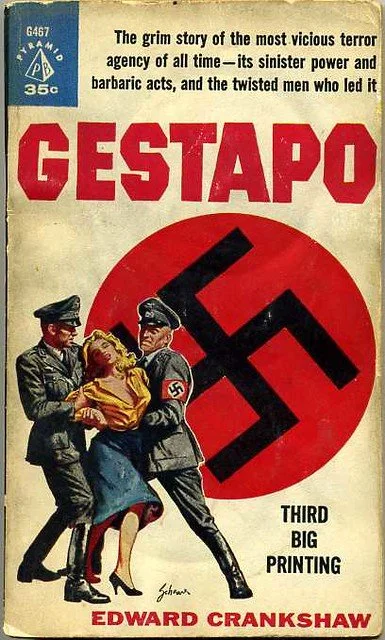
Gestapo by Edward Crankshaw, reprint 1959, cover illustration by Harry Schaare.
“The habit of obeying authority without question, even when that authority is clearly seen to be evil, accounts in some measure for the remarkable readiness with which intelligent, educated, and in some ways highly developed men committed unheard-of crimes.”
-Edward Crankshaw
There’s a particular history lesson from school that has stuck in my mind. Imagine a 1930s Germany, still reeling from its losses during the first World War. Then imagine a political party, led by a radical politician that finally breaks through the family radio. He promises redemption for your failing country, massive economic and political gains. Finally, someone to enact real change, someone “finally able to finally do something active and bold to rehabilitate [your] shabby life.” (Crankshaw, 73) All he needs is your vote.
In only eighteen months–from Hitler’s election as chancellor to his declaration of fuhrer–the Nazi party took complete control of the government. Free speech and political exercise were slashed, Nazi Germany became a surveillance state, retribution was swift and unrelenting. As a young student I wondered how a democratic system could crumble so quickly. At what point did the people of Nazi Germany realize there was no going back? Why didn’t anyone try to stop them?
In his 1956 book, ‘Gestapo: Instrument of Tyranny’ Edward Crankshaw recounts the role of the Gestapo, the German Secret Police, in securing the Nazi’s totalitarian control. They were not just Hitler’s outward limb to manage the country, they were a systematic pillar to the Nazi’s quell of dissent. The first part of this essay will explore the relationship between the Gestapo and the Nazi’s claim to power as described in Crankshaw’s book. In the second part we can begin to ask ourselves, are there lessons to be learned here?
The organization that would become the Gestapo began as the Prussian political police force in 1933. It initially formed as a resistance organization, aimed at silencing communist opposition. In 1934 Heinrich Himmler took control, a man who would become one of the leading military figures in Nazi Germany. From this point on the police force took on a military-like rule on German citizens: protests were silenced, any disapproval of the fuhrer or the direction of the country was met with swift repercussions.
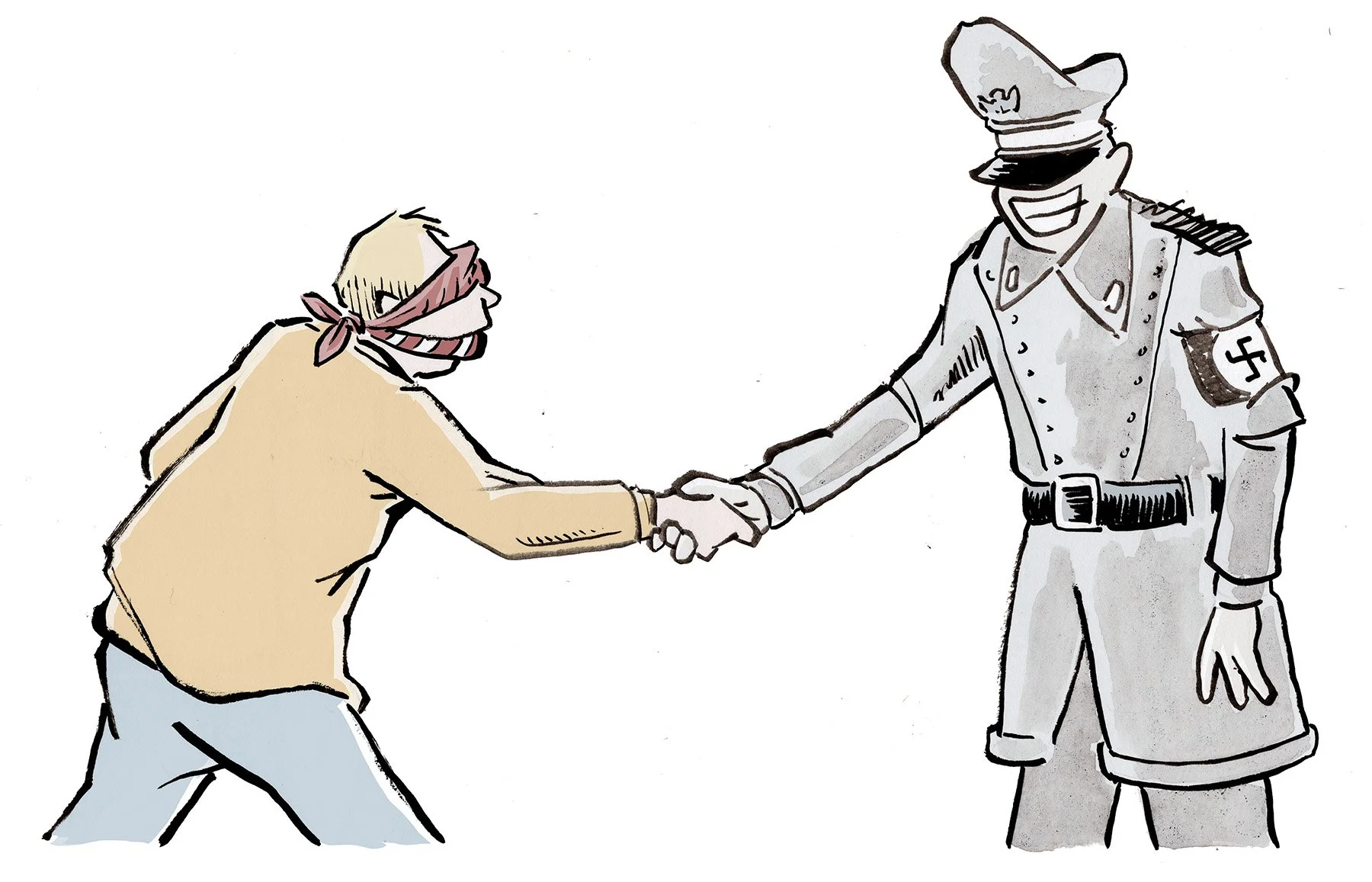
Illustration by John Klossner
The Gestapo seeped into all facets of German society. In government positions, “there were high ranking S.S. officers waiting for the moment to reveal themselves and put on the black uniforms they had never worn.” (39) They achieved control not through brute manpower but through the silent voices in the back of the German people’s minds that said, nobody can be trusted. Their ultimate goal was “to penetrate into every aspect of public and private life secretly, and publicly to create a legend of terror to make them appear omnipotent.” (89)
This perspective was especially difficult, for at its peak, the force only had 32,000 members, a relatively small number for a national police. They relied, therefore, on informants, on regular citizens to turn against each other. It was the fear they instilled that fractured German society. Neighbors, on little suspicion of one another, would offer up information to the Gestapo believing they may one day be shown mercy. Tensions heightened by the day. After Kristallnacht, The Night of Broken Glass, the Gestapo’s detainment of Jews and those aiding them skyrocketed. Nazi idealism had been achieved.
What is the point of a historian? Someone to reflect? Someone to keep the books? We could live our entire lives without ever needing to consider the past. But like a scientist whose failed 1,000 experiments, we too need to look back on the lessons of history so that we can grow, change, and create a better future. The story of the Gestapo and their involvement in the Holocaust is unbearably tragic. It’s an era of history that many would feel comfortable forgetting. But it’s too real and too recent to turn our heads away. To understand history is to learn from it.
The Gestapo’s control was asserted through the power of regular people. It was a collective submission to Nazi rule that gave them the necessary social order to enact the Holocaust. Of course, it’d be reckless to blame the German people for any of this. These people were scared and often defenseless. In many instances brutal force was used to maintain discipline, and these people needed to look after their families.
To be a German under Nazi rule gave two choices: isolation or action. This prompts a logical conundrum. If both options–submission or resistance–will lead to violence, then which option should one choose? It’s an impossible question to answer at the moment, only hindsight can give us the full picture. What if the Nazi’s really did succeed in taking over Europe? Any dissenters to the regime would have fought back for naught. It’s a battle between moral rightness and one’s responsibility to themselves in the moment. There must be a tipping point when reality reaches levels of desperation in which there is no going back. Finding that point is why we study history.
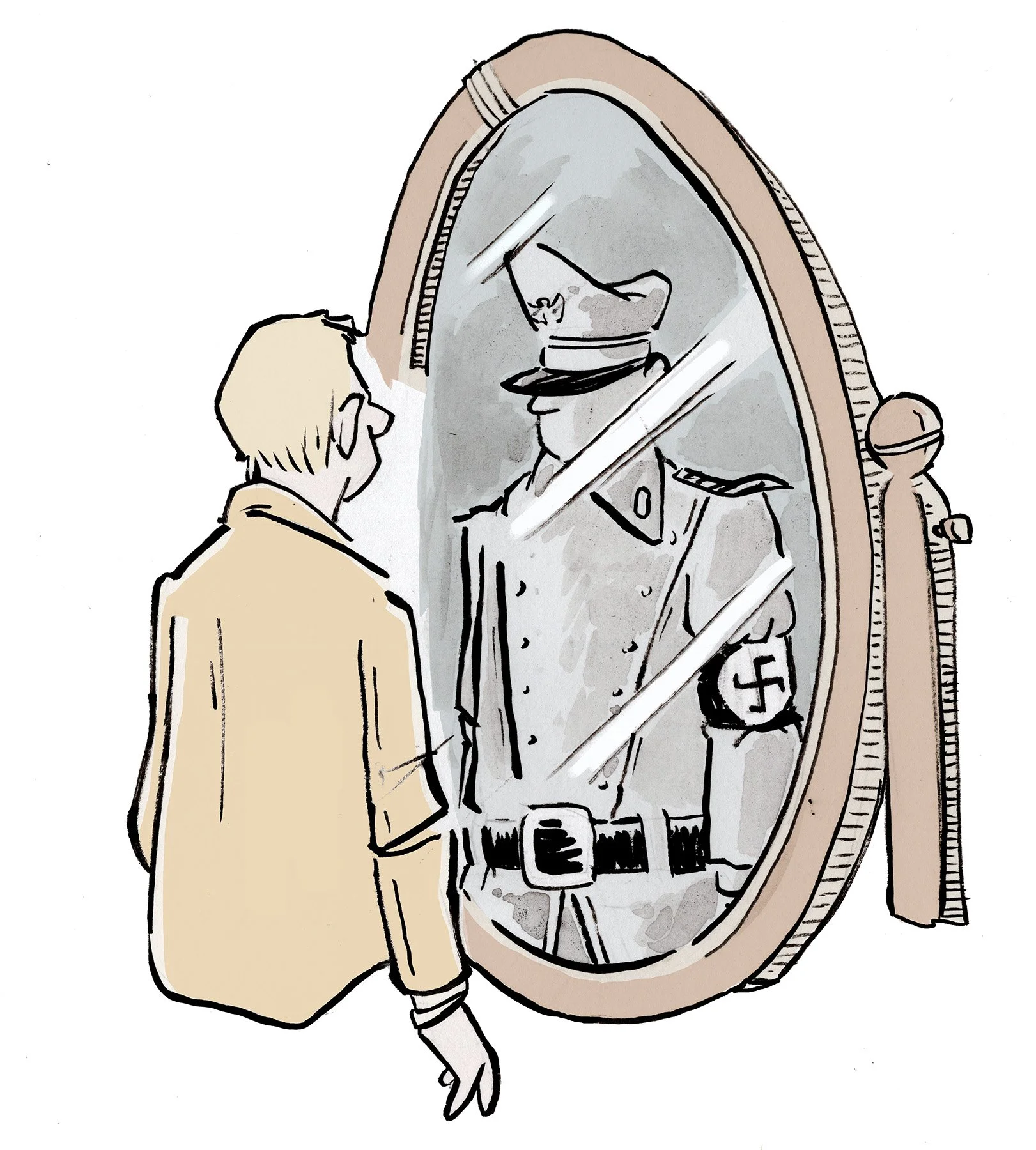
Illustration by John Klossner
Hitler was appointed chancellor through legal means in January of 1933. After this, however, he took instrumental steps towards dismantling the German Constitution and overrode systems of checks and balances that ensured democratic representation.
Like a used car salesman, when a politician claims to hold the answers, but their track record says otherwise, walk away. Political loyalty, or the inability to critically analyze the politicians we elect, is the first step towards the dissolvement of a democratic society. Unwavering support is the wick of the candle towards authoritarianism.
I hope you’ve noticed my disregard of comparison to other political movements, past and present. If you drew comparisons, then it means the lessons of history have not been lost on you. It is only through recollections of history through which we can make sense of the present political moment, both nationally and abroad. But mere acknowledgement of any similarities is simply not enough. Small actions, signs of protest, and enacting our democratic responsibilities are all vital to ensuring we live in a society we’re proud of. Help a neighbor in need, post a sign of support outside your house. To be silent is to be complicit. Things always seem clear in hindsight, so don’t let yourself down today.