Subversive Surrealism: From Breton to Teletubbies
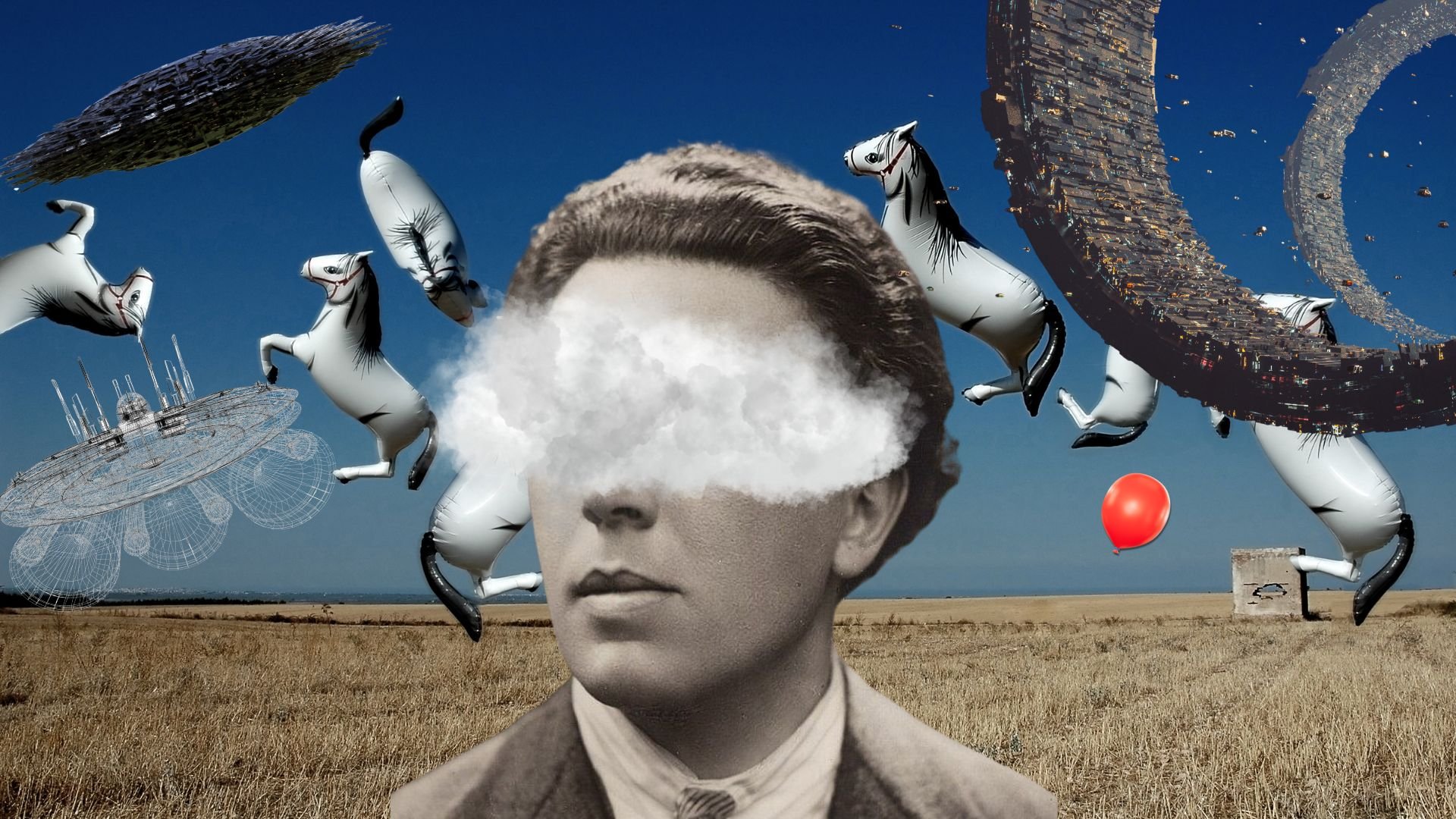
Collage by Eden Pela
A sinking sun somewhere out of frame casts a smolder across the pleasingly liminal landscape. A glockenspiel begins a whimsical melody as puny figures, little more than silhouette, crest a distant hill. They make their wavering march toward the foreground until they fill the frame: twin tigers, elephants, snakes, flamingos plot across the screen in perfect syncopation before eventually melting into CGI squiggles. The scene cuts to four fuzzy alien babies with TV screens for bellies collapsing in fits of giggles.
For at least 25 years now, this strange sequence has occupied my brain, cresting at the most inexplicable moments, all because in the early 2000s, my parents plopped me down in front of a TV to watch Teletubbies.
The debate over “surrealism” and how the adjective is applied (or over-applied) is well-charted territory, stretching back over a century to 1924 when the leaders of two rival French surrealist factions published opposing manifestos aiming to define the term. Most today cite the definition provided in writer André Breton’s Manifesto of Surrealism (apologies to Breton’s rival Yvan Goll), which identifies surrealism as “Psychic automatism in its pure state, by which one proposes to express . . . the actual functioning of thought.”
This definition, perhaps intentionally, is infuriatingly ambiguous.
A better understanding of surrealism is provided when Breton interrogates a linked concept: “the marvelous.” Prying at the edges of his dreams, leaning into slips and errors of the conscious mind and the symbols that trigger them, Breton emerges with “the marvelous,” which he considers anything “capable of affecting human sensibility for a period of time.”
Among the vessels of the marvelous, Breton identifies ancient ruins and mannequins; I’d add the Red Room from Twin Peaks, the minimalist, bell-driven leitmotif that accompanies the character No Face in Spirited Away, and (here we go again) the “magical events” from Teletubbies.
Much has been written on the presence of surreal imagery in children’s media. From The Magic Roundabout to Moon and Me, generations upon generations of children have been nursed on a diet of the psychedelically strange.
It makes sense that work geared toward the very young would be more surreal, as children (especially preverbal children) engage with the world in a pretty surreal way. To the very young, concepts we take for granted, like cause and effect and object permanence, are unfounded. The makers of Teletubbies worked hard to craft a show that approached scenarios in a way that felt natural to toddlers. What the show lacked in rationality, it made up for in aural and visual play. Like the whimsically amorphous figures painted by surrealist Joan Miro, the teletubbies and crew drift stochastically through their liminal environment, abiding by a logic typically restricted to our dreams.
The appeal of surrealism to children tells part of the story, but fails to address a secondary question: why the falloff? Why do surrealist elements, ripe in children’s media, wither as the audience ages?
“At an early age children are weaned on the marvelous, and later on they fail to retain a sufficient virginity of mind to thoroughly enjoy fairy tales,” bemoans Breton.
In a society oriented toward scarcity, the freedom to indulge the imagination and its proclivity toward surrealism becomes a privilege. Breton observes that:
The imagination which knows no bounds is henceforth allowed to be exercised only in strict accordance with the laws of arbitrary utility; it is incapable of assuming this inferior role for very long and, in the vicinity of the twentieth year, generally prefers to abandon man to his lusterless fate.
(Breton, Manifesto of Surrealism)
When survival in our material reality demands constant engagement, what chance does the imagination have? As we mature, we learn to self-edit. Our thoughts and output are filtered through a sieve of self-consciousness predicated on profit. As a writer, I constantly catch myself aborting ideas, sloughing them off as “too obscure, too strange, unpalatable” before they ever make it to the page.
Surrealism, in its preoccupation with dreams and immaterial elements of the human experience, is, at least in concept, unprofitable. In the lead up to the 1990 release of David Lynch’s Twin Peaks (arguably the most popular and successful surrealist TV shows in the US), media analysts and executives were dubious. One ad executive was reported stating “I don’t think it has a chance of succeeding.”
Beyond incredulity, there can be an active hostility toward surrealism. “The hate of the marvelous . . . rages in certain men,” Breton observes. The men who raged against the marvelous 100 years ago are the same men who today cling to technocratic rationalism as a means of enforcing a rigid and anti-democratic social hierarchy. They dictate what media we consume, championing their own AI products as alternatives to human-produced art that stirs the inherently subversive imagination.
Am I implying the existence of a conspiracy against the surreal? Maybe . . .
I still remember peering over an elementary school classmate’s shoulder to behold a scene out of an I Spy book. The image, a surreal masterpiece by the photographer Walter Wick, engrossed me. Eerily incongruent, it struck me as something tugged straight from my dreams, intoxicating for its strangeness that, even at age seven, I sensed rendered it almost illicit. Surreal art excites us in part because we recognize in its anti-utilitarian and irrational nature, a disruptive potential. We love it because it activates in us emotions that are inconvenient, even slightly subversive.
No matter how far we’ve strayed from childhood, surrealist art continues to enthral. Twin Peaks defied expectations and became a hit. As did Teletubbies, which garnered an intriguing following among British ravers who sought the series during the “post-club comedown.” In celebration of Breton’s Manifesto of Surrealism turning 100, a traveling exhibition celebrating the pioneers of surrealist visual art opened in Brussels, drawing massive crowds.
If the pull of surrealist art shows us anything, it’s that we aren’t fully resigned to our “lusterless fates.” A century since it first came to prominence, the surrealist movement continues to offer us access to the inexplicable wonder of existence. I think that’s pretty marvelous.