The Drama of Gun Violence
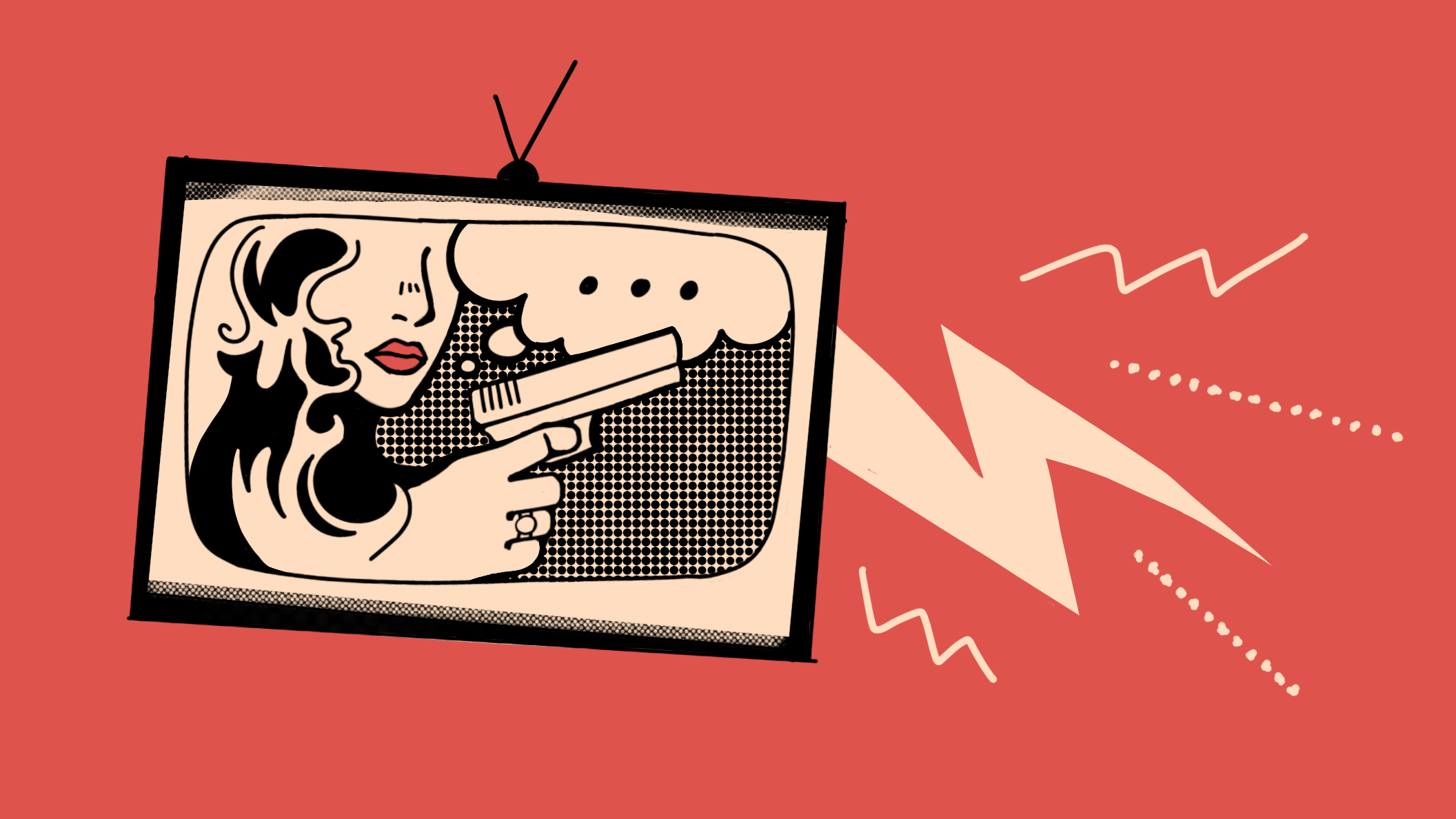
Illustration by Jaydah Victor-Morse
What is the worst thing you’ve ever done? What’s the worst thing someone else could do that you would be able to forgive?
These are the questions driving Kristoffer Borgli’s newest film, The Drama. It’s a movie perpetually caught between genres, the pendulum swinging from rom com to drama to pure comedy from one scene to the next as the film’s main couple navigates a wild dilemma.
Zendaya’s Emma and Robert Pattison’s Charlie are a picture perfect couple on the cusp of getting married. The two of them had a classic meet-cute in a coffee shop, where Charlie thought Emma was ignoring his attempts at flirting, only to find out she was deaf in the ear he was trying to talk to. The rest is history for the two lovebirds. The film progresses through short snippets of their relationship, told from the perspective of the two of them planning their wedding speeches – a nervous first date where Charlie reveals he never read the book he pretended to know to hit on Emma, a first kiss as they set of the alarm bells at the museum Charlie works at, a lot of very hot sex.
Once the speeches are set, we move on to watching them plan the rest of their wedding. This includes a wine and food tasting to pick their menu with their friends, Mike and Rachel. It’s at this dinner that they’re friends prompt them all to say the worst thing they’ve ever done.
Mike begrudgingly admits to using an ex-girlfriend as a human shield during a dog attack. Rachel regales them with the story of the time she locked her neighbor, who was allegedly also mentally disabled, in the closet of an abandoned RV and left him there overnight. Charlie laughs about some cyber bullying escapade, but offers no other information.
And then Emma admits that she planned and nearly carried out a school shooting.
It’s this revelation that has prompted scores of public discourse. Think piece after think piece has been written, trying to make sense of what it means to have a character admit to wanting to shoot up a school in a film that’s half drama and half dark comedy. However, the central sin of this film is at complete antithesis with the hubbub it’s generated: It doesn’t actually have anything interesting to say about the gun violence epidemic.
The Drama is a movie investigating what it means to forgive someone. It pushes the limits of a supposed perfect rom com couple to see if they’ll snap back into their happy ending, even after being confronted by the worst thing Emma has ever done. But it never provides a satisfying enough reason for why Borgli chose the lens of gun violence to interrogate these questions about relationships and forgiveness. For all its attempt at edginess, The Drama doesn’t actually engage critically with the trauma of school shootings.
We watch the film from the perspective of Charlie, a Brit now living in Massachusetts. Charlie’s stunned shockness at Emma’s revelation comes with the added baggage of not being American. The gun violence epidemic is a foreign terror to him that he is only just now having to confront.
Charlie’s perspective is similar to Borgli’s as a Norwegian born filmmaker. There’s a distance in this film between the truth of gun violence and the story that’s being told, and that distance does the film a disservice. The nuance and discussion about gun violence has all the subtlety of a child lifting up rocks in the garden to gawk at the squirming bugs underneath. That is to say, Borgoli is using this twist just as a way to say, wow, isn’t this crazy?
And yeah, it is crazy. But we all know that.
The film is begging to say something more about gun violence, but it just cannot scrape its way up over the hump of hard cuts between past and present and long, artful zooms to make any interesting point.
In fact, you could replace Emma confessing to fantasizing about a school shooting with fantasizing about any other violent crime – stabbing a bunch of her classmates, building a bomb, or driving a car into a crowded area – and nothing about this movie would change.
The only references to America’s gun violence epidemic are that Zendaya hypocritically joins a gun violence prevention group and Rachel, the friend that was at the menu tasting, reacts dramatically to Emma’s confession because her cousin was shot. Both of these things are so surface level in the landscape of gun violence that they could just as easily be replaced as Emma’s planned crime and the movie would function exactly the same as it does now.
By just dancing along the edges of something more meaningful, the film fails to distance itself from other movies that rely on the same premise of the happy couple troubled by a revelation about someone’s past. It’s a gender swapped version of A History of Violence, although in this case, Emma’s past doesn’t put anyone in immediate danger. And the worst thing is, it could have been something truly interesting.
Gun violence is a uniquely American trauma that has impacted every community in our country. I don’t know anyone in my life who doesn’t have some story about them or a loved one being in a shooting, or nearly being in a shooting. It has changed the way we organize crowded events and etched itself into our schools and public buildings with metal detectors and bullet proof windows.
You just wouldn’t know that watching this film.
This movie could have sunk its teeth into exploring the communal impacts of gun violence and Zendaya’s betrayal of her family and school by planning a school shooting. It could have explored the shared trauma and collective grief of gun violence in America instead of piling the grief up onto Rachel and making her the single most obnoxious character into the movie. It could have explored forgiveness from an entire community and how we begin to move forward after something so horrific.
Instead, the movie is focused on Charlie’s spiralling emotions as he completely falls apart in the face of Emma’s revelation, cheating on her before the wedding, and then ruining the big day. We forgo the nuances of gun violence and the focus on community by making Emma’s only goal to regain the trust of one single man. And in the end, the film only rewards her that forgiveness after her partner betrays her in return by kissing his coworker.
The lackluster approach to gun violence is made even more disappointing in casting Zendaya.
In the film, Charlie tries to justify Emma’s past obsession with school shootings by arguing that since there are so many shootings in the United States, more people than you might think must fantasize about committing mass shootings, insinuating that anyone could be a mass shooter.
Statistically, though, that’s not true.
Out of 511 mass shootings since 1966, 95% of mass shooters were men. Over half of these perpetrators were white. The rest of this percentage of demographics works out to about 20% of mass shooters being Black, 9% Hispanic, 5% Asian, and 5% other.
Emma, as a Black woman, is more likely to be a victim of gun violence, rather than a perpetrator. In 2023, the most recent year of available CDC data, Black women were six times more likely to die of gun violence than white women. From 2019 to 2023, the largest increase in gun homicide rates was among Black women with a 44% rise.
By casting Zendaya in the role of Emma, the film plays with a complete, statistical anomaly as there have been almost no Black women convicted of mass shootings. But the film doesn’t do anything compelling with this juxtaposition to real life.
In a hand waving way, we get one scene where a classmate of Emma makes a comment on the fact that mass shooters are mostly men, but Emma refutes that saying there’s been a few women. And then nothing else.
Every part of Emma’s past obsession with school shootings would be impacted by her identity as a Black girl. Emma first gets the idea to commit a school shooting because she falls into radical, online communities that worship past school shooters. While this is an accurate portrayal of how some teenagers become radicalized, it completely overlooks the fact that these communities are often extraordinarily racist and misogynistic, overlapping with niche groups like Black pill incels, or funneling teenagers to them from other hate groups. How does Emma, as a young, Black woman, feel engaging with parts of this community that would fundamentally despise her? We will never really know because Borgli doesn’t take into account how Emma’s identities impact this story.
So if Borgli won’t talk about it, here’s the reality of gun violence in America: In 2025, there were 79 school shootings. Since the shooting at Columbine, over 300,000 students have experienced some form of gun violence at school.
But these are just numbers.
Here’s a real story: when I was 11 years old, 20 children and six adults were shot and killed in Sandy Hook elementary school on December 14, 2012. I lived in the next town over, seven miles from where little kids were being massacred.
On that day, I was locked in a library with dozens of my classmates because the classrooms we were supposed to be in couldn’t be adequately protected in case the shooter decided to come to my school. I’ll never forget how my teachers put on a movie so they could silently cry in shadowy corners to not let us know they were scared. Nor will I forget the boy who slid under the table to conceal his phone to read us updates on the situation – ten, 15 reported dead. I remember thinking that had to be wrong; there’s no way that many children were killed.
In the next years of my life, I would join a walk out in protest for gun violence prevention after a school shooting at Parkland. I would be interning with my senator when children were killed in Uvalde, fielding phone calls from parents wondering if it would be their kid next.
I will never know a life without gun violence. I will never know what it feels like to be in a huge crowd of people and not have a passing thought about what I would do if someone pulled a gun. I will never not find it strange that my roommate is terrified of movie theaters because she’s worried someone will shoot her in one.
The Drama does not capture this cultural upheaval we’ve faced in the last decade as gun violence has gotten worse. It does not speak to the real fears our communities have to weather. And it does not say anything interesting about gun violence.
But it should. And it could have. So this is all to say, if you’re going to write about gun violence, fucking write about gun violence.