What One Unmuted Call Said About Segregation in NYC
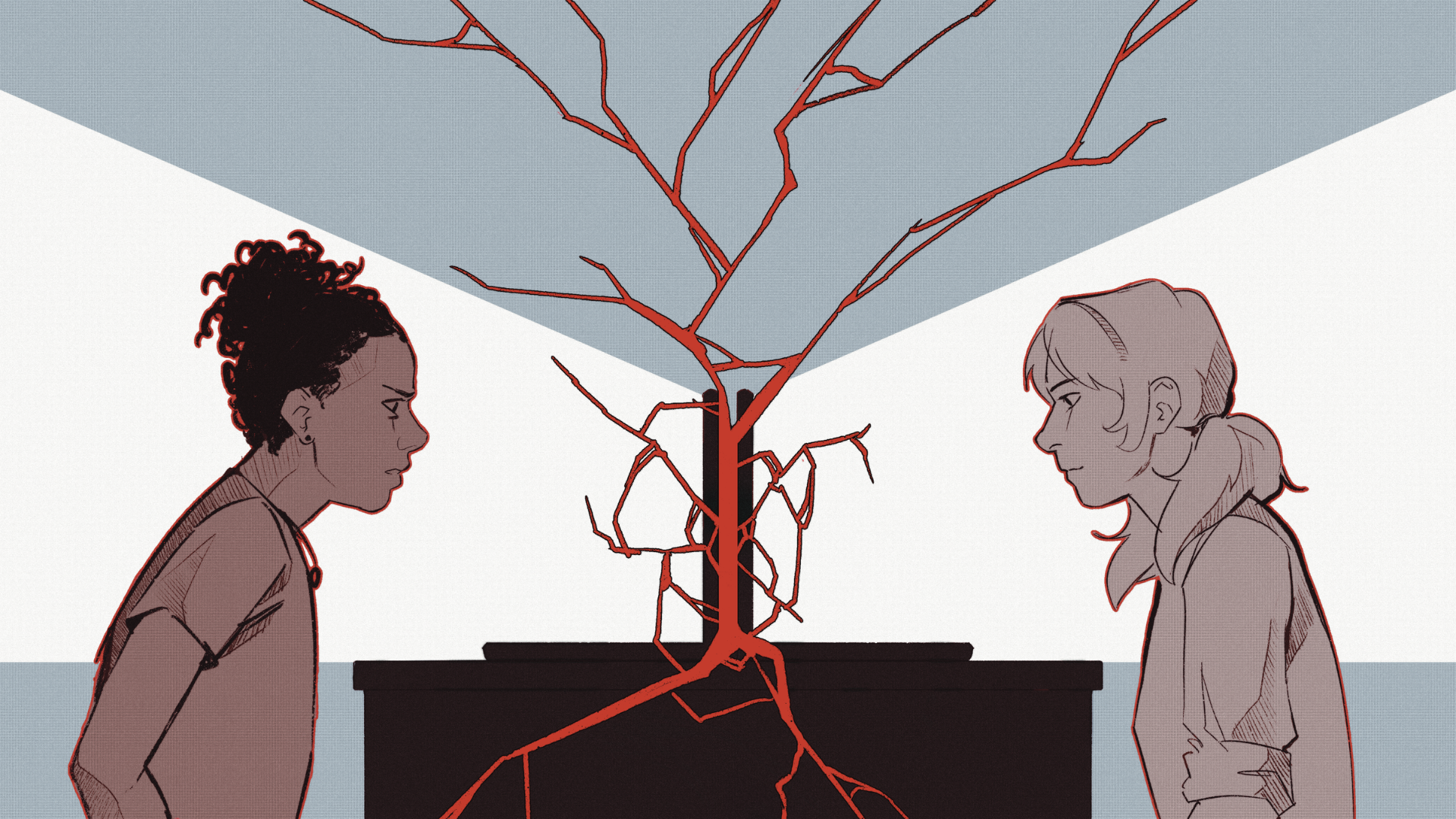
Illustration by Millie Rowe
It was the Zoom meeting heard round the world – or at least within New York City. For concerned families on the Upper West Side, the Feb. 10 meeting held by the District 3 Community Education Council was meant to be a space to voice concerns about recent proposals that would close at least four middle schools in the district.
While New York City is home to some of the most diverse ethnic enclaves in the U.S., it also stands as one of the nations’ most segregated school systems.
As it was Black History Month, interim acting Superintendent Reginald Higgins opened up the forum with a few quotes to Carter G. Woodson. Then, students, who were attending the meeting both in-person and online, were invited to speak about their thoughts on the proposals.
One Black eighth grader was in the middle of pleading against her school's potential closure when Allyson Friedmans’ voice, unmuted on the call, boomed through. “They’re too dumb to know they’re in a bad school,” said Friedman, an associate professor of biological sciences at CUNY Hunter College, where 11.5% of the undergraduate students are Black. “I mean, apparently Martin Luther King said it, like if you train a Black person well enough, they'll know to use the back, you don't have to tell them anymore."
Friedman was speaking to someone off camera, and did not know she was heard. But the resulting mayhem sparked a fire of backlash across the city, even catching the attention of Mayor Zohran Mamdani who called her comments “rephrensible” and “indicative of the exact kind of language that makes students feel as if they don’t belong in our public school system.”
Ultimately, Friedman, who is tenured, was placed on leave by the college, and the scandal has slowly melted away from the public eye. However, another issue prevails: the District 3 middle schools are still subject to closure.
“Abhorrable” was the token word used to describe Friedmans’ comments, with “racist” trailing right behind. While both are true, the nature of her remarks are not one-timed to the situation. Racism and segregation attack the New York City school system everyday, for both schools and universities.
The division starts early for young New Yorkers – parents struggle to pay for early childhood education, where little free options exist. This bleeds into elementary and middle school education, where students are on drastically different learning pathways. Then, in eighth grade, all students go through a rigorous application process for high schools. For the ambitious, they take a test known as the Specialized High School Admission Test (SHSAT) to get into the top nine high schools in the city, where Black students make up just 3% of the student population, and Hispanic students 6.9%, despite both groups making up majority of the city’s public school population. Tutoring services for the exam are costly, and there are currently no free options accessible to all public school students.
At the City University of New York, where in-state tuition is under $7,000 annually and only 23% of the entire student population of 247,000 is white, the perception of CUNY’s educational quality starkly contrasts its private counterparts like Columbia and New York University, who are some of the city’s largest landlords.
While the promise of universal childcare teases a future where education can be more equitable in the city, tomorrow's reality is more grim. Even when affordable options are present, Black and brown students find themselves disadvantaged by their institutions closing, having a lack of funding, or shutting them out entirely.