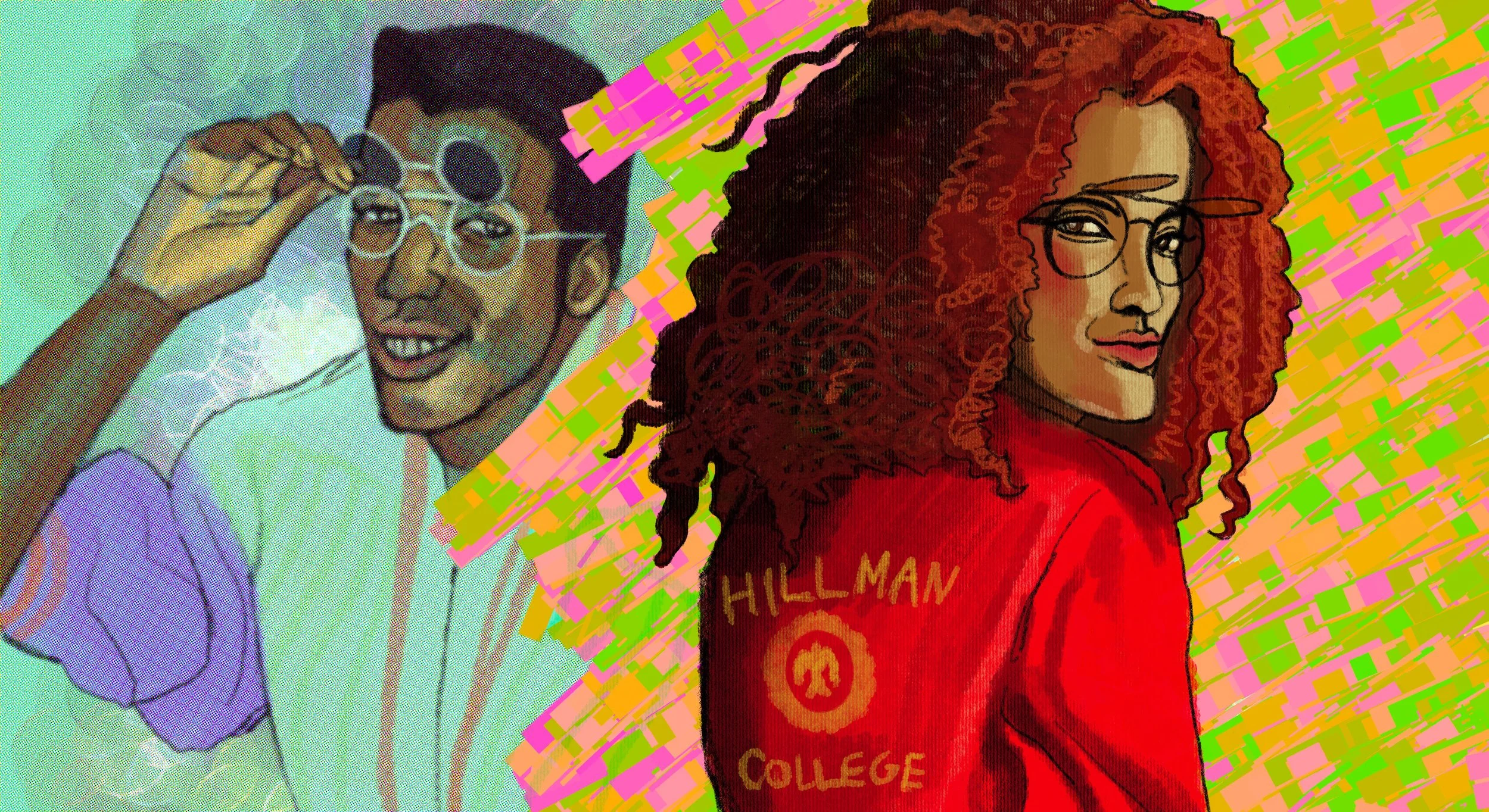
Illustrated by Heather Han
“Relax, relate, release!”
I’ve noticed something interesting when watching people discover that A Different World is a reboot. Some younger viewers, upon learning that the Netflix series is based on an original that aired decades before they were born, dismiss it as another example of Hollywood running out of ideas. “Everything is a reboot now,” they say. “Nothing is original anymore.”
The fatigue is understandable. TV shows nowadays have become crowded with revivals, sequels, and reimaginings that studios hope audiences will recognize. But dismissing A Different World without knowing what came before it overlooks the series' place in Black cultural history. The original was more than a sitcom about college students. For many Black viewers, it offered an introduction to historically Black colleges and universities, a glimpse of a world they might not otherwise have encountered, and sometimes the inspiration to attend one themselves (which I can relate to). Its return invites a question that extends beyond whether the new series lives up to the old one: What does cultural legacy mean to people who have inherited it without necessarily knowing its history?
The original A Different World, which ran from 1987 to 1993, brought HBCU life into American living rooms through the fictional Hillman College. Its students argued in classrooms, navigated friendships and relationships, went to parties, and struggled through the ordinary embarrassments of becoming young adults. The series also made room for conversations about race, politics, and social responsibility within the college experience. For Black audiences, Hillman offered a vision of higher education in which Black intellectual life and community were central to the story.
The show’s influence extended beyond television, as not only did it help introduce prospective students to HBCUs and encourage some to attend, but its legacy is bound up with the institutions it depicted and the generations who saw something of themselves—or a future they had not yet imagined—in its characters, which is a huge deal to the Black community that has experienced being shut out of higher education opportunities in America. To see its return as just another nostalgic exercise is to miss what made the original worth revisiting—especially in today’s political climate around education.
Nearly four decades later, Hillman has a new freshman class. Deborah Wayne, the daughter of Dwayne Wayne and Whitley Gilbert, sets foot at her parents’ alma mater alongside students whose backgrounds and expectations differ from one another. The reboot keeps a recognizable setting and history of its own, but the students entering Hillman today are growing up in a different cultural moment. Their experiences are shaped by contemporary pressure, changing ideas about identity, and expectations that didn’t exist in quite the same way when their parents attended college.
But despite those changes, the reboot recognizes that certain parts of HBCU life remain familiar. Housing and financial aid problems, curfews, homecoming, protesting, cafe culture, Greek life, and the overall negotiation of newfound independence still shape the experience. And like most college students, the characters test the limits of their freedom while living under institutional rules, sharing space with strangers, and trying to reconcile who they are with who they hope to become. Technology and cultural references have changed, but the awkwardness of growing up has not.
Witnessing this continuity play out gives the series a reason to exist beyond the return of familiar characters. An HBCU is more than a backdrop for a college comedy (or now dramedy). It is a community shaped by education, family, history, and the particular experience of learning in an institution created to serve Black students. The new series can honor that tradition while making room for students whose lives don't mirror the original cast. In fact, those differences may be where the reboot has the most to say.
Consider the awkward encounter between Kojo Achebe’s parents and Rashida Duvall, a first-generation college student. When Kojo introduces Rashida to his Ghanaian-Nigerian parents at the cafe, his mother greets her warmly and extends her hand. His father, by contrast, is cold toward her and refuses the gesture. He then criticizes Rashida for not having her books, interpreting their absence as a sign that she does not take her education seriously. The exchange is uncomfortable, and Rashida eventually leaves to return to work at the cafe.
The moment stands out because her circumstances matter so little to the judgment being made about her. Kojo’s father has barely met Rashida, yet he has already formed an opinion of her character. He sees a student without books and assumes she lacks academic commitment. He doesn’t know what her responsibilities are or what it takes for her to stay in school. Her departure to work adds another dimension to the encounter, as the very circumstances that may shape her college experience are invisible to the person judging her.
Rashida’s “seriousness” about her education doesn’t necessarily look the way Kojo’s father expects it to. As a first-generation student, she is navigating a world that may be unfamiliar to her family, with obligations that extend beyond the classroom. Her experience also sits within the longer history of HBCUs, established in response to Black Americans’ exclusion from higher education and sustained by generations who fought for access to learning. For some students, attending an HBCU carries the weight of family aspirations and opportunities previous generations were denied. That history doesn’t define every student’s relationship to college, but it helps explain why assumptions about a student’s commitment can miss so much.
The scene also opens a window onto the differences that can exist within Black communities. African immigrants, Caribbean immigrants, and Black Americans who have lived in the United States for generations may share a racial identity while having different relationships to history, class, education, and belonging. Their experiences of racism and opportunity are not interchangeable, nor are their cultural reference points necessarily the same. Those differences can shape how people interpret one another, sometimes producing judgments that overlook the circumstances behind another person’s choices.
Kojo’s father’s reaction should not be taken as a verdict on African immigrant attitudes toward Black Americans. The scene is more useful as an illustration of how easily assumptions can take hold when one person’s expectations become the standard by which another person or thing is measured. The tension lies in the gap between what Kojo’s father believes and what he actually knows.
That gap has implications beyond this brief introduction. Black identity encompasses people whose families have arrived in the United States at different points in history, as well as people whose ancestors endured generations of enslavement, segregation, and exclusion within the country. The resulting differences in historical memory and lived experience don’t make one person’s Blackness more legitimate than another’s. They do, however, complicate the assumption that a shared identity automatically produces a shared understanding. Cultural proximity isn't the same as cultural knowledge, and recognizing someone as part of a broader community doesn’t guarantee we understand the conditions that have shaped their life.
In this respect, the new A Different World offers more than a portrait of contemporary college students. It gives viewers a chance to consider what happens when people enter the same institution with different expectations about education, respectability, and success. Hillman may provide a common setting, but it can’t erase the differences students bring with them. Nor should it. The value of a community lies partly in what its members share, but also in whether they can understand experiences beyond their own.
Viewers who grew up with the original may approach the reboot with memories of what Hillman once represented, comparing the new students against characters they have known for decades. Younger viewers may encounter the series without that context, judging it on its own merits or dismissing it as another familiar revival. However, neither response tells the whole story. Nostalgia can make it hard to accept a changed work, while unfamiliarity can make it easy to overlook the history that gives its return significance.
The most limiting response to a reboot is assuming a story has nothing left to offer because it has been told before. Familiarity can obscure a work’s historical significance, just as unfamiliarity can make that significance hard to recognize. The main contention isn’t whether the new A Different World can recreate the cultural moment of its predecessor. It’s whether the series can give viewers a reason to think differently about the world it depicts, and whether those viewers are willing to look beyond their existing expectations.
Hillman has welcomed another generation, and its audience has changed alongside them. The original helped foundational Black students imagine a place for themselves; the reboot can introduce that same world to viewers who have never known it. It can also ask longtime viewers to consider how that world has changed and what remains worth understanding. A cultural legacy survives through more than recognition. It survives when each generation is willing to discover what came before, question what it sees in the present, and make room for experiences beyond its own.