In Defense of True Crime
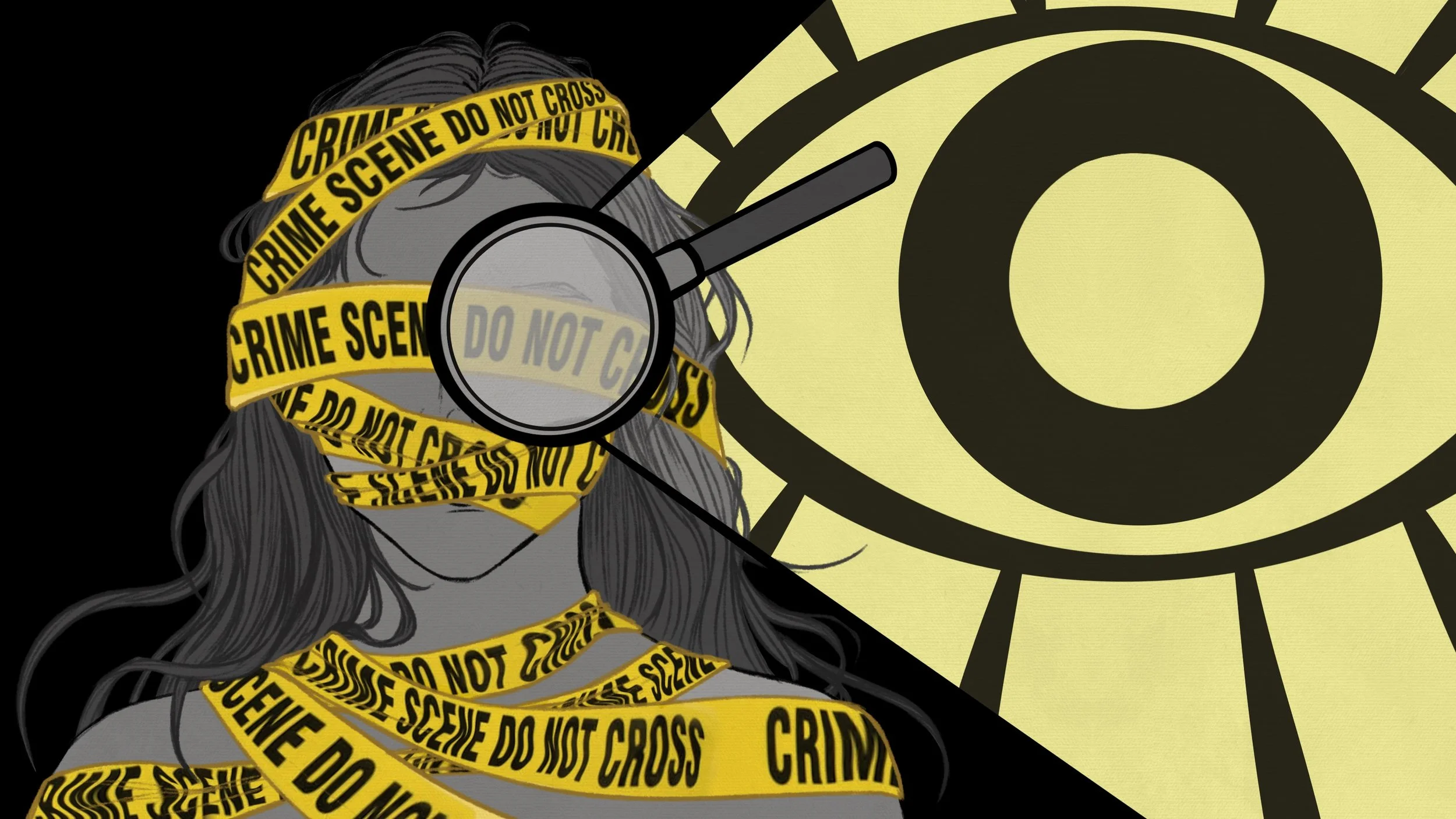
Illustration by Vlada Popyk
Where do we draw the line between exploitation and being informed? True Crime content online has become a bastion of modern online entertainment. Covering infamous cases, serial killers, or unsolved mysteries can propel a creator into stardom, with millions of views being acquired every night. But as much as there is love for the new era of true crime, there is a lot of criticism also—is it right to tell true crime stories the way we do? The desecration of human individuals is witnessed once more by everyone who hears their story again, further violating victims in their final moments. But we can also learn from these moments, so where does true crime stop being educational and transition into absent entertainment?
I don’t necessarily agree with the sentiment that true crime should be banned. There are a lot of true crime creators that I dislike; many of them can be speculative in their coverage, forgetting the fact that they’re just regular Joes and not police officers: Eleanor Neale, Danielle Kirsty, Bailey Sarian, Emma Kenny, and Mile Higher are all creators who employ this style of true crime, bypassing the intention for information into entertainment.
YouTuber Aaron Craft addresses such concerns in his video True Crime "Content" is Exploitative, pointing out the jarring combination of ‘busy-body’ content in the background of true crime stories, with some YouTubers conducting mukbangs or make-up tutorials whilst they recount horrific crimes. The juxtaposition of what’s taking place is obviously horrific, but does that mean all true crime content on YouTube is exploitative?
There's a difference between exploiting graphic details for shock value and acknowledging those details because they're relevant to understanding a crime. There's also a difference between protecting an audience from gratuitous violence and creating a cultural environment in which the uncomfortable realities of violence become increasingly difficult to discuss. In my opinion, criticism that attacks true crime in this way can become its own form of intellectual laziness.
Full censorship risks giving us the illusion that we are being ‘careful’, that we are ‘protecting people’s triggers’; the internet falls under the impression that it is being progressive by not mentioning these things; rejecting it becomes a form of activism without actually evaluating further why these things are abhorrent and why they happen. When you cover up the despicable, it means you don’t talk about it at all, resulting in a lack of attention to prohibitive action, leaving heinous crimes as an unfortunate feature of our society that we accept.
There is a point where criticism becomes redundant. We can end up with a critique of true crime, a critique of the critique, and then a critique of the people who have critiqued the critique. Everyone becomes very good at identifying the ethical problems with consuming media, but considerably less interested in what the media might actually teach us.
The performance of ethical awareness can become a substitute for intellectual engagement. We demonstrate that we know something is problematic, and that demonstration becomes the end of the conversation.
This doesn't mean every criticism is redundant; they just have to be substantive—the distinction is between criticism that helps us understand a problem and criticism that merely establishes the critic's moral position.
In spite of these claims, true crime doesn't always have to be entertaining; it can be informative and useful in making individuals aware of their capacity for self-preservation. From true crime, I’ve learned a lot about human psychology, societal dynamics, the human body, how to keep myself safe, and how the justice system works. I’ve also been able to observe how the social infrastructure has been transformed by certain cases—some so big that they’ve been embedded into modern culture.
It’s interesting to me that women are the main consumers of true crime, and yet its critique is made excessively. In contemporary patriarchal culture, anything made popular by women is eventually met with hostility—there is a moral outrage as to why such things shouldn’t be consumed by women, without inspecting why.
Women are frequently told to be vigilant about their safety—taught to notice their surroundings, assess strangers, share our locations, watch our drinks, lock our doors, and recognize warning signs. We're expected to understand the possibility of violence without allowing that understanding to interfere with our ability to live normally.
True crime offers a way of engaging with precisely these concerns. It gives women the opportunity to examine how violence occurs, how perpetrators operate, how victims are targeted, how institutions respond, and how ordinary circumstances can become dangerous.
Yet when women consume stories about violence, the consumption itself becomes suspect.
There's an interesting contradiction here: women are encouraged to understand the dangers they face, but the cultural products through which they explore those dangers are criticized for being morbid, obsessive or exploitative.
With true crime in particular, this is concerning: true crime can be very informative about safety, familiarise you with legal protections, inform you of your rights—it's incredibly presumptuous to assume that audiences aren’t empathizing with the true crime they’re watching.
People can be fascinated by the circumstances of a crime while simultaneously grieving for the victim, feeling anger towards the perpetrator and recognizing the wider social failures involved. Curiosity and empathy aren't mutually exclusive.
Could it be that in a patriarchal society the bar for empathy is extremely high? Women are the primary targets of violent crime; therefore, it's much easier and more tangible to put themselves in the shoes of the victim. Even without having personally experienced violence, the social mechanisms that facilitate these crimes are so commonplace that the anticipation of violence becomes an immediate reality for those whose identities expose them to discrimination.
Despite my reservations about the critique of true crime, it definitely doesn't mean that I think modern true crime content can’t be exploitative at all. There's a meaningful distinction between a creator explaining a case and a creator positioning themselves as though they're participating in its investigation.
When a presenter explains what investigators established, what the court heard, and what remains unknown, they're helping an audience understand the available evidence. When they become frustrated that they cannot access restricted information, or treat missing information as an intriguing mystery, they risk making their own lack of access part of the entertainment.
The audience is encouraged to experience the case as an unsolved puzzle that they and the presenter are jointly investigating. But the presenter is not necessarily equipped to investigate it—they may not have access to the evidence, the relevant expertise, or the authority to obtain information that isn't publicly available.
The performance of an investigation can become more important than the investigation itself. One particular channel that employs this method is the podcast Mile Higher. Mile Higher is a true-crime podcast hosted by Kendall Rae and her husband, Josh Thomas, covering high-profile murders, disappearances, and unsolved cases. The podcast combines case summaries with commentary, theories, and discussion of potential investigative failures, often taking a conversational, documentary-style approach.
In Mile Higher’s coverage of the JonBenét Ramsey case, there were moments when the hosts seemed to forget that they were content creators, not law enforcement. They discussed the distance between JonBenét’s bedroom and the rest of the family, remarking that they couldn’t show viewers the layout of the house, but that if they could, certain details would make more sense. They also expressed confusion over information that wasn’t available to them.
But why would it be?
Being paid to discuss a crime online doesn’t grant you investigative authority or access to restricted evidence. True-crime creators are working with publicly available records, reporting, interviews, and documentaries; they don’t have the jurisdiction or subpoena power of actual investigators.
The inability to access certain information doesn’t make a case more mysterious, nor does it suggest that information is being withheld from them specifically. Instead, this creates a strange pseudo-investigative persona in which creators present themselves as though they’re involved in the case, framing their own lack of access as another unanswered question for the audience to ponder.
With a case like JonBenét Ramsey’s, which has been subject to decades of public reporting and speculation alongside genuinely restricted investigative material, creators should be distinguishing between documented facts, reported information, investigators’ conclusions, and their own theories. Otherwise, the conversational confidence with which they deliver everything makes speculation sound just as authoritative as established evidence.
One true crime creator I can appreciate is The Casual Criminalist. His videos are extremely long, but utilize extensive, well-read, verified information, with the ‘lightness’ of the episode directed more towards narrator Simon, rather than anything to do with the case. The Casual Criminalist highlights the difference between making a case comprehensible and manufacturing suspense around it.
When true crime creators start employing a ‘style’ of relaying violent cases, true crime becomes intertwined with capitalism also. A creator who simply explains established facts might feel compelled to make the story more dramatic, introduce their own theories, or emphasize unusual details to compete for attention. The platform rewards engagement, and uncertainty is an excellent way to generate it.
The resulting problem isn't simply that some creators are irresponsible. It's that the commercial environment can reward the appearance of investigative insight even when the creator has little new insight to offer.
In his video, Aaron Craft made a comparison between 2000s true crime content and its very loud evolution in the modern media landscape. I don’t disagree; modern creators operate in a different media landscape from the crime programs of the 2000s. They're competing for attention, views, sponsorships and revenue in an increasingly crowded market.
Of course, creators have to make a living, and sponsorships are part of how a lot of these shows stay viable. But there is something uniquely jarring about inserting ordinary consumer advertising into a narrative involving murder, abuse, or someone's family losing a loved one. Forcing the sponsor into the narrative is particularly irksome—the attempt to make the ad relevant to the episode is just annoying and insensitive.
This creates an uncomfortable situation: the audience wants information, but the platform rewards entertainment. The creator might begin with an educational purpose, but the commercial incentives encourage increasingly dramatic presentation.
We then criticize individual creators for sensationalism without necessarily examining the system that makes sensationalism commercially advantageous. This doesn't absolve creators of responsibility—they absolutely have a responsibility to monitor sensationalism because they are producing factual content. However, it does suggest that individual misconduct and structural incentives need to be examined together.
The same applies to audiences. We can criticize people for consuming sensationalized crime stories whilst ignoring the commercial machinery that packages those stories for consumption in the first place. To me, this is why blanket condemnation feels inadequate. It identifies an ethical problem without necessarily explaining how that problem is produced or what a better alternative would look like.
I am not here to argue that true crime is good or that its critics are wrong.
But I’d like to know why a genre that can teach us about violence, psychology, institutional failure and personal safety is so often reduced to a question of whether consuming it is morally acceptable. We automatically condemn discomfort as harmful, commercialization as evidence of exploitation, and curiosity as evidence of deficient empathy.
Perhaps true crime deserves a more serious defense than simply insisting that people should be allowed to enjoy it. It must be evaluated according to what it teaches, how it represents its subjects, what it obscures, what it reveals and what its commercial incentives encourage.
If true crime can help us understand the conditions that make violence possible, then we risk losing what the stories themselves can teach us when we become so preoccupied with the ethics of watching.