Down the Rabbit Hole
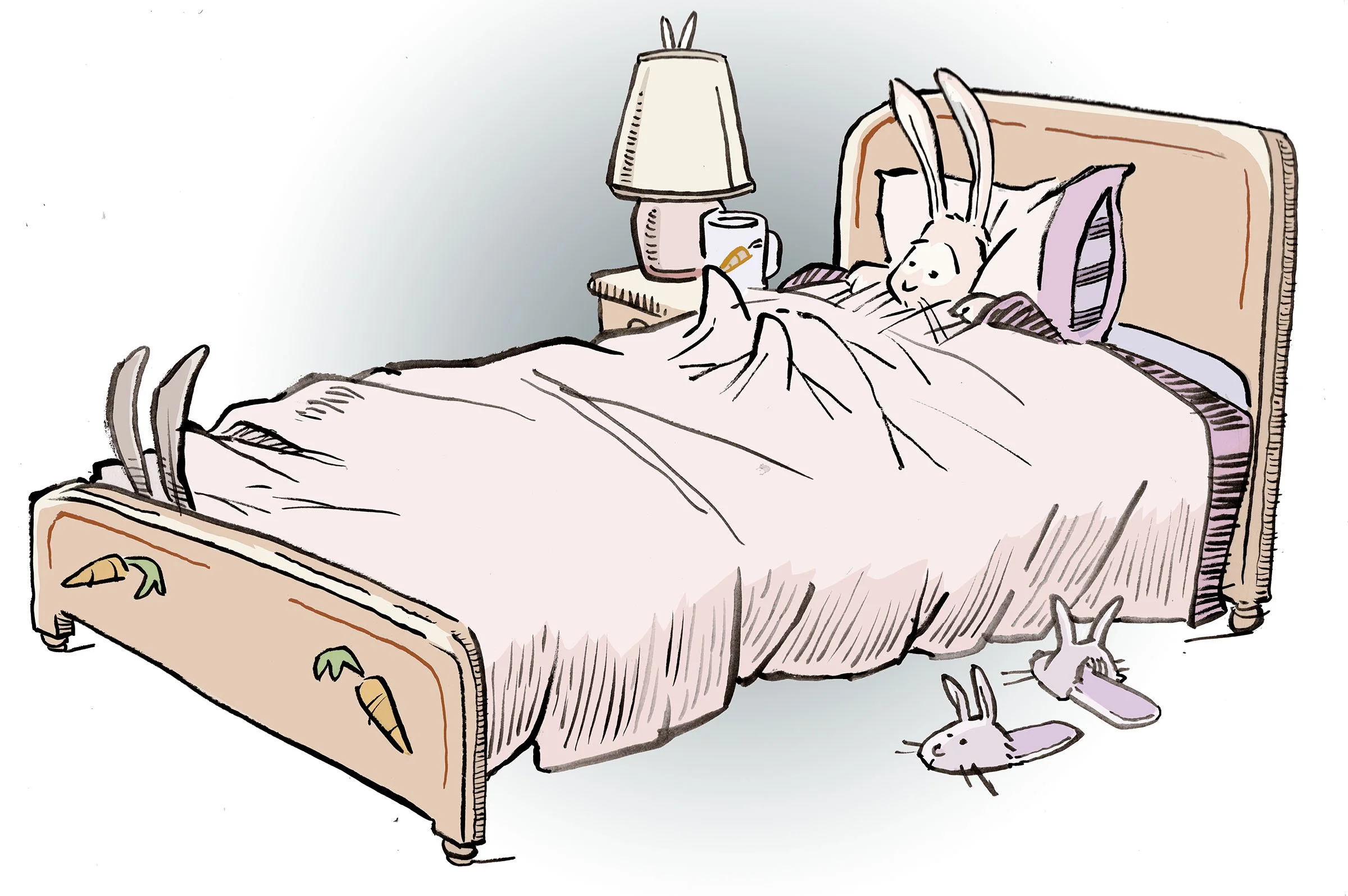
Illustration by John Klossner
I was about six the first time I read Bunnicula, a children’s story by Deborah and James Howe. It was a mystery book that centered around a bunny that the family cat was suspicious of. Each scene of that silent, white rabbit, with unusually sharp fangs made me more and more unsettled. By the time I was supposed to go to bed, I was convinced that this vampire-like bunny was going to hop into my room and suck me dry the same way it drained all those fruits and vegetables.
I crept up to my mom’s room that night—no doubt terrifying her in turn as I stood at her bedside and waited for her to wake up – needing her to protect me from the vampire rabbit.
That’s all to say, when I first watched Donnie Darko, it made sense that the terror in that film was a humanoid rabbit creature named Frank. It was like the spiritual successor to Bunnicula. But as I’ve continued to watch more horror movies, including Us, Caveat, Oddity, and Hokum, with terrifying rabbit and rabbit-adjacent creatures, even I, with my childhood fear of Bunnicula, am left with a nagging question: why is everyone else so afraid of rabbits?
There are a host of other animals with clearer ties to horror. Bats and rats have their connection to infectious diseases, like rabies and the bubonic plague. Black dogs are seen as supernatural, demonic hellhounds, while black cats are both familiars to witches and an omen of bad luck. Goats became a symbol of satan in the 19th century, developing strong ties to the occult and devil worship. Crows, especially near a church or graveyard, are often symbols of grief, while owls have become associated with witchcraft and misfortune.
The zoo of horror animals is quite crowded with the things that go bump in the night, even without considering more monstrous creatures like werewolves. Rabbits, though, are not a traditional creature of bad luck, witchcraft, or devil worship. So how did this cuddly creature get mixed up with the likes of bats, rats, cats, and goats?
The Rabbit Gone Bad
Part of their fear no doubt comes from the role reversal of what rabbits are typically associated with. Rabbits are sweet, harmless creatures that we often see in kids’ books, like Peter Rabbit. Turning them into terrifying monsters, or using them in a horror movie, is a perversion of what we expect from them. It’s another iteration of the long-running horror trope of the innocent gone bad.
Perhaps Jordan Peele, the director of Us, which has an iconic shot of a wall of caged rabbits, says it best: “Rabbits they're supposed to be cute. On paper, they're adorable, lovable rabbits. Have you ever gotten close to a rabbit? You can tell in their eyes that they have a sociopath. If you put a rabbit brain in a human body, you have Michael Myers. They have no empathy.”
This play on rabbits actually isn’t isolated to horror alone. We’ve seen it used in comedy too, notably in Monty Python Cure of the Holy Grail. Now, as someone who read Bunnicula, I was already suspicious of that white rabbit the traveling knights come upon. But even I was shocked at the sheer level of violence that rabbit enacts on the knights as it eats their faces off with a shocking swiftness.
“Look, that rabbit’s got a vicious streak a mile wide. It’s a killer,” the knights are warned as they spot the bunny guarding the cave. “Get stuffed,” they respond, right before they get beheaded and torn apart by the rabbit.
While this scene is hilarious in Monty Python, the sight of that white rabbit’s fur covered in blood is a perfect symbol of how this creature came to be used in horror movies. You can’t possibly believe a rabbit could be capable of this, and yet, it is that unnatural capability that makes the rabbit so terrifying.
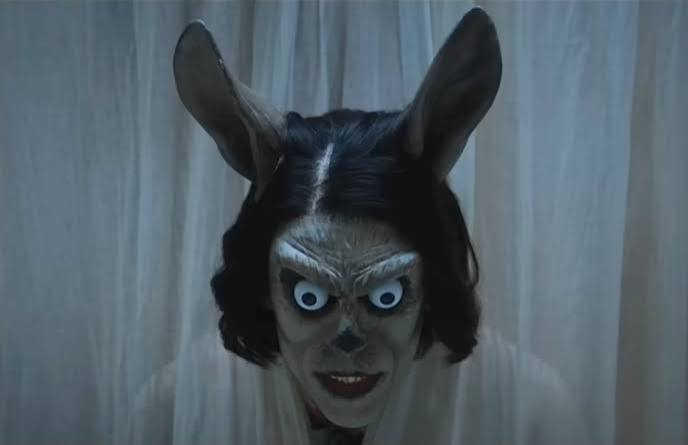
So, when rabbits are made less, well, rabbit-y, taking on demented eyes or bizarre faces, that generically creepy thing has this underlying discomfort. It’s not just that it’s a terrifying mask or a demented smile; it’s the fact that it’s a rabbit, something that’s supposed to symbolize spring and happiness and rebirth, that’s taken on this twisted effect that’s so much scarier.
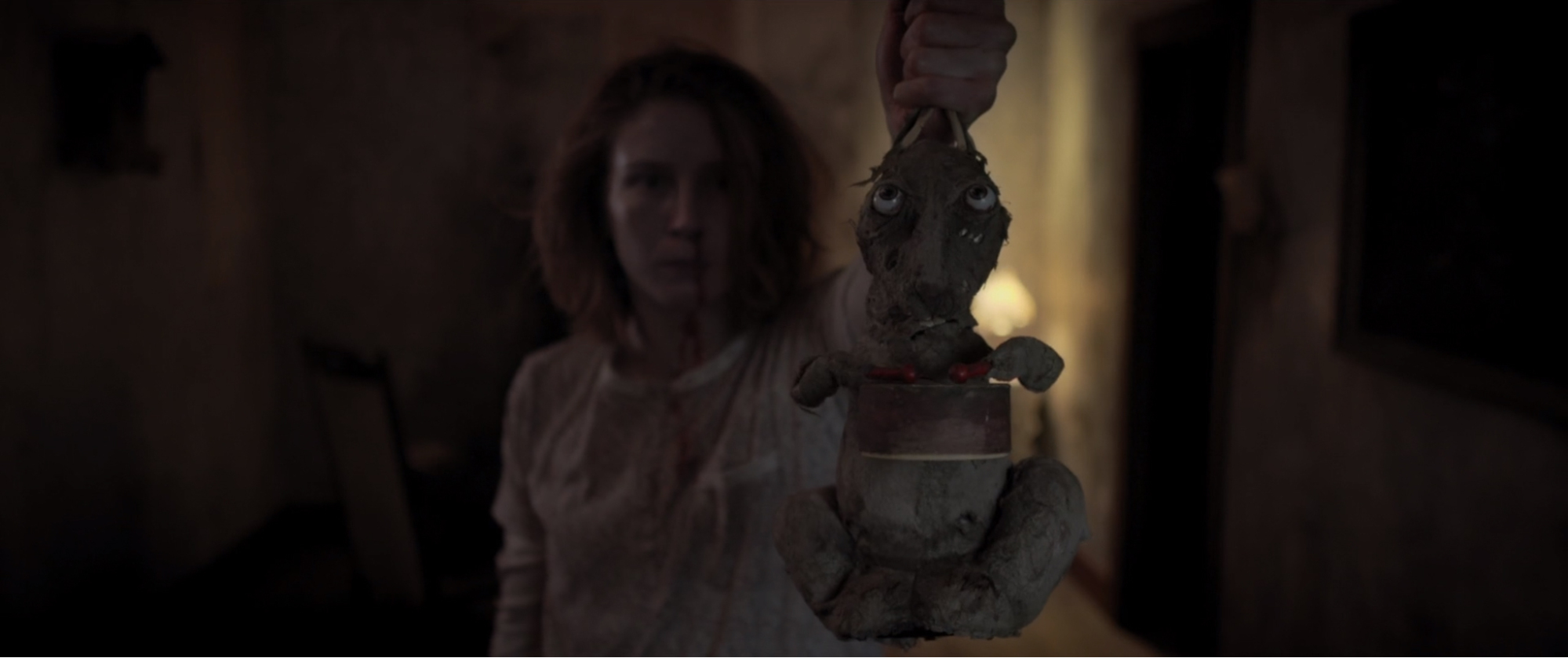
For Damian McCarthy, director of Hokum, Caveat, and Oddity, that’s what makes his rabbits so haunting. McCarthy, in a similar fashion to my own nightmares with Bunnicula, attributes his fear of rabbits to Watership Down, a novel and movie he saw as a kid about displaced rabbits who go to war.
Watership Down also plays on the supposed innocence of the rabbit gone wrong. The terror and trauma of war in this story is made clearer through the symbolism of sending rabbits to battle – once harmless creatures are made into killers. If the rabbits can do such horrific things to each other, what are the rest of us capable of?
As McCarthy brings to life these monstrous rabbit creatures and fills his films with creepy, old rabbit dolls, he is layering his films with an unsettling unease. You know there is something twisted at work as his characters are haunted by memories and trauma that turn something innocent into something killer.
Run Rabbit, Run
More than just innocent, rabbits are also prey. We don’t just expect them to be harmless; we also expect them to die. In this way, rabbits become both a symbol of the destruction of innocence in movies and a symbol of how people become prey once the killer sets their sights on them. The scream queens, final girls, and cannon fodder of horror movies become akin to a rabbit bolting through the woods trying to avoid the hunter and the snare. You know it’s a futile effort.
Take a movie like The Blair Witch Project or The Texas Chainsaw Massacre. Here, we watch as protagonists literally run through the woods trying to escape a predator that’s chasing after them. In some cases, like The Texas Chainsaw Massacre, the risk of death also involves being eaten, just like a rabbit gets turned into dinner.
Even when people are hiding in horror movies, instead of frantically running away, they take on the mannerisms of rabbits. When we picture a rabbit, we picture its twitching nose and big ears craning to hear the sounds of danger. In horror movies, when people are hiding, they sniffle and fidget and cry, trying to hear if the killer has found them, acting like a cornered rabbit. If only they could have the accompanying long ears to hear the killer creeping up behind them better.
In some movies, this connection between vulnerability and rabbits is pushed further, often through repeating motifs in songs or camera shots.
For example, in Peele’s first major horror movie, Get Out, he uses the song “Run Rabbit, Run” in the beginning and end of his film. Peele is literally calling his characters a rabbit with this song choice, as they are ensnared by a white community set on stealing their bodies from them. In the same way a rabbit can get lured into a trap, these victims are lured in by their white girlfriends, only realizing the danger once it’s too late. All they can do when they feel the snare tighten is run, rabbit, run.
Down the Rabbit Hole
Innocence prey, the symbolism behind rabbits doesn't just end there. The White Rabbit in Alice in Wonderland ties them to an experience where someone enters a new world, giving us the phrase “down the rabbit hole.” Their quick reproductive cycles often lend to symbolism around rebirth or hypersexuality – more crudely put, “fucking like bunnies.” And their use in science and animal testing has connected them to experimentation, a concept that can be pushed to the extreme in horror movies.
Without predetermined ties to horror and the supernatural, rabbits become a multipurpose animal, antithetical to other horror creatures that have preset symbolism. When a director adds an animal like a goat, it’s unavoidable that the audience will see it and think about satan and devil worship. While it can be a powerful creature in a film, like its usage in the VVitch, it can also be limiting. You can’t have the goat and not talk about satan in a film, even if that’s not what the director intends.
Rabbits, on the other hand, can be used in a smorgasbord of ways, and their meaning can become far more film-dependent, rather than relying on centuries of mythology and folklore.
The rabbit can be the corruption of innocence in Hokum, as Adam Scott’s character is tormented by something horrible he did as a kid. It can be a depiction of prey creatures in Get Out while symbolizing rebirth and a twisted Easter where things come back alive in Us. And it can be a nod to the fact that Donnie Darko has “gone down the rabbit hole,” and has ended up in a world far different from his own.
The little bunny rabbit is a tour de force of metaphor and allegory, creeping into horror movies and terrifying the living daylights out of us. It’s no wonder horror directors feel drawn to such a creature in their films.
Or as Damian McCarthy says, “Those rabbits keep seeming to find their way into the movie.”