Meat Eating Maniacs: Power, Masculinity, and the Domination of Women and Animals
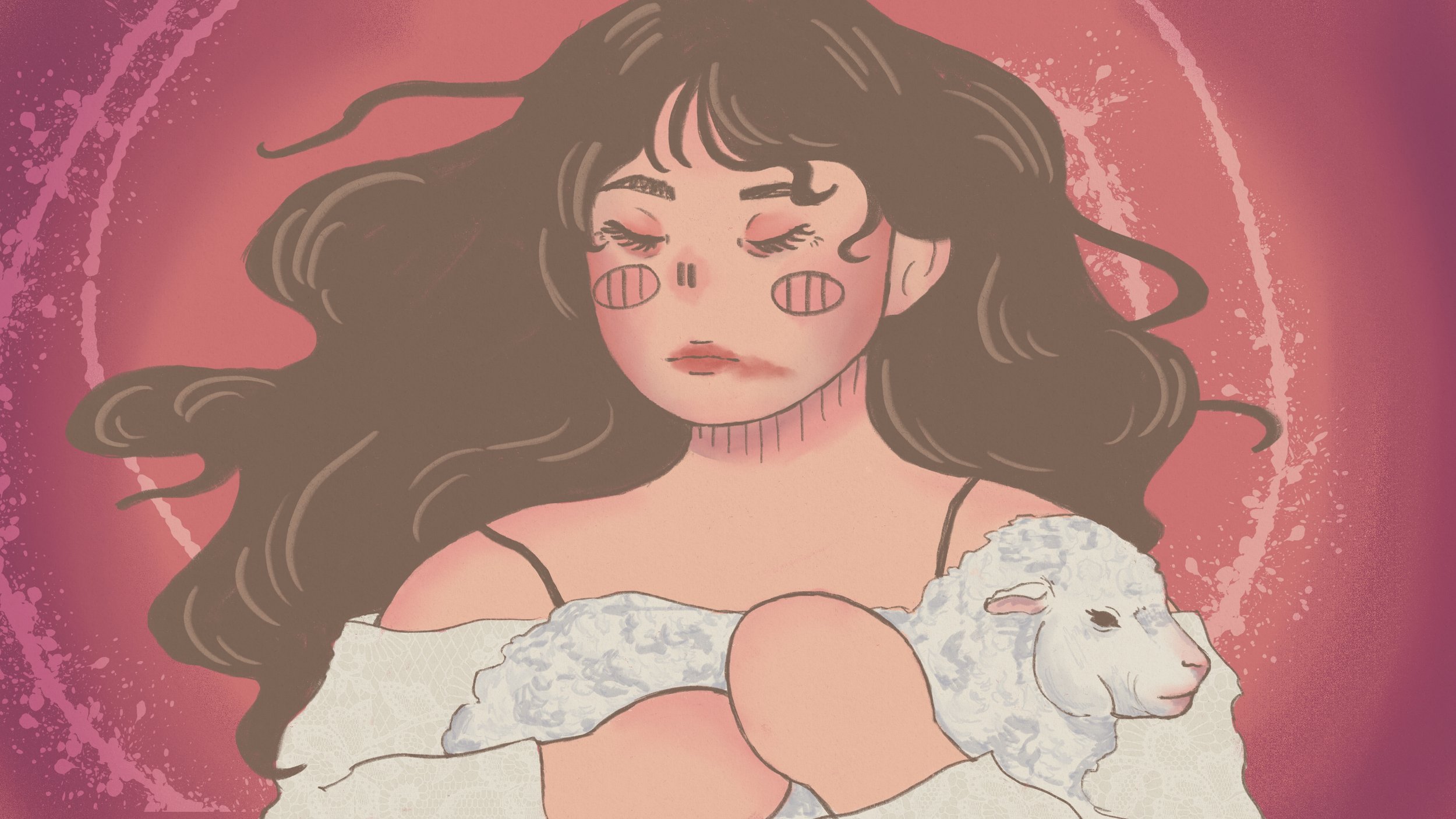
Illustrated by Geliza Paunan
A deep dive of Carol J. Adams The Sexual Politics of Meat and artists that explore the interconnectedness of human and animal life
Carol J. Adams released The Sexual Politics of Meat in 1990, but it wasn’t until early 2026 that I indulged in her theories. A college professor had recommended I read it because my senior thesis had similar themes; however, I did not expect this book to work its way into every part of my life to come after. Every page of my book is lined with tabs and sticky notes, smeared black and red pen working its way through each paragraph. This feminist-vegan critical theory book changed the way I view women and animals, but it also had me searching for artists that share the same passion as Adams.
The most important term referenced in The Sexual Politics of Meat is Absent Referent. Animals in name and body are made absent as animals for meat to exist. The absent referent permits us to forget about the animal as an independent entity; it also enables us to resist efforts to make animals present. The overlap of violence against women and the Absent Referent can be seen within things like pornography, where chains, cattle prods, nooses, dog collars, and ropes are used to reference the control of animals. Women and animal oppression overlap on more than one occasion; Adams emphasizes that, “Women are allied with animals because they too are objects of use and possession. Women’s oppression is expressed through the trope of meat eating.” (Adams, 1990, p. 123).
Shortly after I read The Sexual Politics of Meat, I put together an exhibition pitch that represented an all-female roster, focusing on the theories from Adams. During my search, I came across some incredible contemporary artists who don’t shy away from the macabre, but embrace it and turn it into something beautiful, yet delicate.
Toying the line between exploitation and ethics, New Zealand-based artists Angela Singer and Julia deVille use taxidermy to voice their stance on animal rights. Both women make it known that the animal material used is second-hand, donated, or died from natural causes. While some may say this is negative and goes against what Carol J. Adams preaches, the animals showcased were not harmed for the sake of art, but they are becoming more than a trophy hung inside a shed. The abrasive and vulgar nature of the animals makes their presence known. Angela Singer strips back the botched works of taxidermy, revealing bullet wounds and scars that critique human aggression. She critiques humanity’s complicity in the death and suffering of animals by taking trophy kills and giving them an entirely new life, one where their death can be used as advocacy rather than an ego boost. Julia deVille takes a more fragile approach, blending jewelry and taxidermy. She decorates the animals in precious gems and metals, displaying them on antique “ready-made” items. Her work references Victorian practices of preserving nature and history, admiring the preciousness of life, while also criticizing our desensitized views of morality. Singer and deVille take the lives of animals and render them visible, pointing out the flaws of humanity through the deconstruction of botched taxidermy and admiring the fragility of life with delicate jewelry.
Following Adams theories, the interconnectedness between animals and women cannot be ignored. Kiki Smith and Marlene Dumas challenge our views of femininity through visceral sculptures, erotic paintings, and violent truths about womanhood. Smith’s early work explored reproduction, decay, and morality at a time when abortion was coming to the political foreground. The sculpture Tale (1992) is an acute representation of vulnerability. She exposes an imperfect and raw female body, where it acts as a vessel for trauma, memory, and visceral biology. Smith does not shy away from grotesque subject matter and even finds herself eager to know more about the internal workings of the human body, which she views as our personal baggage carried throughout life. Marlene Dumas utilizes outside imagery to shock the viewer, referencing pornographic images and torture photos. Smith shows what humans hide within the body, and Dumas shows what humans hide behind closed doors. Sexuality and violence create a palpable tension across Dumas’s work. Her painting Dead Girl (2002) is a harrowing portrait depicting the aftermath of a woman who died during an airplane hijacking. Looking at the work creates this suffocating feeling of desolation. Toying with morality and complacency, Dead Girl (2002) desensitizes the viewer to violence. Smith and Dumas work with opposite ends of the female experience, but they both leave nothing unseen, exposing what some try to render invisible.
Most of the contemporary artists I mentioned work from personal experience or values, but it is important to note that previous artists paved the way for female expression. The iconic feminist artist-activist group Guerrilla Girls expose sexism, racism, and corruption within the art world. After the Museum of Modern Art (MoMA) released a survey exhibition featuring 169 artists, with only 13 being women, the group formed and started advocating for other female artists. Their monumental work as advocates has criticized some of the biggest museums in the world, constantly raising the contemporary art world's standards. Currently, Guerrilla Girls still operate, and their work is held in museums across the globe.
The link between women and animals can be traced back all the way to our distant ancestors. Regardless of the time period, gender inequality has been an obstacle, an immovable force that is constantly making its presence known. A doe awaits an inevitable death on a cold October morning, and a woman is denied reproductive care at the hospital she was born in. The odds are unfair, and the weight of disappointment drags like an anchor attached to a leg. Carol J. Adams and all the female artists I mentioned above have found a way to use their knowledge and talent as power. They reprimanded the system that chose how they must go about life, and they found that living things, human or not, can be more connected than we may think. Objectification and violence are shared through lived experiences, women, and animals alike.