Big Moods, Big Ideas, and, Occasionally, Big Mistakes
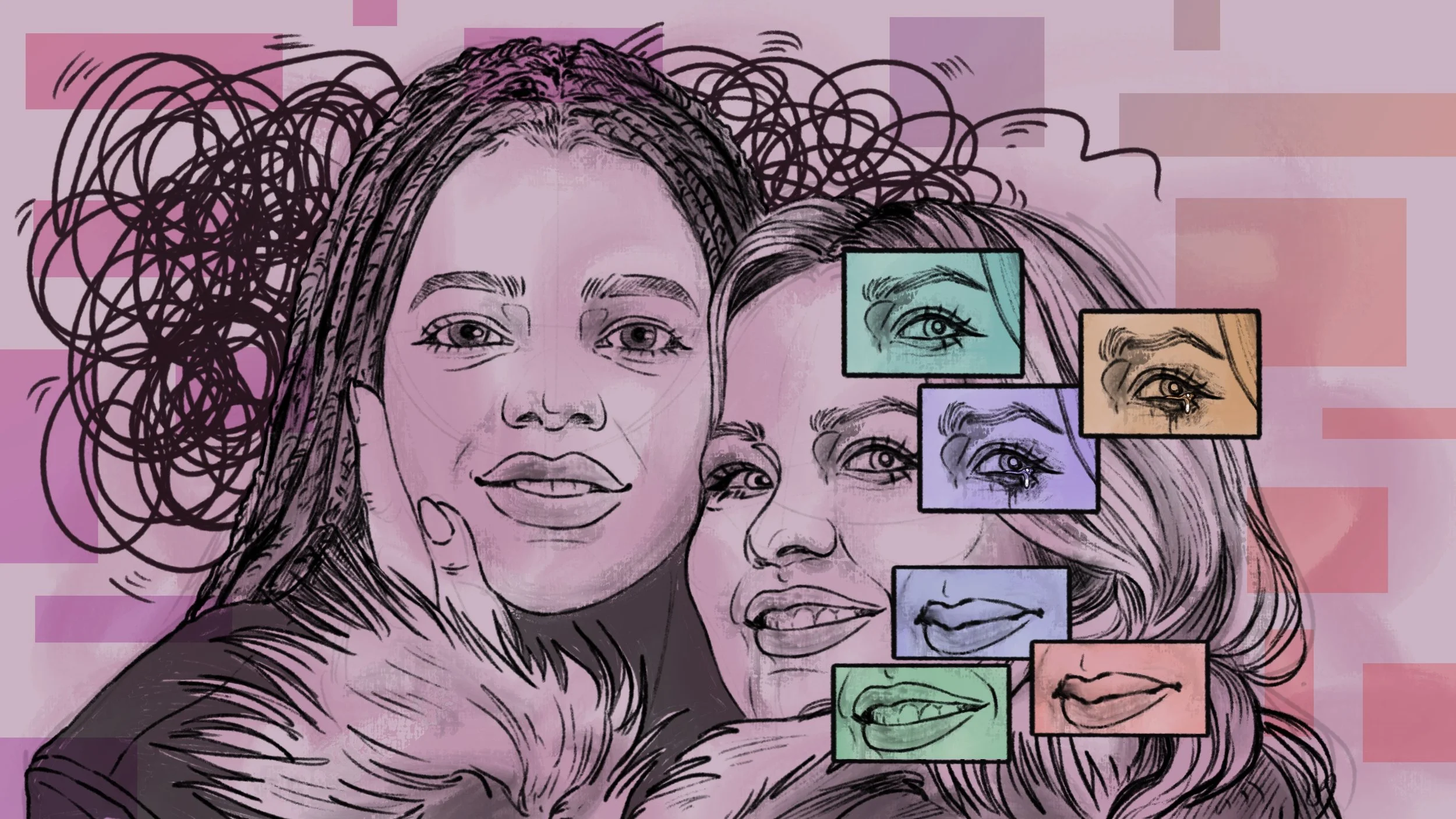
Illustrated by Vlada Popyk
“Friendship is certainly the finest balm for pangs of disappointed love.”
There is something almost charming about Maggie when she is in a “big mood.” She is funny and magnetic, full of ideas that seem brilliant (well, mostly to her) because she is so convinced of them. In the opening scenes, she moves through the world with the kind of confidence that can make recklessness look like spontaneity and impulsivity look like freedom. It is easy to understand why people love her, but past the first episode, it is also easy to understand why loving her can become exhausting.
This friction is what makes Big Mood one of the most interesting portrayals of bipolar disorder I have seen on television. The UK dark comedy follows Maggie (Nicola Coughlan) and her best friend Eddie (Lydia West) as Maggie’s bipolar disorder begins to disrupt their life in East London. The show is ostensibly about female friendship, but its more difficult question is what happens to a friendship when that friendship becomes tested by one’s struggle with mental illness.
Once officially revealed at the end of Season 1, Episode 1, “Up,” Maggie’s bipolar disorder is never treated as a quirky character trait, but neither is it separated from the consequences of her behavior. When she eventually stops taking lithium, believing the medication is interfering with her work as a playwright and, ultimately, her personality as a whole, stability begins to feel like a trade-off. For Maggie, being well can feel like being less of herself, as her more restrained self also feels less creatively charged. And for a while, the people around her can mistake that unmedicated intensity for exactly what makes Maggie…well, Maggie.
That is part of what Big Mood gets right about mania: her heightened experience doesn’t stay hers alone. The same energy that makes Maggie exciting can make her extremely reckless, and the confidence that makes her magnetic can become destructive when nothing is slowing her down. Decisions that might initially seem funny or just a tad bizarre in isolation start damaging her career, finances, friendships, and romantic relationships. It’s fascinating how Big Mood gradually redirects the audience’s attention from what Maggie is experiencing to what everyone else has to live with.
And Eddie has been living with it for a longgg time.
Their 10-year friendship has the intimacy of a marriage without the formal boundaries that might force either woman to acknowledge how much labor is involved. Eddie knows Maggie’s moods and repeatedly tries to keep her grounded. But in doing so, she becomes the only reliable person Maggie can lean on when things fall apart, while also trying to maintain some semblance of her own life. The longer Maggie is unstable, the more Eddie’s own needs disappear into managing someone else’s.
There is no easy answer because Eddie’s loyalty isn’t foolish, and she isn’t simply tolerating Maggie out of obligation; she loves her. Their friendship is real and deeply rooted — and as you can see, Maggie genuinely needs her. But that need creates its own burden. Big Mood shows that love doesn't make the consequences of illness disappear. Eddie can understand why Maggie is behaving the way she is and still become exhausted by having to deal with the aftermath. The more Maggie struggles, the more Eddie has to decide how much of herself she is willing to give up in order to keep the friendship intact.
And the strain doesn’t stop with Eddie. It follows Maggie into other relationships she tries to navigate while unstable, even if romance is never as central to her story as her friendship with Eddie. Her interest in her old boyfriend resurfaces while she is manic, and even her more casual romantic encounters (the old high school teacher and the random guy from the dating app…yuck) tend to happen around the same heightened periods. But rather than giving Maggie a sprawling romantic life, Big Mood uses these moments to show how mania can alter what—and who—feels desirable. Her romantic impulses, which tend to lead her to questionable characters at her worst, are swept up in the same momentum that carries the rest of her life.
None of this makes Maggie easy to characterize: the show refuses to make her either a villain or a helpless victim. She is sick, but she is also a human who makes human mistakes. Bipolar disorder is, though deeply misunderstood, profoundly human.
That makes Maggie more complicated than the familiar television versions of mental illness, where a diagnosis often becomes either the source of tragedy or an explanation for eccentricity. Big Mood is more uncomfortable than either. Maggie can be hilarious and cringy in the same episode. She can be someone the audience roots for while also being someone another character desperately needs distance from. The comedy gives her a personality beyond her diagnosis, while the consequences keep that personality from becoming an excuse.
Production seems to have been conscious of that balance. Director Rebecca Asher has discussed the responsibility involved in depicting bipolar disorder, particularly the danger of making mania superficial simply because the series is a comedy. The effort makes sense for a show that wants to find humor in Maggie without making her illness the punchline.
Season 2 shifts the story in an interesting direction because Maggie is in a more stable place—leaving her to deal with what happened when she wasn’t. Coughlan has described Maggie’s struggle to change her friends’ perceptions of her as a major part of the season. As one of the show’s most mature insights, stability may change Maggie’s circumstances, but it cannot immediately change everyone else’s memory of what they endured.
This shift is particularly true for Eddie. Maggie can move forward while Eddie still remembers the version of their friendship that required her to not only brace for the next crisis, but feel abandoned during one of her own. Forgiveness doesn’t necessarily restore the relationship to its previous shape, and understanding doesn’t require forgetting. Even after the immediate fallout (and Eddie's year-long life dilemma) has passed, both women still have to figure out what their friendship can look like now.
As it progresses, Big Mood becomes more about the limits of intimacy. There is a social expectation that loving someone means accommodating them by any means necessary, especially when they are struggling. Compassion can mean patience, flexibility, and a willingness to understand the behavior that would otherwise be too difficult to comprehend for the average person. But there comes a point when the person doing the accommodating has to consider what the relationship is asking of them in return, especially if it’s to their own detriment.
Maggie doesn’t become unworthy of love because she has bipolar disorder, and Eddie doesn’t become a bad friend because she eventually reaches her limit. The series leaves enough room for both women to figure out balance: Maggie has to learn to manage her illness and take responsibility for the damage it can cause, Eddie has to figure out how to remain Maggie’s friend without making herself responsible for keeping Maggie together, and both have to respect each other's limits and learn not to be too codependent.
One of the biggest lessons from this show is that loving someone through their worst moments doesn’t guarantee that the relationship will be unchanged. Sometimes the person you are trying to help has to learn how to live with their illness, while the people around them have to learn where their own responsibility ends. b finds its richest material in that uncomfortable space, where affection survives alongside frustration, accountability, and the memory of things that cannot simply be undone.