It’s Alive! How International Horror Movies Are Brought Back to Life for the American Audience
Illustrated by Geliza Paunan
What’s more classic to the horror movie genre than scream queens, final girls, calls coming from inside the house, or bloody murders? Remaking all of them.
No other film genre sees such blatant repetition as horror. Classic, popular horror monsters get pulled like taffy and stretched across prequels, sequels, remakes, reboots, and reimaginings with little regard to canon or past lore. While this fad is never-ending in horror, the early 2000s saw the biggest boom in horror movie remakes. It defined the genre, calling into question where the horror genre in America was headed and what was going to sustain it.
Remakes are always controversial. Some people love them. What’s better than getting to see your favorite film remade again and again? But diehard horror fans, and even some casuals, often dismiss them as greedy cash grabs by Hollywood executives that rely on a cloying nostalgia to get people to buy tickets, or worse, treat them as the death of creativity in the horror genre.
What I find most interesting about horror movie remakes, though, isn’t the things that stay the same that directors and studio execs prey upon to reinvigorate their audience. Instead, the most interesting thing about a horror movie remake is what changes.
As horror movies are remade, rebooted, and reimagined with decades between the original and the new model, the film changes to mark the same passage of time. We aren’t afraid of the same things in 2026 as we were in 1976. The fears of our parents and grandparents are rewritten to fit our modern sensibilities.
Sometimes, though, the difference between the remake and the original isn’t the passage of time, but the span of distance. In the boom of remakes in the 2000s, a common tactic was to remake a popular international horror film and bring it “home” to an American audience. Movies from quite literally across the world were rewritten and recast with Americans within two or three years of the original, leaving almost no breathing room between them. The things that changed in these films were not a product of time between the original and the remake, but the difference in countries and audiences. Even films that were almost completely identical had the smallest alterations to fit an American writer and viewer.
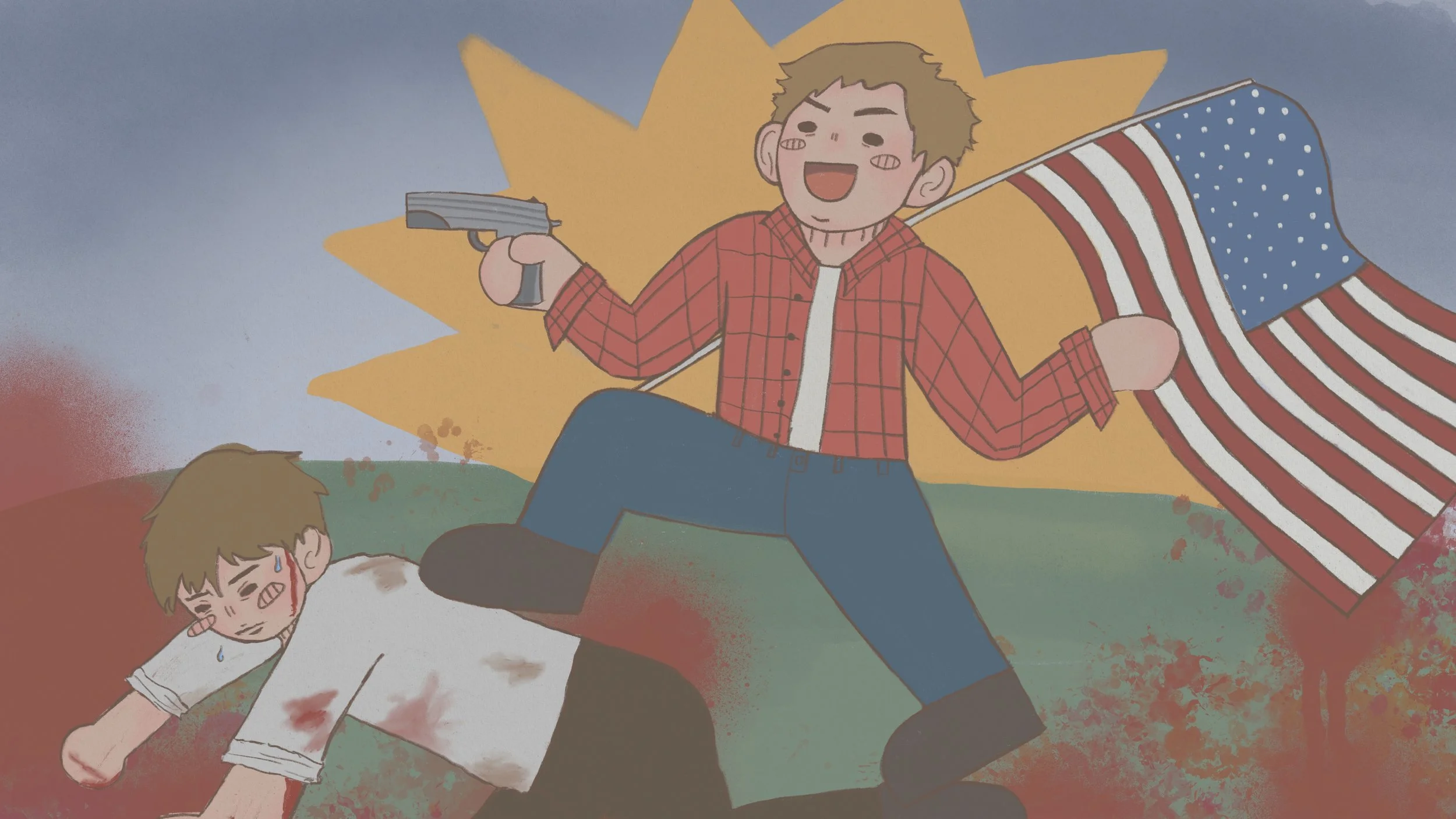
In the broadest strokes, American remakes of international horror like to do one main thing: give people agency. Bleak, international horror films were rewritten into heroic attempts at survival, making helpless victims into determined heroes. With this fundamental change, American remakes are often simultaneously bloodier, gorier, and grosser, while also being far more hopeful than their original counterparts.
The Hero (Who Carries a Mighty Gun)
Watching international art house films that are usually sadder than they are scary, I am struck with the incessant knowledge that in the American remake, all of these people would probably have a gun. And it is stunning how often that thought turns out to be correct.
The gun, though, is a symptom of a larger trend, which is that American remakes don’t like to center on a protagonist that has no control over what’s happening to them. These films rebuff the idea that a person could accept their fate and, instead, give the main character a fighting attempt at survival. In a country that is plagued by the myth of a "good guy with a gun" who can swoop in and save the day, American remakes often use the gun as a shorthand way to give power back to the protagonist to try to save themselves.
When that attempt at survival is successful, you get a remake like Speak No Evil.
The original Speak No Evil is an unrelentingly depressing movie that functions as a sort of satire of Danish cultural norms. In the film, a Danish family meets a Dutch family on vacation, and when they are invited by the Dutch family to visit their home in the Netherlands, they decide to go. That visit ultimately proves fatal. As the Dutch family becomes more and more bizarre, the Danish family refuses to leave, trapped by social norms and niceties. In the end, their child is kidnapped and her tongue cut out, while the parents are stoned to death in a quarry.
It’s that type of movie that leaves you sitting in silence as the end credits roll, wondering what in the hell you just watched.
The American remake, on the other hand, spits on the idea of an unavoidably dismal ending. Instead, the ending is an utter romp as the endangered American family gets their hands on weapons, including guns, and fights to stay alive. Gunfights, booby traps, and trickery get them all out alive and well, including the original kidnapped child the evil family used to lure them in. It could not be any further removed from the ending of the Danish original.
These types of remakes play on the American idea of pulling yourself up by your bootstraps. No matter what situation you wind up in, the prevailing idea to American audiences is that you can escape. And if you have a gun to shoot the family that’s keeping you hostage, all the better.
In other remakes, the idea of agency and heroes is used to emphasize the horror of the movie.
Take a movie like Martyrs. In the French original, the film is stomach-churning in its horror as it follows a cult that tortures people to turn them into martyrs, hoping that they can see what’s beyond the veil of death. Lucie, who escaped the group, is trying to take revenge on the people who tortured her, but her friend Anna gets caught up in the plot. After Lucie slits her own throat to kill herself, Anna is subsequently caught by the group and turned into a martyr. The last nearly hour of the film depicts Anna being methodically tortured until she fully relents to the pain. After she submits, she is skinned alive, the film ending on her dazed expression.
In the American remake, this entire plot is reversed. Here, it is Lucie who ends up tortured and skinned, with the skinning coming without her full submission. It’s also a far bloodier affair. In the French film, the camera only focuses on Anna’s face as she’s skinned. In the American remake, we watch in extreme detail as the knife cuts into Lucie’s back and blood gushes out of her as her skin is slowly pulled away.
However, even if this scene is bloodier, it’s far more hopeful. In the American remake, Lucie isn’t alone. American-Anna survives being buried alive and frees herself. She then races back to save American-Lucie, freeing other potential martyrs and, notably, arming herself with a gun. While neither of the American characters survives, their deaths are far, far less depressing. American-Anna is injured on her way to save American-Lucie, but before she dies, she shoots and kills all the cult members and pulls American-Lucie down from the cross she’s being skinned on. The two women die in each other’s arms, a merciful death compared to the French original, as French-Lucie is still alive, alone, and missing every inch of her skin.
By giving characters agency and allowing them to be heroes, American remakes can be both happier because the protagonist has a chance to live and simultaneously grosser. Bloody, violent scenes in American remakes are diluted by the hope the viewer has. The terror can be bigger, badder, and grosser, but the movie balances that out by helping the characters fight it. In contrast, when a movie has no hope or agency, the bleakness competes with the terror and blood factor.
It’s the difference between screaming your head off on a fun roller coaster versus standing outside in a dark field, knowing you aren’t alone.
The Ambiguous Made Unambigious
In addition to giving the main character a gun and telling them to shoot their way out of a situation, the other way American films like to give people agency is by explaining everyone’s background. In this way, even if people are unable to save themselves, we at least know why. American remakes don’t like the horror to be ambiguous if the protagonist can’t escape the situation; they want to know in excruciating detail why this is happening to them.
There ard many examples of this in American remakes, but let’s take a classic example: The Ring.
The original Ring was a Japanese film that came out in 1998 about a cursed videotape that kills its viewers within seven days. The movie plays out a bit like a mystery: after a young girl is killed, her aunt tries to figure out what caused her terrifying death. She ends up putting herself, her ex-husband, and their child in danger after watching the cursed videotape, turning the movie into a race against time to save everyone.
The American remake came out four years later in 2002. Beat by beat, the movies are nearly identical – a dead niece, an aunt employing her ex-husband for help, a race against the clock. The major difference in the films is in the tape and the explanation of the curse.
Both videotapes are creepy, but the American version is filled with explicit body horror, while the original, Japanese version is much more subtle in its horror. The original has clips of people crawling in reverse and a man standing with a white towel over his head. There’s the suggestion of something terrible happening without actually seeing what that terrible thing is. In the American remake, the video is much more gory. A finger is pierced through with a nail, writhing maggots become writhing bodies, dismembered fingers twitch in a box, and a woman jumps to her death. What was subtle insanity in the original becomes a much clearer, grosser story in the remake.
That change is also reflected in the explanation of the two videotapes. In the original, little explanation is given beyond the fact that the curse was caused by the rage of a psychic child who was buried in a well by the doctor researching her. In the American remake, a LOT of explanation is given. Every single image in the video tape is reviewed, discovered, and explicitly explained by the aunt who’s on the case, and there is extensive background given to the woman in the video and the psychic child that creates the curse. Absolutely nothing is left up for debate.
If characters in horror movies are at the mercy of dark forces, American horror remakes ask the simple question: why? Why these people? Why this curse? Why this death? They can’t cope with the answer being that the loss of agency just happens. They crave an explanation to an obsessive degree.
Horror movies reflect the culture and context they’re made in. When remakes boomed in the early 2000s with an emphasis on agency and clear-cut characters backed by hours of explanation, they came in a period marked by 9/11 and American military invasions. Terrence McSweeney, a leading writer in American cinema, wrote that they “contended with the shadow of 9/11.” Their obsession with explanation paralleled the national desire to find out why such a horrible thing happened after 9/11. The lack of ambiguity paralleled the political desire for everything that came next to be seen as a battle of good versus evil, with Americans firmly on the side of good.
It’s the type of political climate that led to The Strangers, an American film, being lauded as having one of the most terrifying lines in any horror movie. When asked why the strangers were attacking the newly wed couple the answer was simply, “because you were home.” What could be scarier than terror with no justification?
The Remake Lives On
Horror movie remakes are the monster that will never die. They are the zombie clawing at the grave and the body continuously reanimated. As time moves on the reason behind remakes will change. What was a boom in the 2000s to give characters agency and explanation will shift as American culture changes.
Arguably, we’ve already seen that with Suspiria.
The Italian original was made in 1977, but the American remake wasn’t released until 2018, coming much later than the early 2000s boom. In this remake, many of the usual hallmarks of remakes are followed: Characters are given far more agency and many things are given far more explanation.
Both films center on a dance school and its newest student, Susie, and the other dancer she befriends, Sara. As the movie progresses, we discover that a coven of witches runs the school and is enacting evil. Besides these main plotpoints, the two movies differ vastly. In the original, Susie is more or less clueless to what is happening, and while Sara tries to figure it out, she’s mostly focused on saving herself. The witches also remain a bit of a mystery. In the American remake, we learn a lot about the witches, including their hierarchy and motives. Sara also actively tries to save one of her classmates who has gone missing, trying to be the hero all while putting herself in grave danger. And in the final climax of cult-terror, the biggest change is that we discover that Susie is in fact the undercover mother of the witch coven and murders many of the witches who originally spoke against her.
In a complete divorce from early 2000s remakes, the agency and explanation in this film isn’t to create a hero, it’s to create a villain. Explanation and backstory don’t create black-and-white, good-versus-evil characters; they muddy the water with Susie’s massacre.
I don’t presume to know what next international horror movie will be remade. But it stands to figure that as time moves us further from the early 2000s, the meaning behind these remakes will change along with us. In Suspiria, the change ended with us finding something terrifying in what was supposedly an innocent young girl. Ten, twenty, fifty years down the line, I wonder what will be the next monster hiding in the American remake’s closet.