My Semi-Analog Week
Illustrated by Heather Han
In the spring, while writing about the influence of multitasking on content production, I stumbled across a horrific little study. Meant to explore the neural processes associated with media multitasking, the study observed that individuals who tend to spend more time consuming multiple forms of media simultaneously often have “smaller gray matter density.”
I won’t pretend to understand much of the study or the effects of gray matter density variation, but that line has been clanging around my head ever since. I can be flipping between tabs on my laptop, pausing in an article I’m reading to check Instagram, listening to a podcast while scrolling through emails—and there it is again, a mosquito’s buzz at my ear: smaller gray matter density.
And I have been harboring suspicions that my digital media intake habits have been having adverse effects on my cognition. Since college, my ability to focus for extended periods has shriveled. I’m constantly distracted by a din of disordered questions—What is our high school quarterback up to now? How many calories were in that ice cream sandwich I ate yesterday? Was Don DeLillo hot in his twenties? Technology (and the near-universal internet access it affords me) has removed all friction between the rise of these intrusive quandaries and the opportunity to pursue them, and my resolve is weakening; the ruts leading down that old road of internet rabbit holes are so jagged and tall that, once I’m veering, it’s nearly impossible to reverse course.
There’s more. I rarely make it halfway through reading an article before being assailed by the desire—no, compulsion—to start another one. In my dependence on the online Merriam-Webster thesaurus—which is always open on my laptop—my ability to come up with synonyms on the fly has atrophied. The prospect of making a decision, even one as minor as choosing which online publication to peruse, looms insurmountable.
My life is commanded by an anxiety that I’m doing the wrong thing at the wrong time and also that I’m never doing enough. I blame tech.
Or, to be more fair, I blame my bad digital media habits—always having my phone next to my laptop, interrupting reading sessions with Google searches, keeping a million tabs open at all times, leaving social media apps running in the background and treating their notifications with a degree of deference that really ought to be reserved for the humans I love.
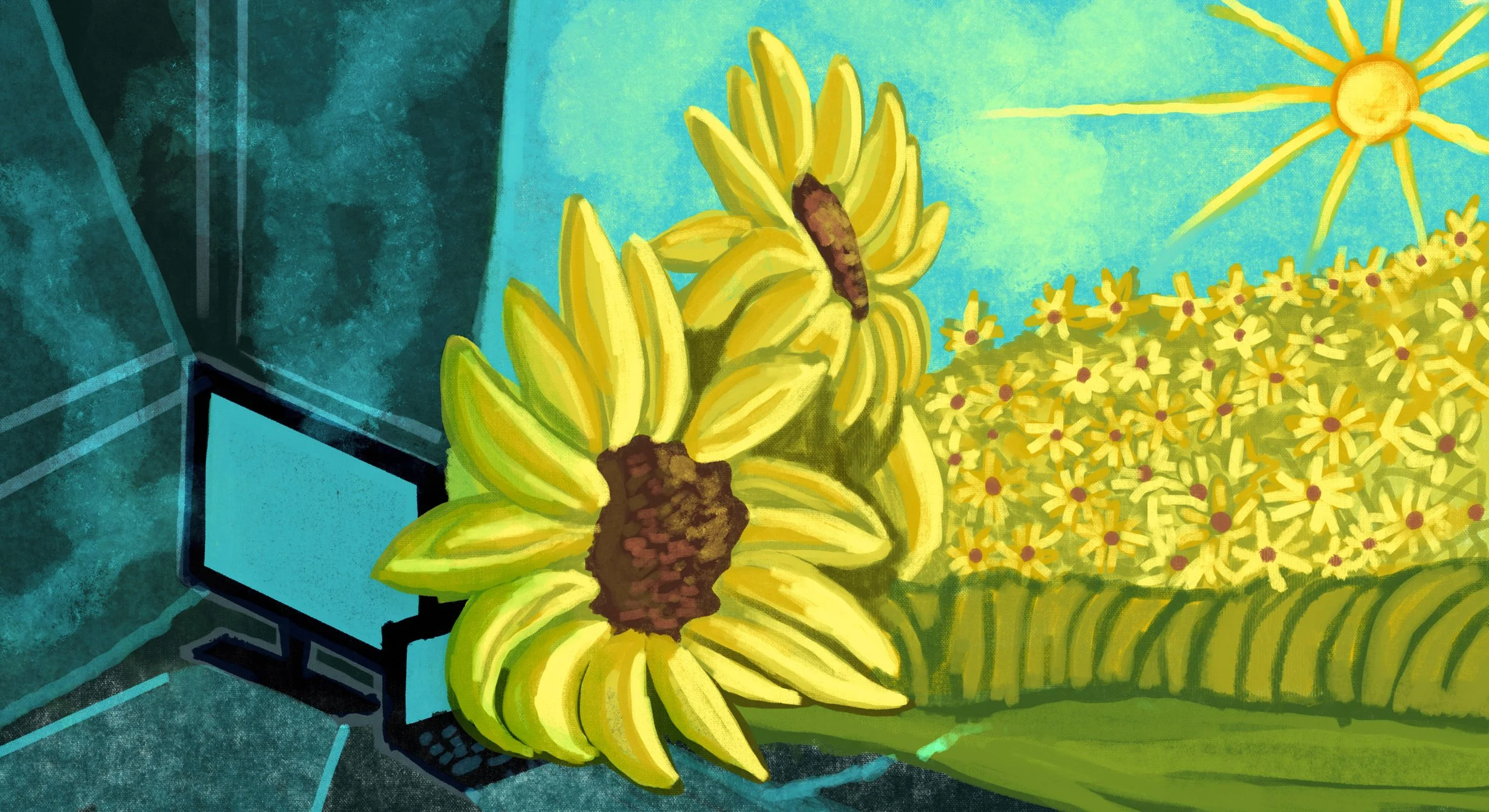
The solution bloomed, all sunflowers and bliss: I’d go analog! And I’d write a damn good essay about the process. How easy, how clean: I’d simply quit tech and all the sickening trappings of a digital existence.
I imagined a week of books and vinyl. I’d be a free soul. Immersed in the honest labor of physical discovery, I’d come to appreciate art in a whole new way. I’d unlock parts of my brain blocked since childhood. Colors would be more vibrant, scents more aromatic. My mental faculties would sharpen. Food would taste richer, orgasms more encompassing.
. . . and then I grabbed my phone. It was time to maintain my Duolingo streak.
Having recently moved to a new city and country to start grad school, I’ve been extra reliant on my phone lately, using it to plot routes, find events, and keep in touch with friends. My inbox is constantly clogging with emails from my department, my bank, my phone provider, my job, my mom—and they all demand responses.
The New York Times app pulsed with breaking news updates. This might not be so easy.
While I’d love a reprieve from the digital world, I also love affording rent and food and being able to interact with my loved ones and read the news. A full digital blackout would not be an option.
Okay. Back to the drawing board. “Semi-analog” had a nice ring to it.
First, a note on diction
To come up with the mechanics of the experiment, I’d have to come up with a working definition of semi-analog, which meant a quick etymological foray into the word “analog” and subsequently, a discovery that I’ve been, uh, misusing it.
Writing in Fortune, Luba Kassova identifies Gen Z’s proclivity for analog as “an act of defiance in the face of the formless digital world and a cry for respite from the enormous noise perpetuated by the 24/7 social media cycle.”
In tandem with (or more accurately, as one of) Kassova’s Zoomers, I tend to behold the phrase “analog” as a catch-all for physical media, and thus consider it oppositional to Big Tech and the digital realm it stewards. But the practice of employing “analog” as an antonym to “digital” is based on a misunderstanding. It’s absolutely true that digital technology is not analog technology (as any audiophile will tell you). “Digital” serves to describe any technology that stores and reproduces data through solid values (digits). “Analog,” meanwhile, refers to an alternate means of capturing and storing information through “analogous” physical quantities. Both terms refer to means of technological reproduction, but there are plenty of other means of producing physical media (say, through a printing press, film camera, or loom) that aren’t analog.
“Plenty of older (and current) technologies are analog,” Rob Loukotka writes in Fringe Focus, “Just be sure to ask yourself if that device has variable signal/data, or if that device is just really old . . . Sound waves being converted into an electrical signal is analog, a film negative is not.”
The goal of my experiment being to distance myself from digital media, it would have been more appropriate for me to dub this my “semi-anti-digital” week. But, in honor of the transitory nature of language (and my own stubbornness), I decided to stick to “semi-analog.” Sue me.
The rules
In lieu of accurate terminology, I figured that what actually mattered was that I have a set of goals to guide my actions. I wouldn’t be throwing away my smartphone or eschewing the Cloud altogether for my semi-analog week, but I was interested in a partial “break” with many of the offerings (trappings) of Big Tech. The goals were to 1) impose strict limits on my use of digital technology; 2) avoid media multitasking (specifically digital media); and 3) replace digital media with physical (or analog) media as much as possible.
Recognizing that much of my work is dependent upon internet access, I settled on a compromise in homage to my own childhood. Up until high school, when I got my first clunker of a laptop, internet access was limited to the family desktop, which sat in the corner of the living room. Having lived on laptops and smartphones for over a decade now, it’s hard to recall a time when my internet access was limited to specific physical spaces, but for more than half of my life, this was just how it was.
Finding the concept of an “internet corner” rather charming, I figured it was time to return to the 2000s and establish a fixed point in our apartment for all of my online activities. And as we have no desk, my internet hub would be the kitchen table. Here was where my laptop was to live (when I wasn’t in the office or classroom, of course). And as for my smartphone, well, if it wasn’t in physical contact with the tabletop, it would be functionally a dumb phone—used exclusively for calls, texts, and taking photos.
In the interest of avoiding media multitasking (and maybe recovering some of my gray matter), I came up with a couple of simple rules: I could watch TV (but not YouTube), or have my phone open, or use my laptop at the pre-established FTZs (free tech zones), but never at the same time. With audio media, there’d be a little more leeway. I decided that music could be listened to while using other media, but—in a nod to the truly analog—records were to be prioritized. Glancing at our meager record selection, I decided to budge a little and allow digitized music, but only so long as it was in a format also accessible via analog (full albums and E.P.s only—no algorithmically-generated playlists and no podcasts—and never through headphones).
With regard to social media, my initial inclination was to shut it all down. The few social media accounts I have I use almost exclusively through my phone (accepting Discord and Reddit, which I limit to browser use only), and as my phone would be dumb once away from the kitchen table, there’d be very few opportunities even if I were to keep the apps open. I considered my Rolodex of accounts. I’d canceled my Twitter/X years ago and had been too lazy to restart Bluesky after accidentally logging out and forgetting the password in 2024; I’d never joined TikTok, and Facebook’s AI-spangled feed made me nauseous. Really, the only social media that maintains any hold upon my soul is Instagram.
Saturday night, set to begin my flirtation with digital freedom the next morning, I clicked the pink camera icon, indulged the algorithm’s magnetism for a couple of sickening minutes, then hit “uninstall.” Pretty painless.
Of course, there were the more niche, social media-adjacent apps, namely Strava and Duolingo, to consider. While I liked tracking my runs on Strava and considered the occasional “kudos” from old cross-country teammates a nice means of athletic encouragement, I figured I could handle a week away.
Duolingo produced a stronger hesitation. I’m no polyglot. I harbor no delusions that in my daily dates with Lily, Vikram, Eddie and the rest of the Duolingo cast, I’ll achieve anything resembling Spanish proficiency. But still . . . I glanced at my streak: 471 days. I couldn’t just let that fall to the wayside. Sheepishly, I wrote an addendum into my plan: Duolingo was fair game, provided I completed my daily lesson at the kitchen table.
Rules established, I found myself faced with a new question: How to track the process? In a perfect world, I’d journal freely and constantly, taking note of each moment I find myself forced to adjust a habit to fit my new limitations and analyzing my response. But who has time for that (certainly not people who stupidly schedule their semi-analog week so it falls during their first week of grad school)? Also, no one should be forced to read that.
Instead, I settled on a more rudimentary, reflective means of qualitative analysis, stealing from the rose/thorn/bud method. For each day, I’d note my:
Analog rose: a pleasant side effect of the experiment.
Technological thorn: a challenge that arose (or if I flat-out failed and broke my rules).
Existential bud: a daily reflection on the general experience.
Apps uninstalled, kitchen table cleaned, schedule committed to a physical planner, I was ready to roll.
Sunday
Let’s start with the technological thorn: I woke up to notifications on my phone . . . whoops. Sliding my alarm off, I was met with a slew of headlines and personalized notifications from LinkedIn and the New York Times. Clearly I’d failed to take into account how many apps lurked on my phone and what an imposition they’d pose for my new low-tech lifestyle. I silenced the apps, already feeling a little underprepared.
Analog rose: Getting our turntable set up was one of the first things we did upon moving into our new apartment last month, and though my music consumption protocol for the week allowed a little flexibility on listening medium, I was looking forward to the opportunity to really lean into analog and play some records. Instead of doing my morning workout to the drone of YouTube video essays (the standard approach), I flipped through our records for some appropriate background music, settling on Wednesday’s Bleed. Somewhere between the twang of the pedal steel and Karly Hartzman’s angst-tinged lyricism, I found a fuel for crunches and rowboats far more powerful than the slopified video essays to which I typically listen.
Existential bud: I hadn’t realized how integral a role the internet plays in my wakeup ritual. I’m accustomed to gradually coaxing my brain to action with the assistance of low-effort word games and headline scrolling. Not ready to drag myself to the kitchen table and my internet hovel this Sunday morning, I stared limply out the window for a while. While my partner commenced his own wake-up routine with a ritualistic Reddit scroll, I admired the quivering of leaves beneath a bright blue sky. What a perfect September morning; will the sunshine last? My fingers wriggled toward my phone for a weather app consultation, then paused: not allowed.
Monday
Analog rose: Because they actually respect Labor Day in Canada (and also because we are both under-employed), my partner and I had a completely free day to spend exploring Pacific Spirit Park—a sprawling forested park a few kilometers from our apartment. As we emerged from the forests on a cliff overlooking the Fraser River estuary, questions of names and geography populated: Were the distant mountains located on an island or the mainland? Could we see the U.S. from here? Were the mountains of Vancouver Island considered stratovolcanoes? The answers to all these questions lounged innocently in our pockets. It would be so easy to pull up Google Maps and check. But no. Remembering my commitment to analog and living in the moment and my own gray matter, we instead reveled in the view, enjoying the distant anonymous mountains for their beauty rather than their trivia value.
Technological thorn: While checking my email, I saw that I had a notification from Discord: “someone mentioned you in UBC September 2026 Cohort.” I panicked—Discord is definitely on my opp list when it comes to social media: I hate the thing. And accessing it was 100% a breach of protocol. But also, in the lead-up to the start of classes, our program’s Discord group served as a critical source of information and social connection. Ultimately, I decided to check on my laptop and was glad I did: I would have missed an invitation to a cohort picnic. Marking the event and noting the location carefully on my planner, I hastily logged off . . . thank you, Discord, until next time.
Existential bud: Two days in, I was feeling positive, which in turn made me suspicious: This is too easy. A part of me suspected I’d been too lenient with my rules. The Duolingo addendum was a lot. And was I wrong to allow Discord back into the mix? I’d rationalized the choice as a gateway to in-person interactions, which I sought to prioritize in lieu of social media and tech dependence. For now, I decided to give myself some grace. The next day would herald a new chapter in my life: It was my third day at my Work Learn position at the University’s alumni magazine, then a three-hour orientation during which I’d be meeting my cohort. This was where semi-analog would be kicked into action.
Tuesday
Analog rose: After hours of orientation, I was feeling pretty drained socially, and a strong part of me longed for quiet isolation, but there was the cohort picnic to attend, and as I’d reopened Discord for the thing, it felt wrong to slough off. Unsurprisingly, the picnic proved the highlight of the day. As the sun dipped, young writers collected on the local beach. We drank and chatted about craft, academic gossip, goals both artistic and existential. Wheeling my bike back in the dark, I grinned at the realization: I’d passed an entire evening tech-free.
Technological thorn: Without social media scrolling and internet rabbit holes to steal my attention, I figured getting everything prepared to be out of the house by 7:30 would be easy. But of course I still managed to mistime things. I was running out the door at 7:40 and watched the bus I typically catch pass me by. I knew there was another bus—an express line that ran to campus more frequently—but I’d forgotten to confirm the location of its nearest stop ahead of time. This prompted a conundrum: Do I open Google Maps to figure out the bus stop location, or just start walking and hope I find it? Panic spiked: There wasn’t enough time and the stakes were too high. I cheated. Turns out the bus stop was two blocks away. I shoved my phone deep in my backpack and refused to look at it again until I was on campus.
Existential bud: Often in uncertain social situations full of new faces, I find myself reaching for my phone. It’s an easy social crutch, a means of escape in the face of the natural awkwardness that comes with meeting strangers. It would be inaccurate to say there were no moments of awkwardness during our formal orientation and the informal picnic, but without my phone as a deflector, I found myself more adept at managing it than I’d anticipated.
Wednesday
Analog rose: I have two classes on Wednesday, each one spanning two hours. Chop this up to first-day enthusiasm, the intimacy of 12-person MFA classes, or the vivacity of my instructors, but not once during class did I sense the pull of the phone. By the end of each session, I was more met with a sense of amusement upon seeing my phone at the bottom of my pack: Oh yes, you again.
Technological thorn: There was a brief moment of self-consciousness as I ate lunch alone at a table on the library patio. I longed to pull out my phone, to prove to the undergrads all around me that I did have friends and was not a loser: They’re just not with me right now! Look, I’m on my phone! See how busy and socially engaged and well-adjusted I am!
Existential bud: In a perfect world, I’d only have one tab open on my computer at a given time. As an editorial assistant, this is not an option. I knew going into this week that my work would prove one of the greatest impositions to my semi-analog aspirations, and I’ll admit, in the office, my media multitasking was about as bad as ever. Though I was technically only ever using one screen at a time, the tab shifting necessary for fact-checking and answering Teams chats felt genuinely unhealthy.
Thursday
Analog rose: Okay, as we’ve established, there’s nothing technically analog about a library (or a book). But for the sake of my secondary (see inaccurate) definition of analog as antithetical to Big Tech and everything it represents, I’m going to say that libraries are pretty damn analog. In honor of the analog spirit, I decided to seize the day and get a library card. The entire process was done in person (I didn’t have to look at a single screen) and now I have free access to an entire city library system’s worth of physical media!
Technological thorn: I’ll admit it, Google Maps was accessed multiple times today. I used it first by semi-legal means to plan the least hilly-bike route to campus (spoiler, there were still more hills than my legs could handle) and then again when I got lost trying to find the Graduate Student Lounge. I could have avoided this second application by asking passersby on campus, but I’m a coward, so I stuck to the phone.
Existential bud: When meeting new people in 2026, it’s standard to exchange contact information. Sure, phone numbers or WhatsApps are fine and good, but it seems that—at least among twenty-somethings—the preferred medium remains Instagram. Perhaps asking for one’s IG feels a little less intimate or intrusive than requesting a phone number. The Instagram follow establishes a willingness to orbit short of committing emotional labor (as a 28-year-old from a city infamous for its emotional distance, I fucking cling to that shit). This is to say, I’ve spent a good deal of this week trying to explain why my Instagram app is currently out of commission while typing my username into other people’s search bars.
Friday
Analog rose: Since starting my week, I’d been curious what it would feel like to run without tracking, and finally it was time to find out. I still carried my phone as an emergency measure, and out of habit, kept reaching for it whenever I hit a stoplight, as I’m accustomed to pausing Strava for such interruptions. But by the third light, I was finding the whole notion of running untracked rather thrilling. No one would ever see how fast (or slow) I was; my mileage was a secret kept between the pavement and my body. It was liberating.
Technological thorn: A sense of FOMO has been building. Twice, I caught myself typing I-N-S-T-A into my laptop browser before cutting myself off. I’d added so many followers over the past few days. What if they were all inviting me to fabulous writing events and I was missing them all?
Existential bud: Initially, my physical internet restrictions felt like, well, restrictions. But as I’ve acclimated (and I’ll admit that this type of acclimation does result in me spending a good deal more time at the kitchen table), I’ve come to enjoy how uninhibited I feel away from my FTZs. Previously, responsibilities tied to digital commitments, or anxieties tied to news headlines, followed me wherever I went. But denied the ability to address or indulge these tasks so dependent on digital engagement, I found myself crafting a new map, one where the islands of internet access looked less like a technological oasis than an outcropping of anxiety in an otherwise tranquil sea.
Saturday (rose-thorn-bud all rolled into one)
For the last day of my semi-analog week, I felt a need to do something big, to really test my resolve in the face of “the formless digital world.” Thankfully, my creative non-fiction instructor presented me with the perfect opportunity by assigning us an 11,000-word essay (which she secured in a lovely spiral-bound packet containing physical copies of every reading we’d have during the term; I was genuinely elated). Popping a Wes Montgomery record on the turntable, I plunged into the essay, committing to read the whole thing in a single sitting (no screen recesses allowed). Were it a lesser text, maybe the whole experience would have gone differently, but luckily, the piece, a roving epic of a personal essay by Sheila Heti, was sublime. I rode alongside Heti for over an hour, sobbing and giggling in equal parts. Toward the piece’s end, Heti describes witnessing a pleasure-gathering god while on LSD, writing:
Anything that spoiled your own pleasure, like, for instance, guilt that helped no one when you were trying on clothes, or impatience to be done watching a movie when you had work to get back to . . . could be considered neighbors of sin.
Beside the excerpt, I scrawled frantically in the margins: When I consider these “potential pleasure” eaters, I think of phones and how they tug us away from the beauty of experience.
It had taken a semi-analog week and an hour of straight, screen-free reading to commit to paper what I’d known all along: My relationship with digital media, and my phone specifically, is cheapening my ability to experience life.
Now what?
I’ll be honest: I did this experiment on easy mode. The adjustments I made were primarily just that—adjustments. My computer usage was basically the same, save a few location-shifts and a paring down of applications. As far as experiments go, my methods were far from scientific, and my results were thoroughly inconclusive.
This being said, aside from a couple of Google Maps-related issues, I never regretted my digital scaling back. Upon reinstating my social media (I know: I’m weak), I discovered that I really hadn’t missed much. And what I did miss wasn’t all that important. My life sans newsfeeds and livestreams was plenty full—probably more full to be honest.
Going analog is simply not an option for most of us (it certainly isn’t for me), but if this week taught me anything, it’s that a little distance from the overwhelming demands of the digital world goes a long way. And now, I’ll be off to shut my laptop, leave the kitchen table, and go for a run. Where I’m going and how fast? I’ll never tell.