Emotionally Charged Canvas: Artificial Intelligence and Technology’s Impact on Abstract Art (A Critique of Contemporary Audiences' View of Abstraction and Why Its Presence in the Art World Matters)
Illustrated by John Klossner
For my 23rd birthday, I went to The Mint Museum in Charlotte, North Carolina. As I turned the corner into a room full of abstract work, I saw a large Elaine de Kooning painting. Honestly, I reacted completely normal for someone who loves abstract expressionism, especially the female artists of its time. After about 30 seconds of distraught silence, I finally explained to my family why I was fangirling over a canvas covered in colored brush strokes. I went on a five-minute tangent about her husband, William de Kooning, and how he shadowed her work, why abstract expressionism is so influential, the significance of color, the intention behind each stroke, and some more. Their response to my miniature art history lecture was, “If I ever painted, this is the style I could most likely do.” After my years of attending an art school, comments like these don’t faze me. I’ve started a folder in my brain for research and facts to rebuttal this kind of talk. My most recent finding was from a study in 2011 that showed people paintings by famous abstract expressionists paired with paintings by preschool children or animals. Each of the 30 pairs of paintings was matched by style, color, brushstroke, and medium, but after participants were asked which they preferred, most selected the artist's work over the children/animals work at a significantly higher rate. While, yes, if you asked someone to replicate a Rothko painting, they probably could get close to the original work, but the true meaning of abstract art doesn’t lie in technique.
If you look back to the Pre-Raphaelite era and examine artworks by John Everett Millais, William Holman Hunt, and Dante Gabriel Rossetti, you’ll find that their influence was literature or religion. During this time period, they relied on characters, motifs, and symbolism to create the visual components of a story. Creation was rooted in replication, with critics defining the work as “acceptable” if it accurately translated the story being told. For example, Millais Ophelia (1851-1852) is inspired by William Shakespeare's play Hamlet. In the painting, it’s obvious Ophelia is drowning, but the motifs and small details hold the most weight. The ring of flowers around her neck can symbolize faithfulness, chastity, or death. The fabric of her dress floats while also helping to pull her waist further underneath the water, and her hands are positioned open and outwards, as if she’s accepted her inevitable death. Although this topic seems so insignificant, it’s important to look at the work that came before abstract art to understand why its presence is so much more than just paint on a canvas.
If someone were to open their sternum and ask, “What does my soul look like?” I can guarantee you it wouldn’t look like the Mona Lisa (1503-1519); instead, it would be a vibrant soak-stain painting by Helen Frankenthaler. It’s nearly impossible to visually capture what human emotion feels like without the actual presence of a person, but abstract art successfully does. Using non-representational forms and techniques, the art of abstraction comes from the humanity behind the paintbrush. Process becomes just as important; color acts as a reflection of the mind, texture is the skin of your hand grazing concrete, movement is the music that escapes a quaint cafe hidden behind an ivy-covered door. If there’s ever a point where you’re looking to feel something other than the doom of our technology-ridden world, turn to abstract art because it’s always open for those who choose to see.
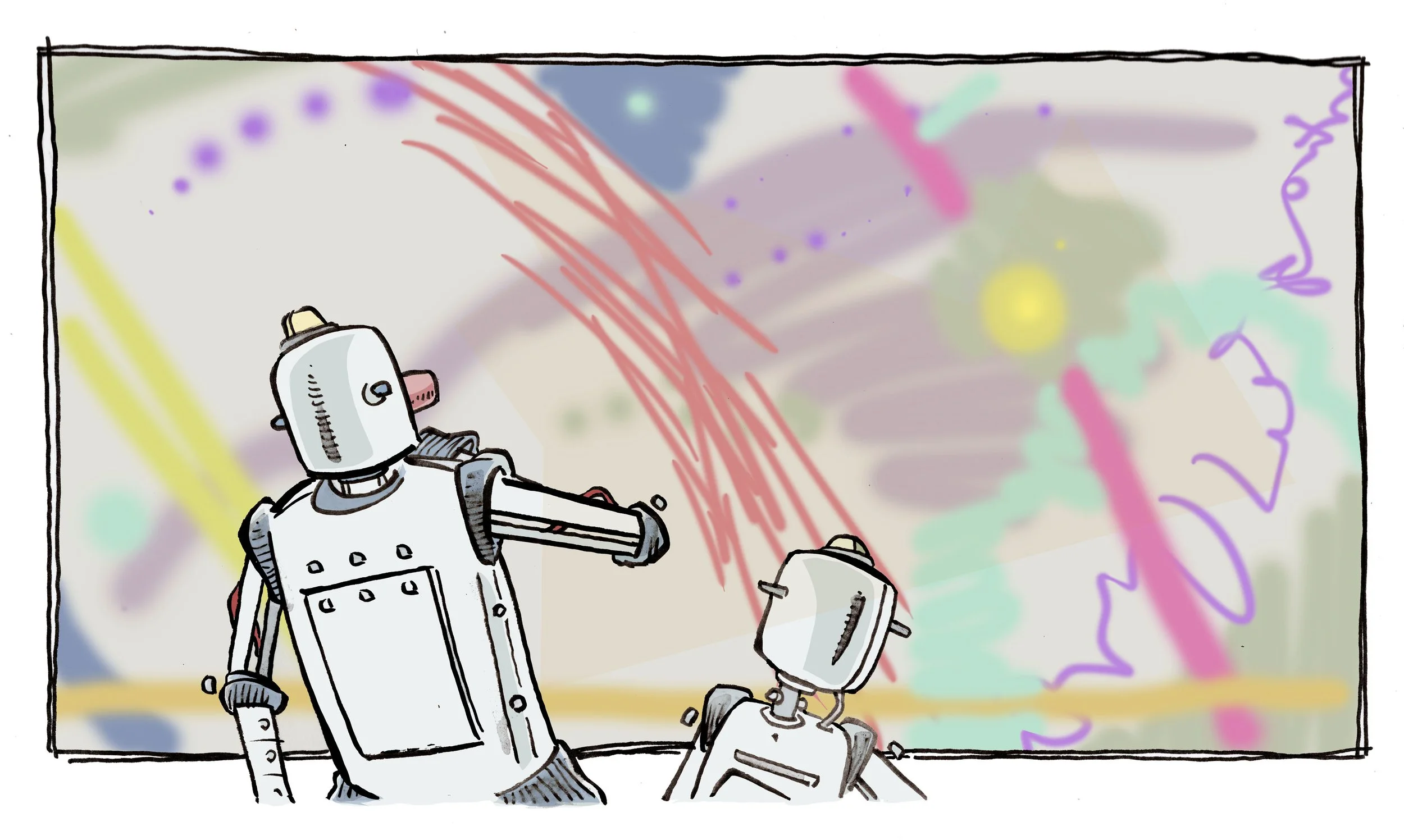
Why is abstract art so important now? Most people would argue that with a simple prompt, any AI tool could create an abstract piece. When you take non-representational art at face value, yes, it does seem less challenging than something like an old masters painting or a marble sculpture from Greece, but who’s to say what is and what isn’t considered art? I wouldn’t blame technology like artificial intelligence but instead our current world's lack of understanding each other. A lot of negative feedback about abstract art comes from confusion. “I don’t get it?” “What does it mean?” “Is this supposed to make me feel something?” It’s easy to look at a work of art that depicts a woman drowning and know it’s supposed to make you feel dread or melancholy, but if it’s not displayed in vibrant, bold letters, a general audience won’t understand.
When you take a step back and think of all the ways we humans have regressed, it becomes clear that it really is all connected. Why take the time to search for sources and academically accredited research when artificial intelligence can give me a quick summary of everything? Why ask a friend what’s wrong when I could ask their friend if they know what’s wrong? There’s a lost art to being human, and that’s time. Taking in the mundane, stopping to look a little harder at an abstract work of art, taking the extra time to dig through databases for a reputable source, asking a friend to meet and talk instead of texting a quick, “you okay?”
Abstract art forces the viewer to stop and contemplate. It questions what you feel, what you see, how you see it, what the artist was thinking, what the artist was feeling. Our world is currently consuming so much all the time, all at once; I’m honestly surprised we haven’t completely fried our brains. Abstraction is the genre that disrupts the chaos; even if it means causing the viewer confusion, it still makes them stop and engage. The beauty of it lies in the human condition. To know that even if artificial intelligence created something abstract, it still wouldn’t be considered abstract because the human mind didn't create it. Every brushstroke, every line, every color, every peek of raw canvas is done with intention. A real person, with real thoughts, ideas, emotion, trauma, grief, and happiness, made the decision to plaster an amalgamation of color onto a canvas. Forget the technique; imagine neurons firing inside your head—what would that look like? Abstract art is not meant to be an aesthetic monument hanging in the Louvre; it’s an exploration of humanity in its truest form.