My Two Cents on 50 Cent
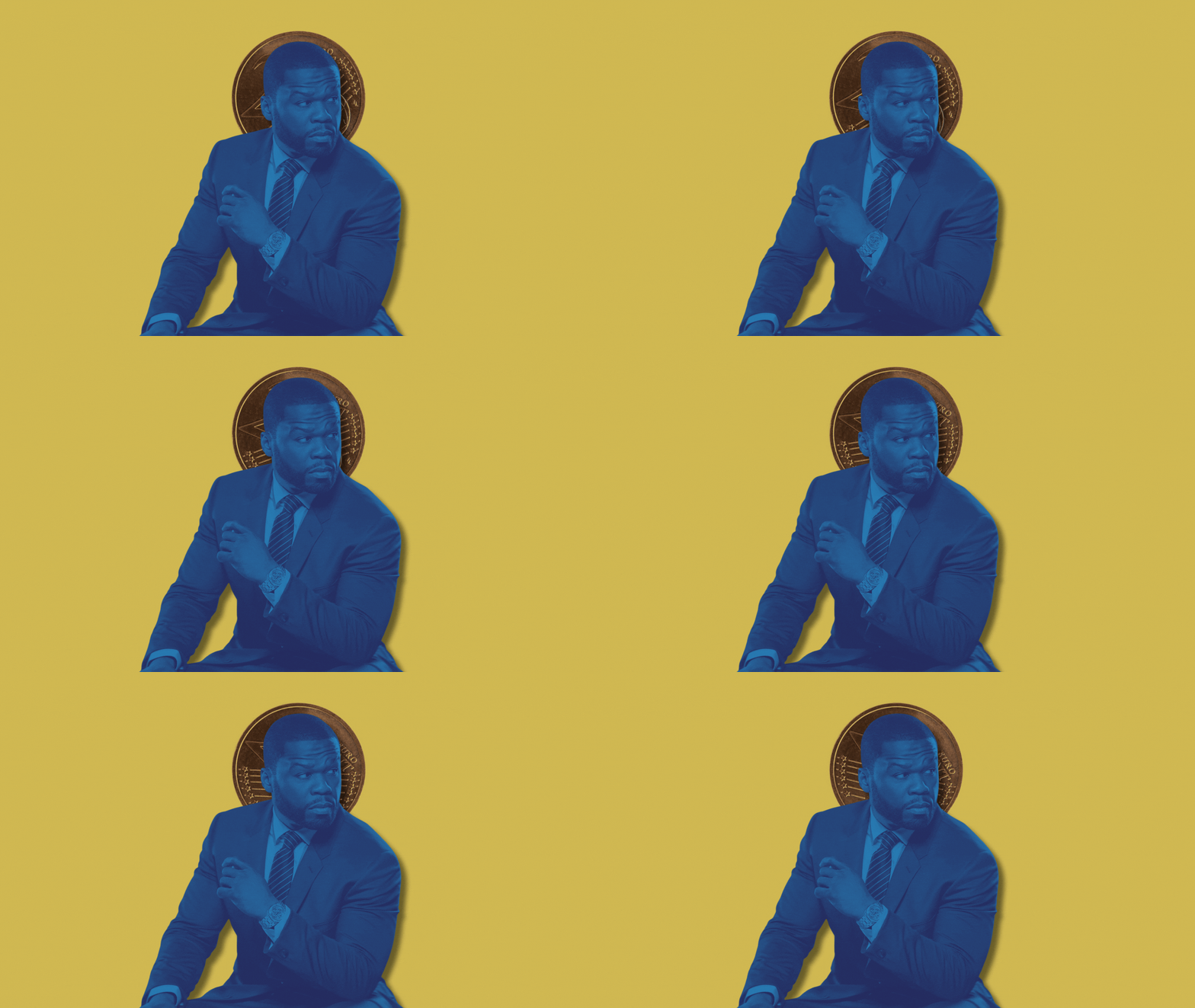
Illustrated by Eden Pela
“Not all men — only some men, especially not me.”
In October of 2025, Sean ‘Diddy’ Combs was sentenced to 50 months in prison. The gust of media attention on the international case came to an abrupt halt. His sexually exploitative conduct had been established, Cassie had gotten justice, and another rich, powerful man had been exposed in the seemingly dark underbelly of the Elite’s depraved sexual proclivities.
To me, it felt like many people didn’t really care. There was scrutiny over Cassie’s identity as a victim because ‘she had been there’, and much of the attention around Diddy focused on his nefarious supposed involvement with the Rap community's criminal underworld, with people explaining away the suspicious circumstances of his late wife Kim Porter’s death and the death of 90s rappers Biggie and Tupac.
Nobody really seemed concerned that Diddy was found guilty of transporting people for prostitution, whilst the jury rejected the sex-trafficking charges against him. If transporting people across state lines for the purpose of prostitution isn't considered trafficking, then what exactly are we supposed to call it? And yes, I understand reasonable doubt, the prosecution's burden of proof, the distinction between the charges and the jury's specific findings — but you get my point.
Nobody seemed concerned about the senseless violence that defined rap culture and the blatant misogyny and desecration of Black women's bodies in its music. Or about the sanitisation of the men at the centre of its mythology: Biggie's marriage to Faith Evans was marred by chronic infidelity, whilst Tupac was a convicted sex offender.
So when 50 Cent came out with his documentary expose on Diddy with Netflix, I rolled my eyes. What could 50 Cent possibly have to tell me that I couldn’t have deduced through years of watching a misogynistic music culture unfold in front of me? The answer, as it turned out, was absolutely nothing.
Much of the documentary seemed less interested in the women Diddy had allegedly abused than in the mythology surrounding him: his supposed involvement in the deaths of Tupac and Biggie, his status as a kingpin within the violence that has long defined the mythology of rap. To me, the documentary's focus on whether Diddy was responsible for Tupac and Biggie's deaths feels almost beside the point — given the violence already embedded in the culture, it seems almost inevitable that some equivalent tragedy was likely to have happened regardless, whether it was Tupac and Biggie or someone else.
Then there were the men coming forward with their own stories of sexual assault, whilst admitting that they had witnessed Diddy assaulting women and essentially did nothing because they were still on his payroll. The asymmetry in victimhood is especially present here: the men who were present could apparently recognise their own experiences as violations once they happened to them, whilst having already witnessed violence against women without treating it as a reason to intervene, illustrating whose boundaries were culturally legible to them.
These men didn’t have to have personally assaulted women for the environment itself to have been structured around male power and female vulnerability. They could occupy a world in which women's boundaries were already being treated as less important, whilst still understanding their own boundaries as inviolable.
And then there is the inevitable, “but men are victims of sexual assault too” response. Yes. And overwhelmingly, when men are sexually assaulted, the perpetrator is another man. The men who suddenly found themselves speaking the language of violation when Diddy turned his attention towards them were not discovering some entirely new phenomenon. They were discovering that the thing they had apparently been able to tolerate happening to women could happen to them, too. Violence against women had been background noise, but violence being inflicted upon a man’s sexuality was scandalous.
And most heartbreakingly for me, there was Aubrey O’Day, confronting the possibility that she had been assaulted by Diddy during an incident she has no memory of. Watching her sit with that possibility — the confusion, denial, heartbreak and complete lack of confirmation. Devastating. It is difficult to think of any situation less suited to becoming content for millions of people to consume.
Despite this, 50 Cent was being hailed for “hating to his utmost potential”, as though his willingness to publicly humiliate Diddy made him one of the few men in rap with any integrity. I found the praise genuinely confusing. This is a man who once rapped, ‘when you sell like Eminem and the hoes wanna fuck,’ being treated as some unlikely feminist hero because he had decided that another man deserved to be publicly destroyed.
50 Cent does not exist outside the culture that produced Diddy — he exists within it. He has participated in the same casual objectification, the same commodification of women's bodies, the same language that treats women as accessories to male success and sexual gratification. People praised him for “exposing Diddy all along”; he had a long-standing feud with Combs, but considering the culture within which he exists – how could he possibly be surprised by what Diddy represented? The difference is that, in this instance, his misogyny was useful to us. He was pointing it at another man.
The final straw for me was an AI parody of Family Matters that 50 Cent posted to Instagram while Diddy's trial was in the news. In it, Cassie is introduced as “Cassie SideChick Ventura” whilst holding up a bottle of baby oil. Cassie was a victim. There is footage of Combs physically assaulting her. And yet, in a parody about Diddy's alleged sexual abuse, 50 Cent's contribution is to reduce her to a side chick — the woman whose abuse is part of the story becomes another punchline.
And it wasn't just Cassie. J.Lo appears with the caption “Age 50 still bad”. Perhaps “bad” can be defended as a compliment; women are allowed to be beautiful at 50, after all. But why is a woman's sexual desirability the joke in a parody about a man accused of sexual abuse? The plausible deniability is almost the point. It is presented as harmless because he is technically complimenting her, but the word “bad” carries an obvious sexual implication in this context. Once again, a woman becomes something to look at while the men are allowed to remain the subjects of the story.
Then there was 50 Cent's own baby mother, Daphne Joy. Why was she even there? As far as I could tell, her relevance to Diddy was that she had been named in allegations connected to him. If the joke was simply 50 Cent taking a shot at the mother of his child, why do it within a parody about a sexual abuse scandal? Even the phrase “baby mama” carries its own particular kind of casual disrespect, reducing a woman to her relationship to the man's child rather than treating her as a person in her own right.
What made this even more uncomfortable was looking into their history. In 2024, Joy accused 50 Cent of sexual and physical abuse, allegations which he has denied. The allegations came amid a custody dispute over their son, after 50 Cent sought sole custody following claims made about Joy in connection with the Diddy case. 50 Cent's representative said the allegations against Joy had prompted him to take legal action to protect his son. But the fact remains that this is a man publicly positioning himself as an exposer of another man's treatment of women, whilst his own relationship with a woman who accused him of abuse is a part of the public record. I don't need to decide whether Joy's allegations are true to find the contradiction worth examining. It makes the jokes considerably less funny.
And then there was Kid Cudi. Perhaps most interestingly, he was the only person in the spoof who didn't have a subheading making some sort of sexualised or underhanded comment about him, undermining the idea that this was simply what the format of the joke required. The women could have been characters in the story — instead, their bodies, sexuality and relationships became the material.
50 Cent clearly knows what misogyny looks like when another man is doing it. He can identify Diddy's behaviour, package it, ridicule it and turn it into entertainment. But when the joke is his, the women are suddenly fair game. Cassie can become a “side chick”. J.Lo can become a sexual punchline. His own former partner can become material for a joke about a scandal in which she had been named. The women do not stop being women when the joke changes hands; only the man making it changes.
I find the reaction to men like Diddy so strange. We are perpetually shocked when misogyny becomes sufficiently spectacular to make the news, as though it has arrived from somewhere completely foreign to the world we inhabit. But misogyny is not only the assault, the rape, the coercion. It is also the music we listen to without thinking about the lyrics. I Need a Girl. No, you don't. And you have never been owed one.
It is the joke that everyone laughs at. It is the assumption that a woman will accommodate you. It is the confidence with which a man interrupts her, speaks over her, decides what she meant. It is so pervasive that I find it increasingly difficult not to assume that men move through the world with some kind of patriarchal baseline — not necessarily consciously or maliciously but there nonetheless, like an irritating, inherited, niggling trait.
And if that is true, then what exactly are we supposed to mean when we tell women to “judge the individual”?
We are constantly told that not all men are misogynistic. That we should judge men by their individual character and treat them accordingly. But nobody develops outside of the culture that raised them. There is no man who has grown up entirely untouched by the expectations, assumptions, and hierarchies of a patriarchal society. There are no individuals who arrive in the world having formed themselves entirely from scratch.
So how do we judge individuals when the culture has already shaped everyone?
Perhaps this is why the distinction between “good men” and “bad men” has always felt slightly inadequate to me. I am not talking about pretending that every man is equally dangerous, or that a thoughtless joke is morally equivalent to violence. I am talking about something much harder to quantify: the feeling that patriarchy is woven into an overwhelming proportion of my interactions with men. Not always dramatically. Usually not dramatically at all.
It is the interruption. The assumption. The joke that isn't quite a joke. The expectation that I accommodate. The confidence with which they're wrong.
None of these things are necessarily enough to call a man a misogynist. But they are enough to remind me of the world we're living in.