Honey, Are We Watching Morality Island Tonight?
Illustrated by Jaydah Victor-Morse
“We see things not as they are, but as we are.”
— Anaïs Nin
When June rolls around, people all around the country look forward to watching the newest season of Love Island USA. Hot, young, single strangers enter a foreign villa hoping to find a romantic connection. At the same time, people sit back at home and watch these relationships develop, dissolve, and occasionally surprise everyone involved. The entertainment comes from watching seemingly ordinary, everyday people navigate attraction in real time. Someone might enter the villa convinced they have found their person and change their mind a week later, while another couple that seemed destined to win could fall apart overnight.
The show started as a lighthearted, fun watch, but over the past few seasons, it has twisted into something much deeper and darker than the reality-show relationships themselves. Before islanders spend one good night in the villa and couplings truly have time to unfold, social media has already assigned motives and labels. A contestant who chooses someone of a different race or skin tone over another is evidence of colorism and racism. A speech by a male contestant at a recoupling is an example of misogyny. Hesitation with choosing between two people means you’re a “fuckboy” or “thot.” Every romantic decision requires some sort of sociopolitical explanation, and every explanation seems to demand a stance for larger moral meaning.
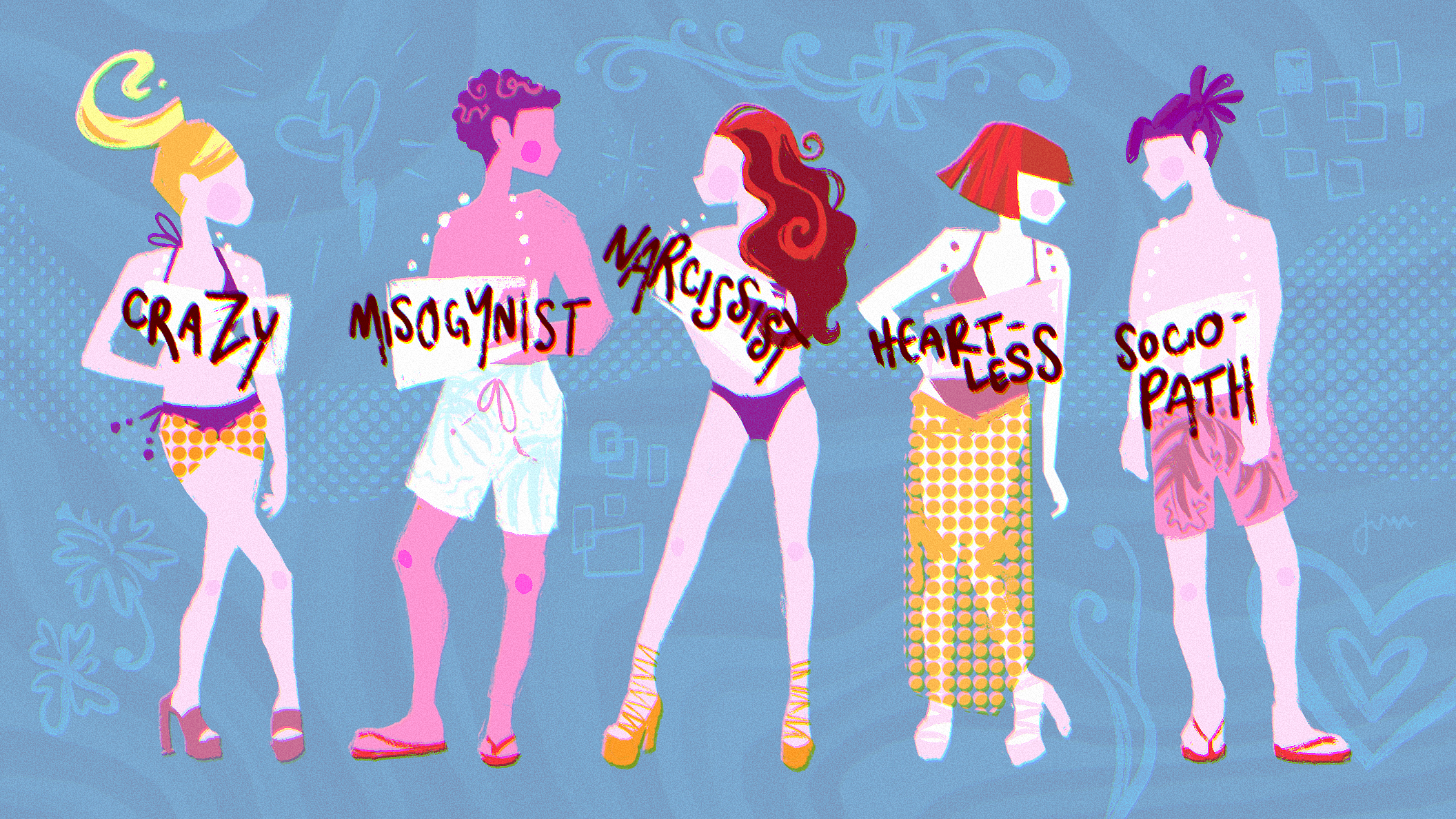
By the season 8 finale, watching the show alongside social media commentary had become unbearable. The audience had effectively created its own version of the Fiji villa off-screen, one where every islander was given a small box to pack themselves into, with every romantic decision capable of rapidly transforming someone's status from fan favorite to most hated islander, all driven by personal biases and selectively edited footage.
Conversations around Love Island USA exist within a larger reality, so none of this is to suggest that colorism, misogyny, or racism have no place in discourse about dating television. Reality TV has long reflected broader social hierarchies, and Black women in particular have often occupied a difficult position within dating shows where beauty standards remain deeply entangled with race and skin tone. Those dynamics obviously deserve serious attention. But the problem begins when the existence of those dynamics becomes the starting point for analyzing every interaction. Systemic analysis can reveal patterns, but it cannot automatically tell us why one person was attracted to another, why someone changed their mind, or why two people simply did not work.
That problem became most apparent with KC this past season. Long before he returned from Casa Amor with another partner, viewers had already begun constructing a negative narrative around him and his relationship with Aniya. His growing distance from her was treated less like a connection naturally unraveling than as another example of something being “wrong” with him. Once he returned with someone else (Miss I’m TiTi!), accusations of him being a colorist, misogynist, and emotionally manipulative were the instant conclusion. His feelings appeared to have shifted, but the audience seemed more interested in explaining why they believed those feelings were wrong.
The criticism surrounding KC exposed a contradiction at the center of the show’s current fandom. Love Island quite literally requires its contestants to explore different connections and decide who they believe they have the strongest chemistry with. That is the entire point of putting these random people together in a villa. Yet when those choices do not align with what viewers want, the same dating experiment that drew them to the show becomes a source of outrage.
Had KC remained with Aniya despite no longer wanting the connection, he could have been accused of leading her on or wasting her time. By leaving, he became public enemy #1. Either way, the audience had already decided what his actions meant. He occupied an impossible position where any and every decision could be interpreted negatively.
The same contradiction followed other Black male contestants throughout the past two seasons. Taylor, Ace, Corbin, and others frequently became less like participants in a dating experiment and more like a blank slate onto which audiences projected broader conversations about desirability and respectability. Their individual preferences were treated as reflections of those larger issues, leaving little room for the possibility that a man could simply be attracted to one woman and not another. Ironically, the same audience demanding that Black women be recognized as human with feelings and emotions often appears reluctant to acknowledge that same individuality in Black men.
Part of what made this show so difficult to engage with social media was the speed with which contemporary political language became diagnostic. Words like “colorist,” “misogynist,” “red-pilled,” “narcissist,” and even “gaslighter” were used as immediate explanations for behavior viewers disliked, often before there was enough context to support them. Instead of describing what a contestant actually did, the label became the description. Once attached, it could absorb every subsequent action, no matter how ambiguous, into the same narrative.
The difficulty with this kind of analysis is that it can blur the line between recognizing social patterns and assuming bias. Colorism and misogyny certainly exist, and both influence how people experience dating and attraction. But those realities do not mean every rejection is an act of colorism or every disagreement with a woman is an act of misogyny. A person’s behavior can exist within a society shaped by those forces without every individual interaction carrying the same explanation.
The conversations surrounding Olandria and Chelley in the previous season made that problem even more complicated. Olandria’s experience resonated with many viewers because discussions surrounding darker-skinned Black women and desirability are deeply rooted in real histories of exclusion. The frustration many viewers expressed came from a genuine desire to see Black women, especially those who have historically been overlooked, receive affirmation and romantic interest.
However, Olandria gradually became more than a contestant they liked. She became representation of the unwanted dark-skinned Black woman, and her experience was treated as confirmation of what they’ve already been conditioned to believe about how women who look like her are perceived, bringing their insecurities and old wounds very close to the surface. Chelley, however, complicated that narrative simply by being another dark-skinned Black woman whom more people in the villa coupled up with. In response, Chelley’s appearance and overall demeanor were dissected to prove a point, even with claims that she had “Eurocentric features.” Both are beautiful women who just happened to have had different experiences in the villa, but instead of allowing both realities to exist, they ended up policing the appearance and personality of one Black woman in order to protect the narrative they had built around another.
That reaction revealed how personal projection can interfere with the very conversations people believe they are having about colorism. If Olandria’s experience had become proof that dark-skinned Black women are broadly unwanted, then Chelley’s experience created an uncomfortable contradiction. It meant that two women with similar skin tones could receive very different reactions without either woman’s desirability proving a larger rule. Rather than reconsidering the assumption, they ended up creating another hierarchy in which two Black women were pitted against each other, rather than allowed to exist as equally desirable in different ways — reproducing the very comparison they were trying to critique.
The same dynamic reshaped how audiences understood accountability. By the final weeks of this past season, loyalty to particular contestants often outweighed consistency. The so-called “Core Four” this summer inspired intense devotion, with supporters defending behavior they might have condemned in other islanders. Critics of KC rarely extended the same scrutiny toward contestants whose actions complicated their preferred narrative.
The phenomenon with the “Core Four” group reflects a broader reality of modern fandom. Viewers are starting to build parasocial relationships with reality stars, create narratives around them, and sometimes defend them as if they know them personally. Once someone becomes a favorite, criticism of that person can feel like a personal attack rather than just an honest observation about their behavior, and that, in fact, is quite disturbing.
Selective loyalty has changed the experience of watching the show. Reality television has always encouraged viewers to pick favorites, but what feels different now is the expectation that those favorites remain morally infallible while everyone opposing them becomes morally deficient.
That ideology has a detrimental effect beyond social media. Contestants now enter the villa knowing they are not only participating in a dating experiment but also entering a highly scrutinized online environment where every conversation, facial expression, and romantic choice can be analyzed in real time in search of social failure. Producers are also aware of this trend, editing and manipulating clips with social media conversations in mind to craft episodes that will spark viral arguments and boost engagement.
The result is a destructive cycle in which audiences pick heroes and villains, producers create storylines that reinforce those expectations, and viewers become confident in conclusions drawn from edited footage, thereby reinforcing the very thing that made those edits possible — and the dating experiment (literally the whole point of the show) begins to disappear beneath all of the turmoil. The islanders are no longer simply people trying to figure out whether they like each other or not. They become representatives of beauty standards, gender politics, racial dynamics, relationship theories, and whatever else the audience wants to place onto them.
I don’t know whether this shift comes from a particular generation of viewers, the spread of rigid ideologies online, or some combination of both. But if Love Island USA continues, viewers need to come to terms with the fact that attraction is unpredictable and compatibility is imperfect. Not every failed connection reveals systemic prejudice, and not every successful one disproves it. Sometimes attraction reflects larger cultural issues, but sometimes, two people just aren’t the right fit for each other. The difficulty — and the responsibility — lies in knowing the difference.
That logic has become harder to preserve in an online environment where every move someone makes demands a clear justification and every answer to the justification competes to sound more morally definitive than the last. The language of structural critique remains important for understanding the inequities that shape modern dating, but when that language becomes a reflex rather than an accurate analysis, it can obscure the very people at the center of the conversation. It can also create a strange double standard in which some contestants are granted grace for complex human behavior while others are expected to carry the weight of whatever argument viewers have decided to make about them.
Love Island was never meant to be a referendum on perfect sociopolitics. It is a messy experiment in attraction, timing, incompatibility, and chance. The more audiences insist on translating every romantic choice into some hardcore moral judgment, the less room remains for the very thing the show asks us to watch: people trying — and often failing — to figure out who and how to love.