Tell me about a complicated woman; please, I am begging you.
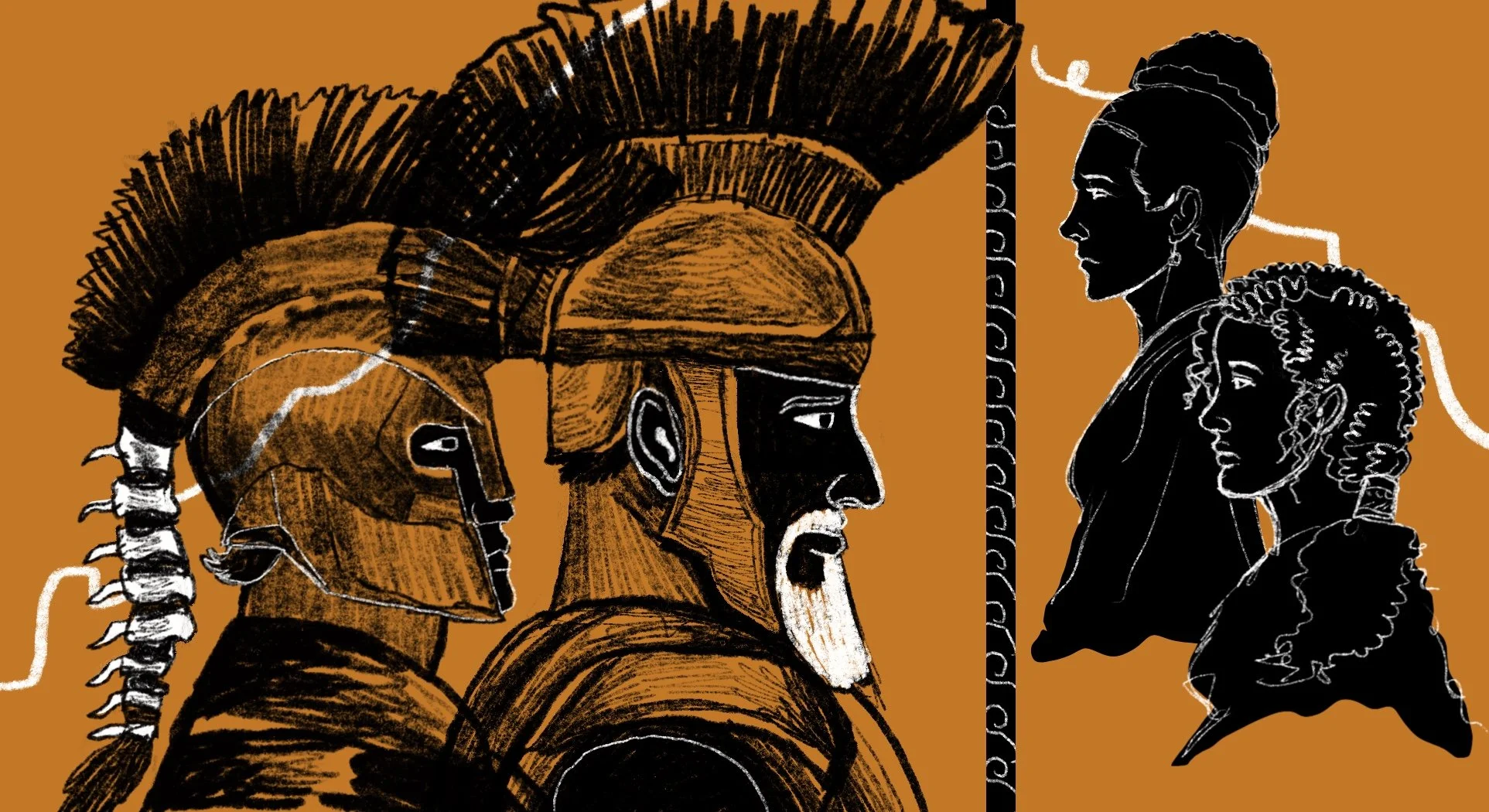
Illustrated by Heather Han
Here’s the thing about Christopher Nolan’s summer blockbuster The Odyssey: it’s fun. The film is a cavalcade of big-name actors and wide IMAX shots of rough oceans, clashing fight scenes, and the choking smoke of a burning Troy.
Some of the scenes in Nolan’s film had my heart racing, like during the tension of the men trapped in the Cyclops’ cave. The body horror of Circe warping Odysseus’ men into pigs with her bare hands made my stomach turn. When the gates of Troy opened to reveal Agamemnon standing in his full black armor, the ridiculous pause he does before his men attack is utter cinema.
It’s the type of movie that demands to be seen in the theater. Ludwig Grusson’s soundtrack thrummed through my sternum while sitting in the comfy IMAX chairs, and each twang of Odysseus’ bowstring reverberated through the room. The true, floor-to-ceiling IMAX screens made it feel like I was there with Odysseus and his men, hunkering down in terrible rainstorms on the boat or running from the thundering cyclops. In a time when cinema attendance has been down, these types of blockbusters are crucial to get people back into the theater.
But here’s the thing The Odyssey is not: complicated.
Nolan’s Odyssey is an adaptation of the famous epic, but instead of pulling from older translations, Nolan references Emily Wilson’s work, the first woman to ever translate the Odyssey into English. In Wilson’s translation, she starts, controversially, with a request: “Tell me about a complicated man.”
Nolan’s adaptation fundamentally refuses that request.
Instead of the mischievous, and at times downright jerkish, Odysseus made famous in the epic, we get, instead, a stoic and pragmatic Odysseus played by Matt Damon. There’s nothing complicated about this retelling of Odysseus. He’s trying to get back to his wife and son. He’s upset about the desecration he witnessed in Troy, and feels guilty about his part in sneaking his way into the city. But that guilt doesn’t complicate his actions or his story.
It’s akin to every American war movie made in the last twenty years, and rips off most of the moral ambiguities from Nolan’s last film, Oppenheimer. A man does horrible things. A man feels bad about it. A man goes home and deals with that. It felt a little, been there, done that.
Odysseus’ guilt doesn’t change his actions. Instead, it makes it permissive. He can be the man with the plan in the Trojan Horse and be the reason for the raping and pillaging of Troy, but because he’s a good leader to his men and feels bad about his culpability in what happened at Troy, he gets to also be welcomed by audiences and his family as the hero returning to save his wife and son. It’s not a grey world that Nolan's Odyssey operates in; it’s startling and stoically black and white. Odysseus is only a hero.
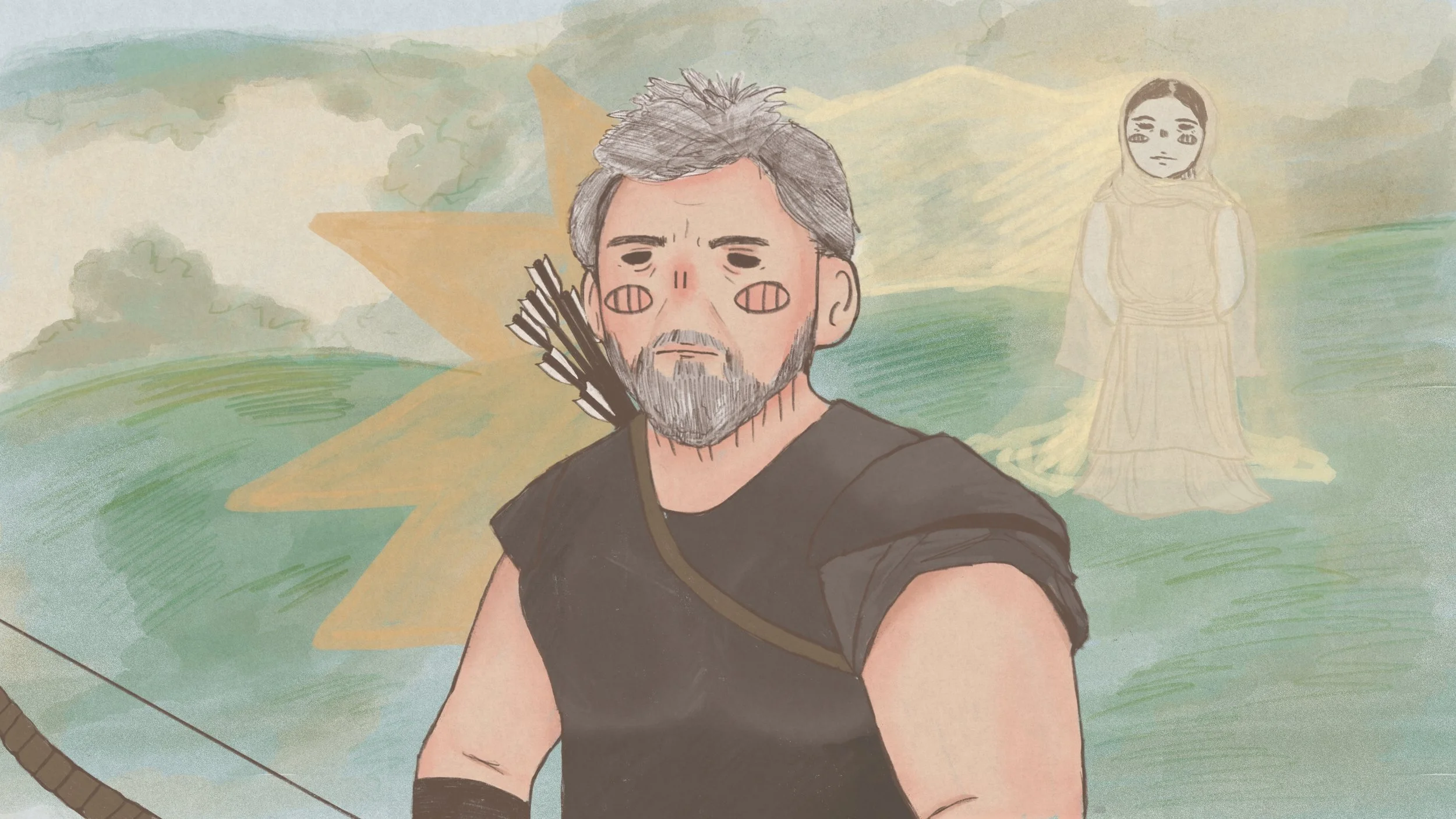
Illustrated by Geliza Paunan
It’s divorced from the epic version of Odysseus that has made generations upon generations of English students argue over whether or not he’s a hero, an idiot in his capacity for falling asleep at the worst times, or one of the worst husbands to exist.
There’s no debate with Nolan’s Odysseus. Everyone knows where the story is going, and every character gets relegated into a well trodden archetype.
Part of that is due to Nolan’s struggles with screenwriting. For such a serious movie, there were multiple times the theater I was in inappropriately laughed out loud at some of the lines of dialogue. Among those included Telemachus’, played by Tom Holland, very earnest delivery of “my dad is coming home.” The one that stuck with me was Matt Damon’s serious delivery of, “our Bronze Age is collapsing,” an amazing insight for a man who wouldn’t know he was in a Bronze Age.
But worse than Nolan’s frequent struggles with screenwriting is the way that an uncomplicated Odysseus relegates other characters in this glorious epic to bit parts. Since Odysseus’ character doesn’t wrestle against a grey morality, no one has any reason to step into the ring to counter him. And as is often with Nolan’s filmography, the greatest victims of flattened screenwriting foray are the women.
There’s this term we use for writers like this. We say, the “can’t write women,” as though women are alien creatures that the poor writer struggles to understand through some sort of cultural or language barrier, and not as human as any man. But in Nolan’s film, his women do seem alien, or, at least, a category completely divorced from the men.
Part of the othering of women in Nolan’s film, and particularly The Odyssey, is that they are defined by their victimhood.
Penelope is the grieving wife left behind, cornered in her house by the suitors who want to pick at her body, waiting for a man to come save her. The cleverness of the original Penelope in leading suitors on or unweaving her neverending burial shroud each night is instantly seen through by Antinous, putting her in even more danger.
Helen of Troy is literally scarred when we meet her; her face is a memorial to the violence that men do to women in war. Beautiful, controversial Helen we only get to see at her lowest as she’s grabbed and mocked by Menelaus. Her most notable scene, while played well by the indomitable Lupita Nyong’o, is to apologize desperately to Telemachus for what she’s caused.
In meeting Helen, we also get a flashback to Clytemnestra, Helen’s twin sister who murdered Agamemnon. Instead of seeing her plotting and planning, conniving to murder her husband, we watch her get dragged away from Agamemnon’s dead body to her own execution. It’s a warning for bloodthirsty women who try to get their own revenge.
Three women; three victims of war. Stripped of their past and future, the scenes that Nolan has chosen to show of these women in his film trap them in places of suffering, as though their most interesting storylines are in their danger and their fear.
Nolan’s inability to write women goes beyond just his human women. His retelling of The Odyssey also flattens his goddesses, once all-powerful figures that have been reduced to almost nothing. In The Odyssey, it’s clear these epic figures have capacity for cruelty and evil. It is Nolan who refuses to tread into that land of grey mortality, or reckon with a mighty woman who can be as ambitious as any man. His Goddesses, Athena, Calypso, and Circe, become annoyingly human, serving as backboards to Odysseus’ stoic journey.
Athena, in Nolan’s tale, is virtually unrecognizable. This is the Goddess of wisdom and battle. She is a master of disguise and a great warrior. Instead of exploring that power, Nolan uses Athena as a sign of Odysseus’ guilt, and another symbol of the victimization of women in war. His Athena manifests to Odysseus in the form of a woman he watched beheaded in Troy. The big reveal of the film is a plot point that rewrites the goddess of wisdom and battle into a poor, dead woman.
Circe has the same undoing of her power in favor of reminding the audience of the cruelty that can befall women in war. In the original tale, Circe plays an active role in luring sailors to their demise, with a singing voice that enchants even Odysseus’ crew. In the film, Circe’s island is invaded by Odysseus’ men, and her actions are born out of her fears of being a woman alone with soldiers who have raped and pillaged villages. She is acted upon by the men in this film, forced into a corner to defend herself, rather than calling victims to her island of her own accord. Nolan’s writing removes Circe’s culpability for her tricks, and instead paints her as just another victim trying to protect herself.
It’s a similar story with Calypso. In the original, Calypso holds Odysseus prisoner on her island for seven years, forcing him to be her lover. She only lets Odysseus go after Zeus himself steps in, and she still goes on to argue with the God of the sky, pointing out that male Gods are allowed to take human lovers, but punish Goddesses for doing the same. In Nolan’s version, we forgo this woman who would talk back to Zeus and instead get a beautiful, quiet therapist. Nolan’s Calypso soothes Odysseus with the lotus leaf, and while he stays on her island in a drug fueled fog, it’s a product of Calypso being loath to hurt him by letting him remember, rather than because she’s holding him captive. In fact, Film-Calypso lets Odysseus go without any fuss, even going so far as to help him understand that the ocean will guide him back no matter what.
It’s a pity for the film. We watch as three powerful, glorious, morally ambiguous goddesses are brought down to almost nothing: a lonely therapist, the fear of rape, and the murder of women and children in war. That’s all that women seem to be allowed to be.
It’s a continued trend across Nolan’s filmography. Women can either be dead, or they can be victims. In Following, Memento, Insomnia, The Prestige, The Dark Knight, Inception, and Interstellar, all of the main male leads’ wives are dead. In Oppenheimer, The Prestige, and Inception, we see wives become victims of their husbands' ambitions. And now in The Odyssey, we see the ultimate victimization of women as they all become metaphors for the terror of war.
It sort of makes you wonder if Christopher Nolan has ever met a real, living woman before.
It’s a bitter pill to swallow that for a movie as exciting and fun to watch, the women are kept from roles that offer anything more than a sad storyline. We don’t get to see them be impressive without watching them suffer. In a bizarre twist of fate there’s something more interesting in the cruelty, cunning, and even evil of the women in the original tale that was all stripped away to make room for a brooding Odysseus and a twanging bowstring. It’s the big blockbuster of the summer, but only, it seems, for the men.
So next time, Christopher Nolan, tell me about a complicated woman. Just once.