Kidnapping, Probing, Impregnation: How Men Become the Victims in Alien Horror Movies
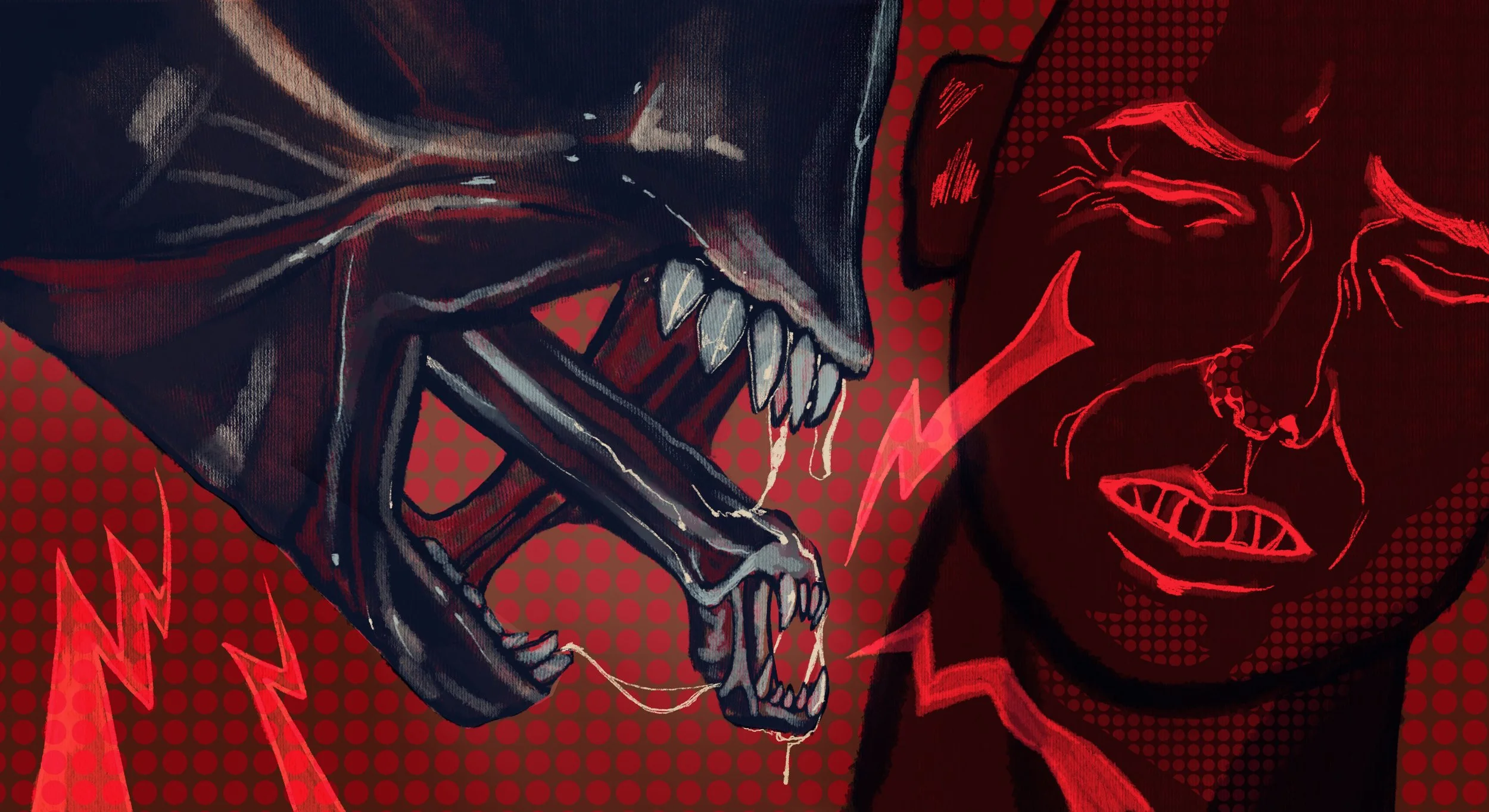
Illustrated by Heather Han
As a horror aficionado, I have to admit that I struggle to watch alien horror movies. I don’t love the—often terrible—CGI when the alien is revealed in all its weird, usually pale and oddly skinny glory. But more than that, I cringe in the anticipation of what has become akin to a joke: they’re going to be probed.
It’s a repeated gag in pop culture. When the aliens come to town, they’re going to start probing the men in their experiments. It’s a joke found in The Simpsons, Paul, Men in Black II, Waiting for Guffman, SNL, and so many other famous TV shows and movies. It’s become an overplayed bit in alien media, and I have yet to find it funny.
But this October, my friend compromised on a trade-off to watch Suspiria if I, in return, watched a classic alien movie, Fire in the Sky. As I watched the movie descend into the usual tropes of kidnapping and experimentation, and our main protagonist was strapped, naked, to a gurney-like table with tall figures standing around him, I was struck by how familiar the scene was.
Horror movies, for better or worse, can feature some of the most brutal, and terrifying, scenes of sexual assault and loss of agency. More often than not, the characters that are the victims of this type of violence are women. Except in one subgenre: alien horror.
Alien horror levies a specific form of body horror and torture onto its male protagonists that usually only women suffer through in horror movies. The men are kidnapped, raped (i.e., probed), and even impregnated. The horror in alien movies comes from watching men suffer through the evils often reserved for our female scream queens.
It creates a reverse narrative from the usual plotlines of horror movies. Instead of the women being in explicit danger, it is the men that are left completely vulnerable.
The Thing Inside of You
Perhaps one of the most classic alien horror movies is Alien. This movie sits at the intersection of a host of different horror movie niches – it’s a final girl movie with Sigourney Weaver, it’s a slasher film as the alien chases the crew around the spaceship, and it’s a pregnancy horror film.
But instead of Ripley, the lone woman on the spaceship, experiencing the horrors of hosting an alien life inside of her body, it is one of the men who writhes in pain in front of the rest of the scientists as an alien lifeform bursts out of his body, killing him instantly. The chestburster scene is one of the most iconic alien scenes in this horror subgenre. Part of the lasting effect of it is because of the role reversal. There have been other alien-birth scenes visited upon women – Prometheus, Aliens vs. Predator: Requiem, Alien: Romulus – but it’s Alien that people reference, that people remember.
With women, there is a sense of expectation. Women are expected to be carriers of life. The fact that they can host an alien lifeform in their body is “natural” in some perverse way. When it’s men bearing the brunt of reproduction, it highlights just how “alien” the whole process is.
Regular childbirth can be brutal, life-threatening, messy, bloody, but women are expected to be able to deal with it. Thus, the literal act of pregnancy in alien horror movies for women doesn’t seem as horrific. Take the scene in Prometheus: while an alien is pulled out of Elizabeth’s body, the literal actions are akin to a “typical” C-Section. There’s a normalcy to it. When it’s a man pregnant with an alien life-form, nothing is typical. It allows directors to showcase pregnancy body horror in its full glory: it highlights the loss of agency, it paints a clearer picture of the dangers that can come with pregnancy, and the reveal of the alien creature is even more horrific.
Films like Rosemary’s Baby or The Orphan, other pregnancy horror films where women are forced to bring to life a horrible creature, don’t have the same graphic depiction of pregnancy as these alien films that depict men as breeding hosts. Women in horror movies more often live through the trauma of being raped and giving birth to the literal devil on earth, while in alien movies, men will be ripped apart from the inside out to bring alien life to completion.
When we talk about traditional pregnancy horror, we often think about it as a horror only women have to suffer. That is not the case in alien movies. The aliens can breed anyone. Everyone is in danger. It’s that lack of discernment amongst the human population that drives home just how dangerous these creatures are.
The Loss of Agency
In the same way that women are often expected to bear the brunt of pregnancy horror in horror movies, women are also typically expected to bear the brunt of sexual assault and rape. Once again, that’s not necessarily the case in alien horror.
There are, to be clear, definitely alien horror films in which women are the ones being terrorized, and on the flip side, more traditional horror movies where men are sexually assaulted or raped. But non-alien horror movies where men are raped are often seen as extremely graphic and hardcore, whereas men being kidnapped, taken control of, and probed in alien movies is seen as a typical level of horror.
It shows up in some ways, like possession or taking over another person’s body.
In The Thing, it is an entire crew of men being hunted down and chased by an alien creature that can take on their appearance and become the crew members’ doppelgangers. While it sows division amongst the crew members, it also forces the crew members' bodies into doing things they wouldn’t want to do. In Slither, Grant is possessed by an alien creature when a barb shoots out at him and burrows into his chest. He then goes on to do the alien’s whims, including making both men and women into breeders.
Possession is often a terror that women face in horror movies—think The Exorcist, Jennifer’s Body, The Conjuring, The Possession, Hereditary, Evil Dead Rise. But in alien movies, we see a much more even distribution between men and women being possessed to do an alien’s evil bidding. These storylines are less discerning about gender and instead take anyone and everyone that comes across their path.
That loss of agency also shows up in the violence wrought upon men in alien movies.
In Fire in the Sky, based on a “true story,” it is a man who is tormented by the alien creatures. A member of an all-male logging crew wakes up in an alien sack with no memory of how he got there. After pulling himself free of the sticky substance, he crawls through the zero gravity of the spaceship, trying to find a way out. When he gets caught, the aliens strip him of his clothing and cover him in this white material that leaves only his eye and gaping mouth open. It is a completely vulnerable position, and one that is usually afforded to the women of horror movies.
He lies there naked, spread out, exposed, and at the mercy of monsters totally surrounding them. What we get to see of the torture is a thin needle slowly inserted into the man’s eye as he whimpers, moans, and writhes on the table, but when the logger returns to Earth, released by the aliens, he has that thousand-yard stare of someone who has had other, unspeakably horrific things done to him.
This vulnerability shifting from women to men in alien horror is consistently present. In Dark Skies, it is the youngest son who’s being targeted by the aliens and at risk of being kidnapped, in the same way that it is often young daughters who are targeted by demonic forces, like in The Conjuring, The Exorcist, or Jennifer’s Body. In Prometheus, it is the male engineer who has a long tentacle shoved down his throat, violating his mouth and body.
The quintessential horror scene for alien movies is that moment where the main character is left at the mercy of the aliens. Along with that comes tubes or tentacles being shoved down their throats, and the ever-present terror of being probed (e.g., assaulted) and impregnated. Unlike slasher films or demonic films where women are at the risk of rape and impregnation while men only have to fear death, everyone is vulnerable in alien movies to all types of victimization.
When Probing Becomes a Joke
If alien movies are the place where men are most vulnerable to being subjected to the same horror female protagonists typically face, it is interesting that their victimization in these films has become more or less a joke over the years.
Why is the alien anal probing a long-standing punchline in comedy movies? Why do we laugh about the possibility of sexual assault?
On one hand, it’s hard to avoid the homophobia in the joke. There is something quintessentially queer about alien media. Aliens don’t have an earthly conception of gender, nor are they forced into the same rigid boxes we have socially created here on Earth. They blur gender and sex whether in a horror movie, a comedy, or the classic Star Trek or Doctor Who.
Alien movies rose to prominence in two very particular eras in American history: in the 1950s during the Cold War and from 1970 to 1990 with the explosion of science fiction. These two time periods saw both the Lavender Scare and the worst of the AIDs crisis. In reflection, alien movies preyed on these societal fears by creating a scenario in which men were the ones being kidnapped and raped. There’s a level of homophobia in this joke, reflective of the times that alien movies were most popular, because the men are made vulnerable the way women typically are, or seem “gay” because it’s specifically an anal probe.
That queer history underlies the rest of the cultural phenomenon that drew us towards alien movies, including incredible scientific developments, mass surveillance and paranoia, and horrific wars that seemed “alien” in their devastation. Put together, it became a smorgasbord of terrors that men faced, including a prevailing fear of being victimized in “feminine” ways.
On the other hand, the jokes about alien probing are inextricable from the continued underreporting of sexual assault against men. Some studies find that more than 90% of sexual assault cases against men go unreported. While there’s an array of reasons someone might not report sexual assault, there is, for men, a prevailing notion that this type of pain is still seen as taboo for men to suffer. That’s why, outside of alien movies, when men are raped in horror movies, that horror movie is seen as far more explicit than other horror movies where it’s implied that women are raped. It’s a type of horror and torture that’s associated with film movements like New French Extremity that are defined by their extreme, graphic, sexual violence.
That shame and stigmatization both contribute to the lack of reporting and emphasize the horror in alien movies. There’s an uncomfortable trend that settles here: it is natural when women are violated in horror movies; it’s perverse and alien when it happens to men.
In reality, of course, it is utterly horrific when anyone is violated, in horror movies or in real life. In watching alien horror movies, there is a stark reminder that this type of pain can happen to anyone. We are all vulnerable. Instead of becoming a joke slathered in the remnants of homophobia that encourages the stigmatization that keeps men from speaking out about their own trauma, alien movies should be a reminder of the real trauma anyone and everyone can face.