The magic of reading . . . tired trope or transcendence?
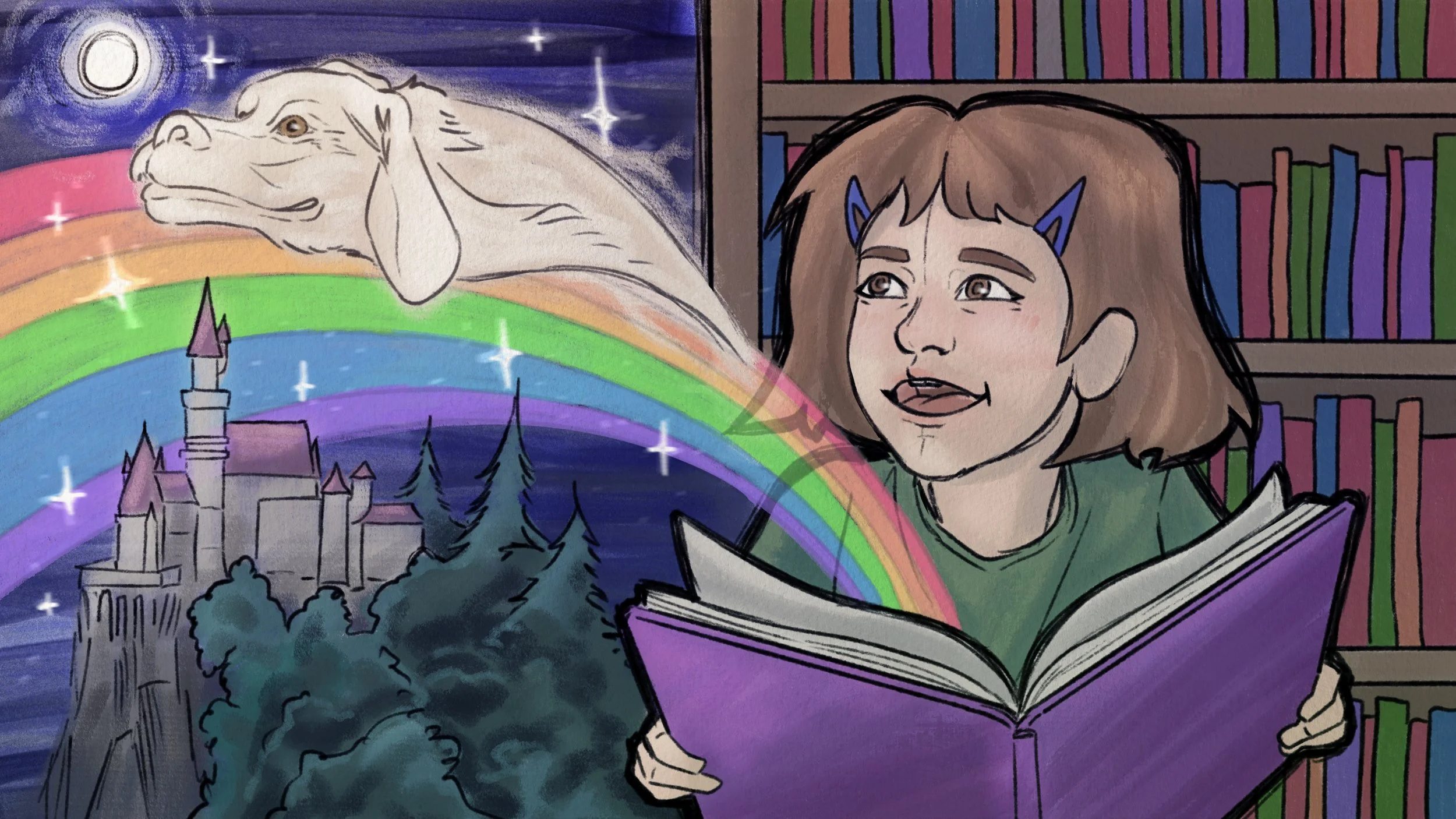
Illustrated by Vlada Popyk
Stuck at home taking care of a sick cat, my partner and I were in the market for some light viewing when we discovered that “The NeverEnding Story” was streaming for free. It had been about twenty years since I’d watched the 1984 fantasy epic and I was giddy at the prospect of reminiscing with the lifesize puppets and miniature set pieces that had ignited my childhood imagination and stalked my nightmares.
But beneath the thrill of scratching that ever-present itch of nostalgia was an underlying anxiety: What if this movie that occupied such a halcyon realm in my early memories didn’t hold up? Would a rewatch uncover previously overlooked racism (à la “Lady and the Tramp”)? I could hardly recall a theme or moral—what if the whole thing was incoherent or worse, cringingly saccharine?
My worries were swiftly laid to rest. The movie slapped. The practical effects, while firmly grounded in the decade of their use, were effective; the little tricks of scale and employment of animatronics were refreshing to eyes clouded by today’s overreliance on CGI. I sobbed when the horse belonging to the hero, Atreyu, was swallowed by the Swamps of Sadness, and rejoiced upon the entrance of fan-favorite, Falkor, the Luck Dragon.
For those unacquainted, “The NeverEnding Story” (adapted from a novel of the same name) follows a meek boy named Bastian who seeks refuge from bullies between the covers of a mysterious book called “The NeverEnding Story.” In a metafictitious twist, it is revealed that, by reading, Bastian has become an arbiter in the lives of the characters contained in the book.
There’s nothing particularly revolutionary about “The NeverEnding Story’s” central thesis that books and the practice of reading are transformative and inherently magical. Many of its contemporaries, like “Matilda” and “The Princess Bride” (again, both film adaptations of books, go figure), also encourage literary pursuits among children by likening reading to magic.
This emphasis on reading in children’s media didn’t emerge in a vacuum. Book-centric films and TV shows were being produced en masse during the late 20th century, when declining reading rates, especially among children, were a major point of concern. This atmosphere, rife with articles decrying the inability of college students to read longform texts, and books chronicling the dissolution of American attention spans in the face of new media (sound familiar?), produced plenty of earnest attempts to ignite a passion for reading among children, perhaps none more iconic than “Reading Rainbow.”
Crafted to combat the “summer reading gap,” “Reading Rainbow” premiered in 1983 and became an instant hit. The show’s host, LeVar Burton of “Roots” and “Star Trek: The Next Generation” fame, became a beloved figure of public access programming, chaperoning generations of children (myself included) through a diverse catalog of picture books.
The show’s 2009 cancellation was in part due to budget cuts and also what some network insiders claimed was a programmatic pivot toward content that teaches basic reading skills. “Reading Rainbow’s” problem was that, instead of teaching very young children to read, it taught older children to love reading, an unimportant side venture in the eyes of the Department of Education.
Fully immersed in the vicissitudes of middle school life at the time, I don’t remember “Reading Rainbow’s” cancellation. Had it been brought up, I’d have likely stifled my own sense of sorrow, then cracked a joke about the corniness of the theme song. By age 12, I was hastily eschewing anything oriented toward children and general wellness as a means of asserting something like independence (cue the outro to Rage Against the Machine’s “Killing in the Name”).
This personal animosity toward didactic media metastasized into an exasperation with pro-book and pro-story content in general. It was ironic, considering I was a prolific reader with aspirations of writing my own books someday, but nothing got me rolling my eyes like yet another snip of content extolling the magic of reading. I even harbored suspicions that the freneticism with which the trope was employed was having an adverse effect, prompting kids to write off a love for literature as dorky and pretentious.
Today, more than a decade divorced from the contrarian bent of my teen years, a viewing of “The NeverEnding Story” stokes nothing but warmth. I find myself nodding along to the thesis: Books are magical; damn right stories expand our worlds. Not a shred of cynicism remains.
Have I changed? Or is this new outlook a response to my environment? It’s at once a cop-out and the truth when I answer, “probably both.”
The alarm bells that tinkled in response to declining literacy in the 80s and 90s have swelled to tornado sirens today as headlines bemoan the death of the reader. Annual surveys by the National Assessment of Educational Progress reflect a downward trend in the reading habits of 13-year-olds, with 29% of those surveyed in 2025 claiming to never or hardly ever read for fun (by comparison, the value hovered around 12% in 1994). Many studies also indicate declines in reading comprehension among students, largely attributed to a failing education system exacerbated by the COVID-19 pandemic. Simultaneously, school districts are policing classroom reading lists, with the states of Florida and Texas leading the pack in book bans.
In an environment implicitly (and sometimes explicitly) hostile to reading, media can play an important role in cultivating healthy reading habits. Unfortunately, as Sadie Mayhew observed in “Movie Studios Think Your Kids are Dumb,” children’s content tends to be “pure stimulation—bright, fast, forgettable.” Today, a slow-burn epic like “The NeverEnding Story,” which extols the essential value of reading, feels less tropey, more transcendent.
My newfound positive attitude toward pro-reading messaging may reflect a wider shift. After a 19-year hiatus, “Reading Rainbow” has returned, albeit now as a YouTube show with a new host. If the original program’s task of instilling a love of reading across a diverse population of children was herculean, the duties of this new iteration, which must promote reading while competing for the attention of its young viewers in a crowded media environment clotted with short-form AI content, are titanic.
If “Reading Rainbow,” “NeverEnding Story,” and all the other book-centric media of my youth had me a little exasperated, maybe that’s not so bad. They also worked. Growing up on PBS Kids, where shows with regular references to reading like “Between the Lions” and “Arthur” were de rigueur, I internalized the understanding that reading was more than beneficial—it was cool. If the messaging eventually became overkill, that’s more because it was too effective.
Contrarianism is all fine and good, but when it comes to fostering a love of reading in children, we’d all benefit from some sincerity. I’ll leave you with the theme song to “Reading Rainbow” (ignore what I said about corniness: The song’s a certified banger).