Computers can’t make Art—but you can
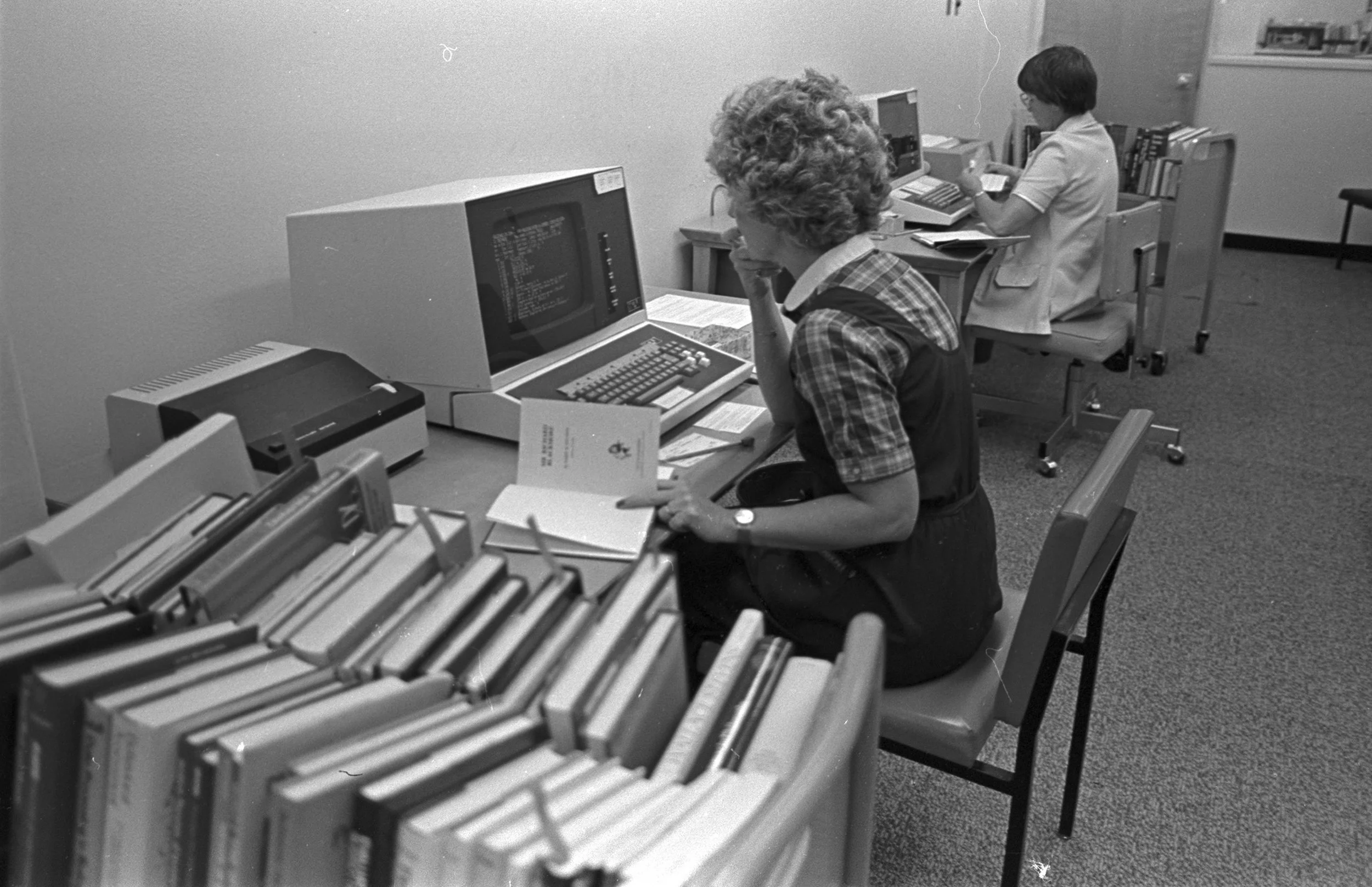
“University of Texas at Arlington Library, woman working at early version of computers.” UTA Libraries Digital Gallery, The University of Texas at Arlington Photograph Collection
The year is 2016. It’s a Saturday and I’m going to the shopping centre with my friends. I walk half an hour, the sun shining on my exposed skin in my cold-shoulder dress, ready to meet them at 10AM at the only Starbucks in town, as we had agreed the day before at school. I tell my parents we’ll be out for the day. They don’t call.
We spend the day trying on cheap lipgloss and taking pictures on shitty androids in our Topshop dresses. We’re having too much fun for the day to end, my friend calls her mum, she picks up and we spend the time playing until 9pm when my mum finally calls to see where she can pick me up from.
Whilst waiting we would watch Queen’s Speech 4 repeatedly and film group music videos in a bedroom clearly only for one – they still sit in my Google photos drive and they will never see the light of day.
10 years ago the world was only burgeoning with technology, we were still able to feel like we were participating in a community larger than a small Oxfordshire town, but the memories are still mine.
In 2026, this element of spontaneity and unmediated experience feels almost unfathomable. Instead of living through something, we’ve shifted into a society that constantly comments on what it means to live. Social media feeds are saturated with articles and think-pieces about how ‘phones are ruining our lives’ and how ‘being offline is the new cool’. The internet has a problem with constantly seeking the validation of everyone whilst simultaneously wanting to detach itself entirely.
But what is ‘it’ ? For years we have understood that you choose to enter the internet at your own peril, the world wide web was a succubus that you had agency within. But increasingly, as technology becomes more ambient and structurally embedded, more people attempt to ‘log off entirely’, as though distance alone could restore a sense of clarity.
This withdrawal, however, is fundamentally unstable. Many people ‘log off’ from the internet now because of what it's filled with: slop, self-aggrandizement, narcissism, extremity, noise. But much of what defines that environment is still produced and sustained by its users’ attention and participation. Without reckoning with the ongoing demand to be seen, detachment risks becoming cosmetic. The question isn’t just what you’re leaving behind, but what you continue to feed – what you consume, what you amplify, what you critique.
With AI becoming a more permanent component in digital daily life, this dynamic intensifies. It is no longer just humans filling the internet with fluff, but machines themselves generating content at a rate 100x faster than users themselves. This shift makes it easier to externalise responsibility: ‘AI is ruining art’,, 'AI is killing originality,' even down to reclaiming punctuation markers such as the em dash. But the ease of blame can obscure the more uncomfortable continuity beneath it—how much of what we attribute to machines still reflects the systems, desires, and attention economies we already participate in.
Ironically this has brought the existence of computer-generated musings to the forefront of society’s psyche more than ever. As AI interfaces write books and make it harder to tell real likenesses from fabricated ones, the internet’s critiques of AI are not completely unfounded. Its presence slowly creeps over from tool to operator — for a species whose existence is dependent on human connection I understand why the use of AI in any of our endeavours is so heavily scrutinized.
However, this moral outrage has outshined the actual issue of production being sourced from human beings. In online spaces all I see about AI is a fear of being replaced, rather than a conscious effort to really think about what we create. We are producing the same complaints and conversations about AI ironically making it more present and relevant than ever.
There’s a self-reinforcing loop in how AI gets talked about online; discourse ends up reproducing the exact dynamics that are critiqued. Anti AI content is rewarded by the same attention driven systems as everything else because platforms only distinguish between engagement and silence. As a result, the more people post about AI’s cultural dominance the more omnipotent it appears, which in turn generates even more commentary about its inescapability.
Suddenly your timeline is filled with doom and despair; internet town criers exclaiming that ‘nobody can, think, write or create anymore’, ironically spending hours reposting the same panic narratives in algorithmically identical ways. The panic itself becomes a genre of content production, shaped by the medium it moves through. Eventually, even reflection starts to become participation: everything is converted into content first and lived reality is only a secondary experience.
The more ‘AI is ruining things’ posts I see, the less I think that the issue is the existence of AI itself, but the conditions that make it feel culturally totalising. If people weren’t living inside constant streams of mediated interaction – feeds, metrics, productivity pressure, algorithmic recommendation – AI would probably feel more like a specialised tool than an existential atmosphere.
The internet itself has developed a fault. Therefore, the systems within it, only emphasise the culmination of an already exhausting relationship. AI isn’t making people lazy, a society that lives within infrastructure that makes it increasingly dependent on technology is making people lazy. Our entire social environment rewards disconnection from direct experience – a feat that long precedes AI.
Offline life has natural limits and texture. You can’t infinitely optimize a walk with a friend, cooking dinner, sitting in a park, reading slowly, messing up a hobby. Online systems tend to erode those limits because everything becomes measurable, comparable, repeatable, accelerated. AI intensifies this trajectory by simple scaling; it can generate more and faster than humans can metabolise.
Within this context, the fear becomes displaced onto technology itself, but part of the real issue is the environment that makes constant synthetic production feel normal in the first place.
The result is that everything collapses into one, giant recursive conversation about writing, creation, and their conditions – the medium stops being a backdrop and becomes the thing constantly thinking about itself.
At a certain point the internet is incapable of talking about anything except its own deterioration. Like culture becoming self-conscious to the point of paralysis. Instead of those undefined real moments that we search for in the extensive branches of the internet, you end up inside a layer of commentary about content itself: content about the state of content, endlessly reflecting back on its own conditions.
Even critical strands of AI discourse can contribute to this repetition: constant doom-discourse. Alongside shallow AI-generated output, a shared atmosphere where everything is pulled toward the same recurring centre is produced: ‘the future of content,’ ‘the death of art,’ ‘what happens to humanity now!’ The same framing loops appear again and again, regardless of what originally triggered them.
People end up talking around life, instead of about life itself.
We have somehow translated the surveillance aspect of the internet to our very existence, contemplating over whether every action is useful or beneficial to everyday self-perception. Introspection is immortalised – everything, always ready and waiting to be folded into a conclusion on how to live, instead of being allowed to just exist as a thing someone noticed or experienced.