Don’t worry, No One’s Paying Any Attention Anyways
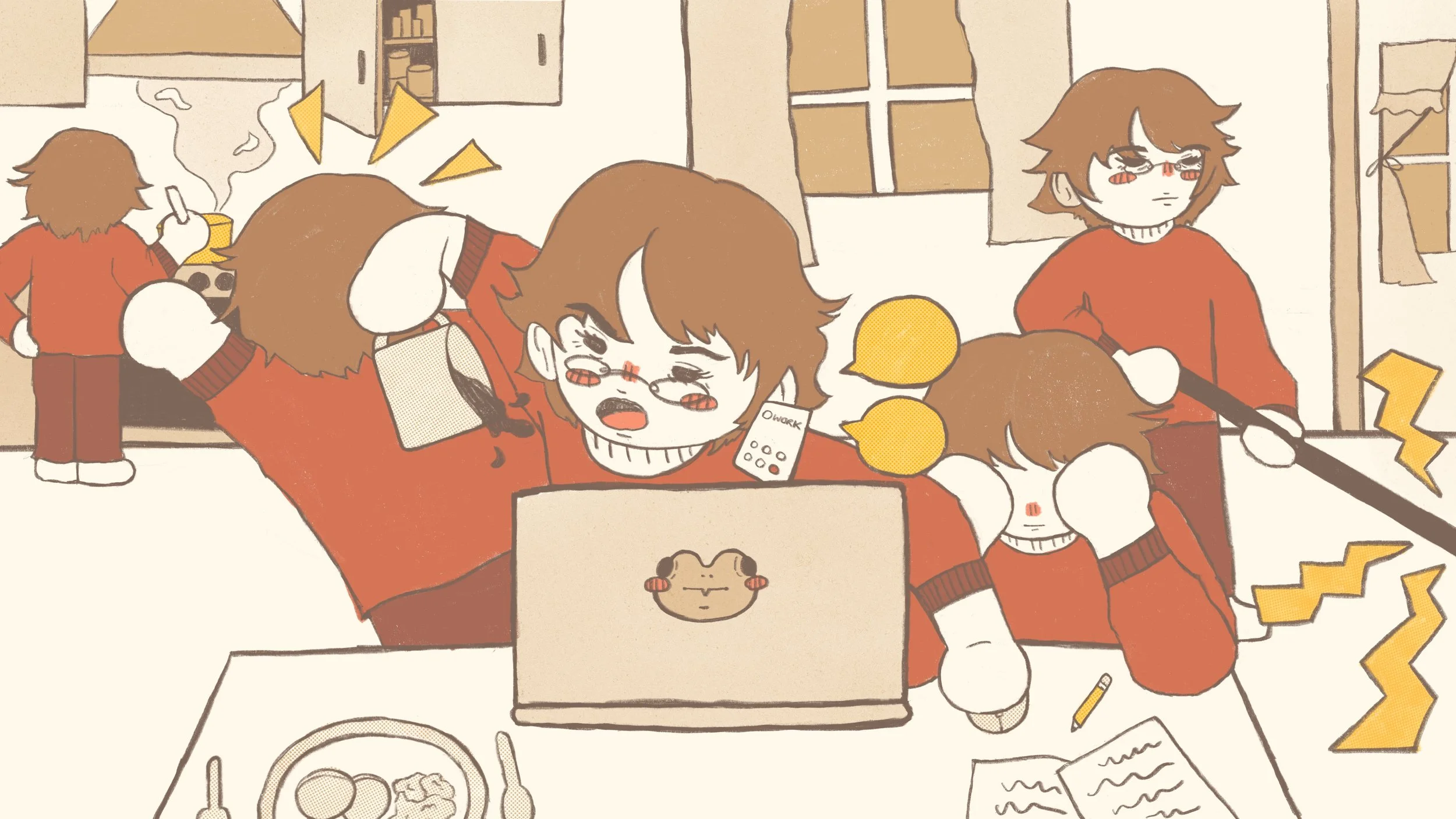
Illustration by Geliza Paunan
I used to write spam emails for a living.
Okay, this is an exaggeration. I wrote emails promoting campaigns and donation drives for an environmental organization. The goal, as my boss regularly reminded me, was for our readers to not mark the emails as spam. Our emails were meant to educate, inspire and most importantly, prompt readers to click a link delivering them to a donation page (or a petition that then led to a donation page).
Though each email was written by an individual, we were encouraged to adhere to a standard format and use brand-approved language. Specific stories and images that produced higher response rates among the audience, according to our extensive data, were re-used on a revolving basis. The transformational potential of the individual was to be emphasized (often with bolded font). Writers were told to employ adjectives in sets of threes (extra points if you place a rhetorical flourish—a cheeky redirection, perhaps—on the final one).
The process was constricting, boring, and, at least in my opinion, produced bad writing.
Whenever my manager noticed that I was taking too long to churn out one of these emails, she reminded me that they didn’t have to be spectacular as “no one’s paying that much attention anyways.” These were just fundraising emails that readers would gloss over during a scroll through the old inbox. The most arresting details were stacked at the top, since, frankly, who had the time or energy to make it to the final third of this 400-word virtual flyer?
The nature of the task dawned slowly: Our writing was catered to the multitasking mind.
The email inbox, with its anxiety-spiking pings and accordioning stack of bold-faced unopened content, is an engineered focus-fryer. The mental oscillations we make while scavenging our inboxes can even result in belabored breathing, a phenomenon coined “email apnea.” No wonder no one has the drive to read an entire 400-word screed urging you to give today to help defend this threatened forest.
Expanded internet access and the ubiquity of smartphones have turned us into a society of glancers and scrollers; the potential to get ahead on messages or promote our work or enrich our knowledge buzzes frantically from our pockets at all hours. With such effortless access to so dazzling a breadth of resources, the compulsion to partake is consuming. Not picking up the phone means squandering an opportunity for self-improvement.
The drawback is that, when the compulsion creeps and our fingers flex toward the infinite potential offered by our phones, we’re usually already doing something. Worry not, they say, this is simply “life optimized.” Check your messages while you commute. Studying to music is “good for the brain.” Listen to a podcast while exercising to become both swole and wise.
Contrary to the claims of Silicon Valley-styled life coaches, psychiatric studies repeatedly indicate that there is no such thing as multitasking. At best, our brains are capable of very quickly shifting focus between stimuli, but this comes with costs. “We lack the energy to do two things at once effectively, let alone three or five,” writes neurologist Richard Cytowic. “Try it, and you will do each task less well than if you had given each one your full attention and executed them sequentially.”
One 2014 study found that the brains of frequent “media multitaskers” performed worse in cognitive tests and had smaller gray matter density, compared to individuals who refrained from using multiple screens simultaneously.
The effects of multitasking can be observed in the way we now produce media. Plenty has been written about the revolution of the film and TV industry in the age of the “second screen,” with Netflix’s glut of movies tagged “casual viewing” serving as especially egregious examples. Less ink has been spilled over the influence of the phenomenon on well, the spilling of ink. It’s unsurprising that written media, which requires more active engagement from its audience than audio and visual mediums, would draw the short straw in an environment where the demands of existence (both real and perceived) have fractured our focus. A 2021 study out of the Pew Research Center indicated that, by 2020, the average amount of time visitors spent on top US newspaper websites had dipped below two minutes—hardly long enough to read most articles. This trend mirrors a 20-year decline in Americans who read for pleasure.
The irony is that, despite dwindling readership, writers are being pressured into churning out more content than ever before.
It was reported in 2024 that the British news publisher, Reach plc, was recommending its journalists write as many as eight articles in a single day, making my former employer’s goal of four to five campaign emails per week sound like a holiday. And as legacy publications continue to “slim down” in the pursuit of profit, writers are flooding the freelance gig economy where they must compete for readership while doing the labor once spread across entire publications. Discussing Substack, one of the largest subscription-based online publishing platforms, Sarah Brouillette observes in The Drift that writers, lured to the platform by its promises of an ad-free commonspace of ideas unimpeded by the exclusivity of legacy publications, find themselves functioning as their own unpaid agents. “The writer’s desire for ‘connection,’ let alone healthy, rational discourse, must be combined with a quest for attention that requires a high rate of production to satisfy customers who are paying for services,” Brouillette writes. “Substack wants to be a conduit to a meaningful life spent in thoughtful conversation—but don’t forget to prioritize your value proposition.”
It’s bad enough that readers are multitasking. But now writers too must multitask.
When survival under capitalism necessitates multitasking, a lapse in quality is inevitable. Even skilled craftspeople, ground beneath the gears of ceaseless production, are forced to cut corners.
Writing not-spam emails hardly counts as craft, but there was a skill to the practice. I’d spend hours digesting arcane environmental bills, then distilling them down to layman’s terms; I’d comb articles for facts that would add color to a narrative arresting enough to convince readers to take action. But vacillating between writing then responding to Teams chats, writing then managing our chapter’s social media content, writing then attending a lecture in which my boss stressed the importance of using our grassroots donors’ money with the utmost efficency—I often slipped. I’d abandon my authorial idealism and just follow the script. My manager would praise me for the improved turnout rate and the subsequent increase in supporter engagement. A knot formed in my gut.
The strange employment of strung-out statistics is paramount to the way we interpret professional and artistic success in the age of the multitasker. In his deep dive into the policies of Netflix, Will Tavlin writes for N+1 that Netflix, by tallying viewings without noting the percentage of viewers that actually completed one of its original movies (which effortlessly slide from the end credits of one film into the opening of another—perfect for the multitasking audience), has created a rating system that has very little to do with the content it is rating. By designating “two minutes” an “intentional viewing,” Netflix has taken advantage of an audience too distracted to turn off the damn autoplay, and turned this practice into a quantifiable rationale for churning out more mediocre drivel. Noting that film studios were once forced to take risks based on the uncertainty of pleasing an audience actively engaged in the viewing experience, Tavlin remarks that “Netflix’s greatest innovation was that it found a way around this uncertainty: it provided a platform on which there are no failures, where everything works.”
These tortured metrics fail to hold up beneath the scrutiny of any but the most tortured attention spans.
When discussing the pitfalls of multitasking, erosions of focus and loss of gray matter are plenty concerning, but my anxiety starts to meander toward the malicious. My boss once mentioned running—out of pure curiosity, he assured us—several of our organizational emails through ChatGPT and then prompting the LLM to produce a campaign appeal of its own. Unsurprisingly, factual hallucinations abounded, but the language, my boss admitted, was right on target.
LLMs are great at replicating the shape of a work. Their tells—ungrounded metaphors, sterile language, a propensity for sets of three (oh dear)—are easy enough to miss, especially if the reader’s attention is already dessicated by the demands of the day.
If I can miss all these jarring holes in the logic of LLM productions, what glimmers of wonder am I missing in art made by actual humans? The unexpected observations that flutter throughout texts like song birds in the canopy, the threads of lyricism, the quiet callbacks, braided motifs that sometimes crest triumphant and sometimes are dropped with an apparition’s subtlety—these are the qualities that make good writing so enthralling. And when I’m writing under pressure, I leave them all out. “No one’s paying that much attention anyways,” I remind myself.
This assurance that no one is paying attention once served as a balm for my own authorial anxieties. Now it feels more like a threat. I used to joke with other friends in the creative sector that our chances of being replaced by A.I. were only as high as our bosses were gullible. But as industries simultaneously demand more (quantity) and less (quality) from their workers, I can’t ignore the creeping sensation that we’re being bred for mediocrity—fattened with meaningless promotions and pats on the back until we forget to care about what we’re making. As the fruits of our scattered labor putrefy, they become easier to reproduce until a boss can run our work through ChatGPT, spit out a prompt, and come up with something identical to the shit we’ve been trained to phone in.
There is a silver lining to this train of thought: the quality of the media vying for our attention is getting worse. When Netflix movies no longer capture the audience’s imagination and all the 24-hour news sites are illegible beneath the clutter of ads, when the campaign letters that clog our inboxes are indistinguishable and the podcasts in our ears only quote A.I. hallucinations, maybe we’ll finally recognize the futility in doing it all.
Free from the compulsion to multitask, maybe, just maybe we can enjoy the all-encompassing pleasure of simply being.